
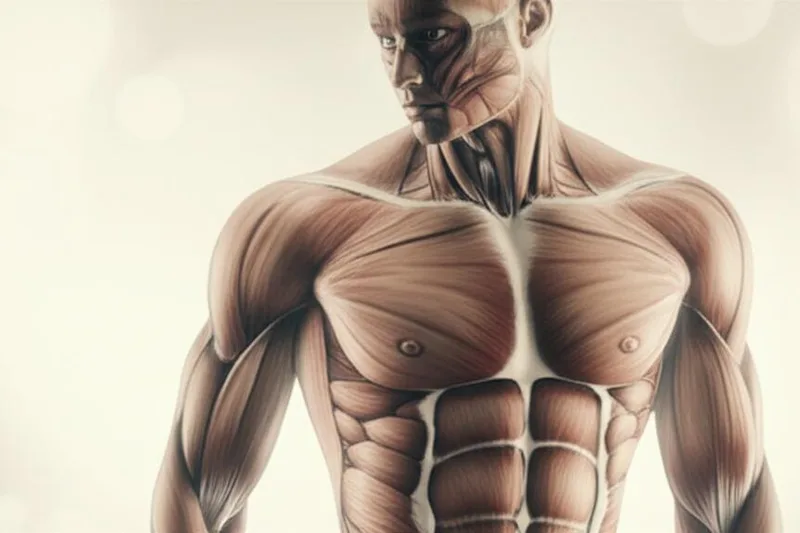
Hello! How are you? Today we are going to talk about a very important muscle group in our shoulders, which we probably don't pay much attention to. These are the deltoid muscles, or in English `(Deltoid Muscles)`. These muscles are essential for things like moving your arm back and forth, lifting weights, etc. So, let's see some details about these deltoid muscles?
What are the deltoid muscles? Where exactly are they located?
Simply put, your deltoid muscle is the muscle in your shoulder. Your shoulder is the joint where your arm connects to your body, like a ball and socket joint, which we call a ball-and-socket joint. That's where the deltoid muscle is located.
The main function of these muscles is to help you move your arm from side to side. Not only that, but the deltoid muscles also help protect and stabilize the shoulder joint.
Like most muscles in our bodies, the deltoid is a type of skeletal muscle . That is, it is attached to the bones by tendons. Skeletal muscles are the type of muscle that we can control (voluntary muscles) . Think about it, when you want to raise your arm, you do it consciously. That's how it is. These are different from muscles like the heart, which we don't think about (involuntary muscles).
What benefits do the deltoid muscles provide us?
The deltoid muscle doesn't work alone. It works in conjunction with other muscles in the shoulder, such as the rotator cuff muscles. Here's what these muscles do:
- Arm abduction: When you raise your arm straight out to the side, the deltoid muscle helps with this.
- Helping with arm strength loss due to injury: Imagine you have an injury in your shoulder, such as a ``rotator cuff tear''. Then the deltoid muscle helps to compensate for the loss of strength to some extent.
- Moving the arm forward and backward: These muscles help move the arm forward, over the head, ``flexion``, and move the arm backward, ``extension``.
- Keeping the shoulder joint stable: These muscles help prevent shoulder dislocations when you raise your arm or lift a weight with both hands.
How is the deltoid muscle located?
The deltoid muscles are like a crown on your shoulder. They cover the front, sides, and back of your shoulder joint. They are ``superficial`` muscles, meaning they are located close to the surface of the skin .
Visually, the deltoid muscle resembles an inverted triangle . All three sides of this triangle are attached to the bones by tendons.
- The broad upper part of the deltoid muscle attaches to the top of your shoulder blade (scapula) and to the side of your collarbone (clavicle).
- The lower, pointed part of the muscle attaches to the upper arm bone (humerus) that runs from your shoulder to your elbow.
How is the deltoid muscle formed? What are its parts?
The deltoid muscle consists of three main parts, or "heads":
1. Anterior deltoids: These are located in the front. This is the part that helps you move your arm forward. They are connected to the clavicle. Imagine you are reaching out to grab something from a shelf, and this is where the anterior deltoids are working.
2. Lateral deltoids: These are located on the side. They help to raise the arm to the side and move it up and down. They attach to a small bony prominence on the shoulder blade (scapula) called the acromion. These are the muscles that are activated when you do exercises like jumping jacks.
3. Posterior deltoids: These are located on the back of the arm. They help to move the arm backward. They attach to the flat surface of the shoulder blade (scapula). These are the muscles that work when you throw a cricket ball or open a door.
Like other muscles, the deltoid muscle is made up of elastic fibers. This is what allows the muscle to be flexible and perform a variety of movements. Skeletal muscles are usually red and white, giving them a striated appearance.
What diseases affect the deltoid muscles?
Unfortunately, these important muscles can also experience a variety of problems. Here are some of the conditions that can cause them:
- Adhesive capsulitis: This is the condition most people know as frozen shoulder . The membrane around the shoulder joint thickens and becomes tight. This can cause shoulder pain, muscle stiffness, and stiffness.
- Axillary nerve palsy: This condition can occur if the axillary nerve, which supplies sensation to the deltoid muscle, is damaged or compressed. This can happen after surgery, an accident, or when you use a crutch for extended periods of time. This can cause weakness and numbness in the shoulder.
- Bursitis: This is an inflammation of the small fluid-filled sacs (bursa) in the shoulder. This can make it difficult to move the shoulder and cause muscle pain.
- Deltoid fibrosis: Continuous injections into the shoulder can cause the muscle to become stiff and prevent healing. This can lead to pain and loss of strength in the deltoid muscle.
- Rotator cuff tears: Some severe rotator cuff tears can also damage the deltoid muscle, or cause it to tear.
- Shoulder impingement syndrome: A condition in which the muscles or tendons of the shoulder impinge on the bones. This friction causes pain and swelling in the joint.
- Shoulder separation: This is caused by tearing of the ligaments between the clavicle and the shoulder bone (scapula). In severe cases, surgery may be required.
- Muscle Strains and Overuse Injuries: These can occur when muscle fibers are overstretched. They can happen suddenly, or they can develop gradually over time as you continue to work on your upper body in the same way.
- Tendonitis: Inflammation of the tendons in the shoulder. This can cause pain in the deltoid and difficulty using the shoulder.
How common are deltoid muscle injuries? Who is more likely to get them?
Shoulder muscle problems are very common. One study suggests that between 18% and 26% of adults will experience shoulder pain at some point in their lives. However, problems affecting the deltoid muscle itself, such as rotator cuff tears, are not as common as rotator cuff tears.
Although anyone can develop problems with the deltoid muscles, athletes who perform overhead work are most at risk . For example:
- Baseball pitchers
- Swimmers
- Tennis players
- Weight lifters
Also, you may be at increased risk if you:
- If you are between 40 and 60 years old.
- If a woman.
- If you are doing another job to continue working overtime (e.g., automotive technicians, those working in assembly departments).
- If you have certain health conditions, for example, diabetes mellitus, coronary artery disease, cerebrovascular disease (e.g. stroke), rheumatoid arthritis, or thyroid disease.
How do you know if you have a problem with the deltoid muscle? What are the symptoms?
If there is a problem with the deltoid muscle, symptoms such as these may occur:
- Difficulty moving the arm from side to side, especially difficulty raising the arm .
- Swelling.
- Feeling of stiffness or instability in the joint.
- Numbness or tingling sensation.
- Pain when just standing or making any movement.
- Sudden muscle spasms.
- Difficulty lifting weights.
- Weakness.
How does a doctor diagnose these conditions?
When you go to see a doctor, he or she will ask about your symptoms and do a physical exam. You may be asked to raise your arm forward, to the side, or back, perhaps against a little resistance. If your deltoid muscle is working properly, the doctor should be able to feel the muscle contract as you raise it.
However, not every time you can't raise your arm, it's a problem with your deltoid muscle . There can be other reasons why your arm muscles are weak. For example:
- `Cachexia` - This means the wasting of a lot of muscle, either due to illness or lack of nutrition.
- Neuromuscular disorders or muscle diseases (myopathies).
- Side effects of some vaccines.
If your doctor suspects something is wrong, he or she may order imaging tests. If you suspect a broken bone, a dislocated joint, or a torn ligament in your shoulder, you may need an X-ray, MRI, ultrasound, or CT scan. An electromyogram (EMG) test can check how well your muscles and nerves are working.
What are the treatments for deltoid muscle disorders?
The good news is that many deltoid muscle problems can be treated with non-surgical treatments . Here are some of the treatments that can help:
- Reduce swelling with ice packs or cold water soaks.
- Painkillers or muscle relaxants.
- Physical therapy .
- Shoulder exercises to improve strength and mobility.
- A sling or other support to keep the shoulder still.
- Steroid injections reduce pain and swelling.
- Soaking in warm water to relax muscles.
However, if the injury is severe, such as a torn muscle, surgery may be necessary. Depending on the nature of your injury, your doctor may recommend either open surgery or arthroscopic shoulder surgery , a minor procedure performed using a camera.
Are there any risks with deltoid muscle surgery?
Like any surgery, shoulder surgery carries risks such as infection, bleeding, blood clots, and scar tissue. But, most importantly, any shoulder surgery can affect your deltoid muscle . Because this muscle runs across most of the shoulder and is close to the skin, surgeons sometimes have to cut through this muscle when performing things like rotator cuff repairs and tendon surgeries.
Possible complications of surgery specific to the deltoid muscle include:
- Damage to the axillary nerve. This can cause decreased movement in the arm.
- Damage to blood vessels. This can cause fluid to accumulate in the shoulder and upper arm, causing swelling (edema).
- The deltoid muscle is separated from the clavicle. This requires surgery to fix it again.
How to keep the deltoid muscles healthy?
Here are some things you can do to keep your deltoid muscles healthy:
- Follow appropriate safety procedures when playing sports (e.g., limiting the number of pitches in baseball).
- If your shoulder muscles hurt, don't put any more weight on them.
- After continuing to work on your upper arm, give your shoulder muscles a rest.
- Before any activity, do a good stretch and warm-up of your shoulder muscles.
- Use proper technique when bowling, swimming, or doing any activity that requires continuous use of the shoulder.
When should you see a doctor?
If something like this happens , see a doctor immediately :
- If you can't move your shoulder or arm.
- If you have no feeling in your shoulder or arm.
- If you experience a sharp, sudden pain somewhere in your shoulder or arm.
Remember, the deltoid muscle is a very important part of your arm that helps move it, stabilize your shoulder, and protect it from injury.
Take-Home Message
So, I hope you now have a good idea about the deltoid muscle. You must have understood how important this muscle is in our daily work as well as in sports. People who work continuously with their arms, such as swimmers, bowlers, and technicians, are more likely to develop injuries to this muscle.
But don't worry, most deltoid muscle problems can be treated with simple, non-surgical treatments . The most important thing is to pay attention to symptoms as soon as they appear and seek medical advice if necessary. It's also important to follow simple ways to keep these muscles healthy. Take care of your shoulders!
` Deltoid muscle, shoulder, shoulder pain, muscle disorders, exercise, shoulder health, deltoid


💬 Comments (0)
No comments yet. Be the first to share your thoughts here.
Add Your Comment