
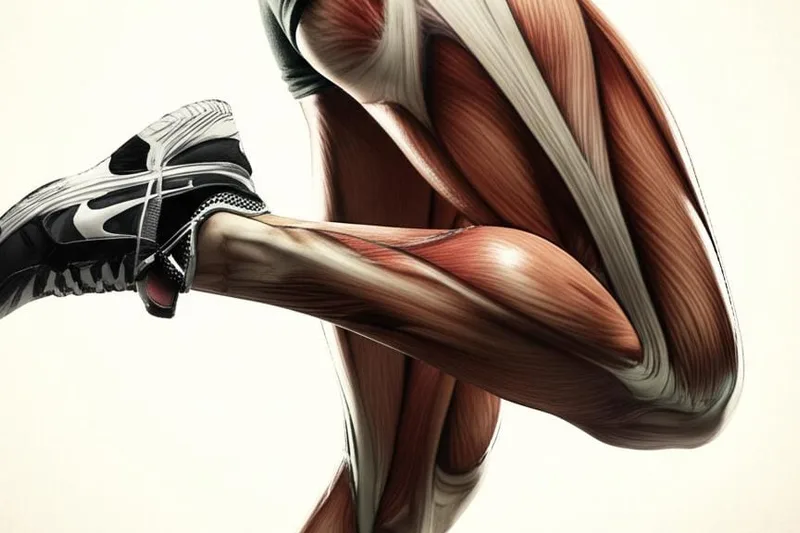
We all walk, run, and climb stairs, right? The muscles in our legs help us with all of this. Have you ever wondered what muscles are on the back of your thigh and how important they are? Those muscles are what we call the ``Hamstrings''. Today, we'll talk about this in a little more detail.
What are these hamstring muscles?
Simply put, your hamstrings are three muscles on the back of your thigh . They are like skeletal muscles attached to bones. What's special about them is that they are called voluntary muscles. That means they work the way you want them to, the way you control them. You can only activate them by thinking about them. These hamstrings are the ones that help us walk, climb stairs, run, do squats, and do many other leg-moving activities. But there's a catch: these hamstrings are a little more prone to injury , especially for runners and jumpers. These muscles are put under a lot of stress when you stop suddenly, slow down, or change direction. They can also be overstretched when you extend your legs while running. That's when we say we have a 'pulled hamstring' or a 'strain'.
Why do we have these hamstring muscles?
Okay, now let's see what benefits these hamstring muscles have for us. They perform some very important functions for our bodies. Imagine how limited our leg movements would be without them.
- Bending your knees: You know, when you sit in a chair, run, or jump, you have to bend your knees, right? That's what these muscles mainly help with. They are essential for this action called `knee flexion`.
- Extending your hip: When you walk, run, or bend forward from a standing position, you extend your leg back, extending your hip. The hamstring muscles also provide great support for this.
- Rotating your hip: These also help rotate your hip from side to side during certain movements, for example when turning your leg in or out.
It is because of things like this that we can easily do everyday tasks, such as walking, running, and climbing.
Where are the hamstring muscles located?
Your hamstring muscles are located on the back of your thigh . To be precise, they start at the base of your pelvis, just below your buttocks, and run down past your knee to the top of your shin. These muscles are attached to your shin, knee, and upper leg by strong, rope-like tissues called hamstring tendons. These tendons are what pull the bone when the muscle contracts, causing movement.
How are these hamstring muscles formed? What are those three muscles?
We've already said that the hamstrings are a collection of three muscles. Now let's take a closer look at what they are, where they are located, and what they do. All three muscles work together to provide the full functionality of the hamstrings.
1. Biceps femoris: This is the muscle on the back of your thigh, located laterally . It also has two parts (the long head and the short head). Its main functions are to help bend your knee, to help extend your thigh at your hip, and to help laterally rotate your lower leg when your knee is bent. Think about it, this is very important when you are running and taking your leg back.
2. Semimembranosus: This muscle is located on the medial side of the thigh. It is a broad, flat muscle. It also helps to bend your knee, extend your hip, and medially rotate your lower leg when your knee is bent.
3. Semitendinosus: This muscle is located above the previously mentioned Semimembranosus, slightly outwards, and inside the Biceps femoris, which is about halfway between the other two muscles . It also performs the same functions as the Semimembranosus; namely, bending the knee, extending the hip, and internally rotating the lower leg.
See? These three muscles work together and coordinate with each other to provide great support for the movements of our legs, especially knee bending and hip extension.
What are the hamstring muscles made of?
Inside your hamstring muscles, there are thousands of very long, stretchy muscle fibers . These fibers are what help your leg muscles contract, or tighten. They can be stretched like rubber bands. These fibers are bundled together to form the entire muscle. That's why you might see these muscles under your skin, and they look striated. These muscle fibers are able to function properly because they have a good blood supply and nerve supply.
What are the diseases and conditions that affect the hamstring muscles?
The main thing that can affect our hamstring muscles is muscle strains . These occur when the muscle fibers are overstretched. This can happen if you run too fast, stop suddenly, or start exercising without warming up properly. These hamstring strains can be divided into three main categories depending on their severity:
- Grade 1: Pulled hamstring: This is a strain on the muscle fibers, but not a tear. There may be microscopic tears . You may feel some pain, stiffness, or swelling in the hamstring muscle. But most of the time, you will be able to use your leg and walk. It may take a few days to a week or two to heal.
- Grade 2: Partial tear: This is a partial tear in one or more of your hamstring muscles. The pain is more severe than in grade 1, there is more swelling, and there may be some bruising. You may feel more pain when you use your leg, especially when you bend your knee. You may also have difficulty walking. It can take a few weeks to a month or two to heal.
- Grade 3: Complete tear: This is a bit more severe. Here, the muscle tissue is completely separated from either the tendon or the bone. Sometimes, when the tendon comes off the bone, it can come off with a piece of bone. This is called an avulsion fracture. If this happens, there is a lot of swelling and pain, and you may hear a "pop" sound when you are injured. The pain can be so severe that you can't use your leg. In this case, surgery may be necessary.
Important: When you have an injury like this, especially if you suspect it's a second or third degree burn, it's important to seek medical attention right away. Your doctor can diagnose exactly what's wrong and prescribe the necessary treatment.
What are the symptoms of a hamstring injury? How do you know?
If you have a hamstring injury, you may experience one or more of these symptoms. See if any of these symptoms apply to you:
- Do you notice an unusual lump or bump on the back of your thigh? (This could be a complete tear.)
- Is there any bruising or discoloration on the back of the thigh? (This may occur several hours after the injury.)
- Do you feel a burning or stabbing pain in the back of your thigh? Sometimes this can be related to a condition called `gluteal sciatica`, which is pain caused by a pinched nerve in the buttock area.
- Is it difficult to bear weight with your feet on the ground? Do you limp when you walk?
- Do your hamstring muscles feel weak ? Do you feel like you have no strength when you try to bend your knee?
- Is it difficult to bend your knee ? Or does it cause severe pain when you bend it? So you may have to walk with your leg straight and stiff?
- Did you hear a 'pop' sound from the back of your thigh when you were injured? (This is often a sign of a severe tear.)
- Have you ever felt a sudden, sharp pain in the back of your thigh? Like a knife stabbing you?
- Did the swelling occur immediately after the injury, or did it increase over a few hours?
If something like this happens, you should definitely be concerned. If it's a minor pain, it can be relieved with rest and ice. But if the pain is severe and you can't use your leg, it's best to see a doctor.
Who is more likely to develop hamstring muscle problems? (Risk factors)
Hamstring injuries are very common in fast-moving athletes . For example, sprinters and those who play sports such as football, basketball, rugby and soccer are more likely to develop this condition. This is because these sports require them to accelerate, decelerate and change direction quickly. Also, people who squat with their knees deep, such as skiers, skaters and dancers, are at risk.
Additionally, you may be at risk for developing hamstring injuries if you have:
- If you are still growing, that is, a young, athletic child . Because at this age, muscles and tendons do not grow as fast as bones, there may be more pressure on them.
- If you are over 40 years old . This is because muscle flexibility decreases as you age.
- If you have had a previous hamstring injury , you are more likely to get injured again in the same area.
- If your hamstring muscles feel tired (`fatigue`) . When you are tired, the muscles are less able to withstand the pressure.
- If your hamstring muscles or the quadriceps muscles at the front of your thigh are weak or tight, there may be an imbalance in strength between these two muscle groups, which can put too much strain on your hamstrings.
- If you don't properly warm-up or stretch your muscles before an activity, this is one of the biggest mistakes many people make.
How do I keep my hamstring muscles healthy?
It's important to take care of your hamstring muscles. Here are some simple things you can do to help:
- If you have pain in your hip, leg, or knee, don't ignore it and force yourself to work out . Pain is a signal from your body, listen to it.
- Give your hamstring muscles a break, either during workouts or after strenuous activity. Muscles need time to recover.
- Warm up and stretch your hamstring muscles properly before any physical activity, especially sports. Warming up increases blood flow to the muscles, preparing them for activity. Stretching the muscles increases their flexibility.
- Do exercises that strengthen your hamstrings and quadriceps muscles . Keeping these muscles strong can reduce your risk of injury.
- Gradually increase the intensity of your workouts . Don't go too hard all at once.
- Drink plenty of water and eat a balanced diet . This will help keep your muscles healthy.
When should I see a doctor?
Sometimes minor pain can be relieved with home remedies, such as the RICE method (Rest, Ice, Compression, Elevation). However, in these cases, you should definitely see a doctor immediately:
- If you can't move your leg and the pain in your thigh doesn't go away , even after a few days.
- If you continue to have difficulty walking , especially if you limp.
- If you feel numbness, tingling, or weakness in your lower back, hips, or legs .
- If you heard a "pop" sound when you were injured.
- If there is severe swelling and bruising .
- If you have a fever .
Symptoms like these may indicate that the condition is more serious. Therefore, getting treatment early can help prevent the condition from getting worse and help you recover faster.
As you can see, our hamstring muscles are very important for walking, running, bending our knees, and extending our legs. However, these muscles are also very susceptible to injury. This is especially important if you play sports like soccer, football, rugby, or other activities that involve sudden stops and starts. Most hamstring injuries can be treated without surgery, but in some severe cases, surgery may be necessary.
The most important thing for you to remember (Take-Home Message)
You can take good care of your hamstring muscles and reduce your risk of injury. The most important things to do are to warm up and stretch them properly before any physical activity . Also, if you feel any pain or fatigue, give those muscles a rest. The most important thing is to seek medical advice as soon as possible if you have persistent pain in the back of your thigh, or if you develop severe symptoms after an injury. Then you can stay healthy, fit, and continue your daily activities and favorite sports without interruption!
` Hamstring muscles, hamstrings, leg disorders, muscle pulls, sports injuries, knee flexion, hip extension


💬 Comments (0)
No comments yet. Be the first to share your thoughts here.
Add Your Comment