

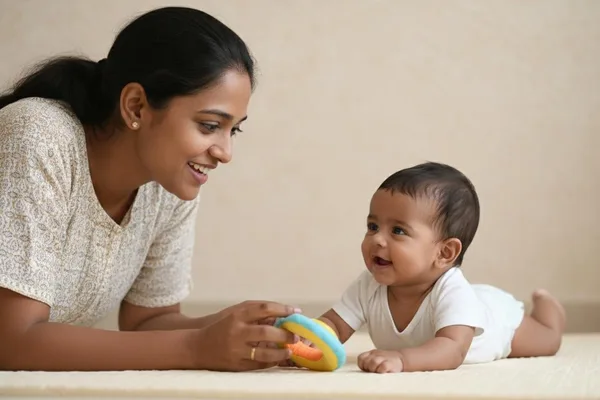
It's an absolute joy to watch your little one grow and do new things every day, isn't it? From raising their head during "tummy time" to reaching for toys, it's all a miracle. These are what we call baby milestones . Simply put, these are the things that most babies can do at a certain age. These little things are the signs that your little one is growing and developing as expected.
How does the pediatrician keep an eye on these milestones?
You take your baby for regular check-ups (`well-checks`). During these times, the pediatrician examines your baby, plays with him, and observes how he moves, plays, and makes sounds. These are times when you can ask the doctor any questions you have about your baby's development.
Experts updated this list of baby development milestones in 2022. It includes things that at least three out of four babies can do on average. Imagine, if your baby is not doing certain things by the expected age, the doctor may suggest some tests (`screenings`). That is, to see if the baby has any developmental delays. If they think there is something like that, the doctor will also talk to you about `early intervention` . These early interventions are treatments such as `physical therapy`, `occupational therapy`, and `speech therapy` . So, there is no reason to worry.
What are these types of development milestones?
Developmental milestones for babies and toddlers can be divided into four main categories. However, some milestones may fall into more than one category. But knowing about these categories will help you keep an eye on your baby's development and discuss it with your doctor.
- Social and emotional milestones: These are the ways your baby expresses his feelings and interacts with others. For example, smiling back when you smile, looking at you when you say his name.
- Language and communication milestones: The way a baby makes sounds, the way he expresses himself without words (for example, cooing, raising his hand to be picked up).
- Cognitive milestones: The way a baby thinks, learns, and solves problems. Think about it, putting a toy in his mouth and learning about it. Things like that.
- Motor milestones: How the baby moves and develops physically (for example, leaning on the floor with his elbows while crawling, pulling himself up to stand).
How are the baby's developmental milestones arranged?
Your baby goes through many stages from the day he is born until he is 12 months old. It's so exciting to see these baby development milestones. Your baby is even more excited because he is starting to discover this world in a new way.
The most important thing to remember is that these milestones are just general guidelines. Don't panic if your baby seems to be taking a little longer. Not all babies are the same, and everyone develops at their own pace. If you have any concerns, talk to your pediatrician.
Below are the developmental milestones that babies demonstrate month by month.
At 2 months
Most 2-month-old babies do these things:
- Staring at something like a toy for a few seconds at a time.
- You look at it as you move around.
- Raises head during `tummy time`.
- Shaking hands and legs.
- Hold the fist for a few seconds without shaking it.
- They make other noises besides crying.
- If you hear a loud noise, you react to it.
- When you talk to him or hold him, he stops crying and calms down.
- Looking at your face.
- They respond happily when they see you.
- If you smile or talk, they smile back.
At 4 months
Most 4-month-old babies do these things:
- When they are hungry, they open their mouths at the sight of a feeding bottle or their mother's breast.
- They like to look at their hands.
- When you're carrying it, it keeps its head straight all by itself.
- You grab something that is handed to you.
- They hit things like toys with their hands.
- They are putting their hands in their mouths.
- When crawling, they lean on the ground with their elbows.
- They make cooing noises like "ooo" and "aaa".
- They respond loudly when you say something.
- They turn their heads when they hear your voice.
- Laughing alone.
- When you do something funny, the little one giggles and laughs.
- They move, make noise, and look at you to get your attention.
At 6 months
By 6 months, most babies:
- When you finish eating, you press your lips together.
- They put things in their mouths to learn about them.
- Reaching out for the toys they want.
- It rolls from its stomach to its back.
- When crawling, they straighten their arms and lift their body.
- When sitting, you lean on the ground with your hands.
- They "talk" to you by making noises back and forth.
- Sticking out the tongue and "blowing raspberries" (making noises with the tongue).
- Making a screaming noise.
- Recognizing people you know.
- I feel happy when I see myself in the mirror.
- Laughing out loud (not just a little giggle).
At 9 months
By 9 months, most babies:
- Looking for things to put on the floor.
- Beating two together – like beating a pot with a spoon.
- Sitting alone.
- Sitting without any support.
- They use their fingers to bring pieces of food to their mouths.
- Transferring things from one hand to the other.
- They make sounds like repeating syllables like "ma-ma-ma".
- You raise your hands when you want to be held.
- Strangers are shy, afraid, and sometimes cling to you.
- We use different facial expressions to show emotions like happiness, sadness, and surprise.
- Responds when hearing their name.
- If you try to leave, they will cry and reach out to you.
- When you cover your face and move away ("Cheer up, baby!"), they respond with laughter and joy.
In 12 months (a year)
Many one-year-old babies:
- Putting small things inside big containers – like putting a toy train inside a bucket.
- You look for things to hide – like when you hide his toy behind your back.
- They hold onto something nearby and stand alone.
- Walks holding onto stationary objects, such as furniture (also called "cruising" ).
- We use our thumb and index finger to pick up small objects like grains.
- When saying goodbye to someone, you wave.
- They call their parents "mom" or some other name.
- I know what "no" means.
- Just playing with you.
How do you ensure your baby's safety as he grows and develops?
A baby's first year is a time of discovery. As he starts to move around, his curiosity about the world around him increases. Never leave your baby alone. A responsible adult should be with him at all times when he is awake. However, being vigilant alone does not cover everything. Accidents and injuries can happen quickly if you do not take the right precautions.
Here are some dos and don'ts to keep your baby safe.
Things to do (DOs):
- To prevent accidental burns, set the water heater temperature to 48 degrees Celsius (120 Fahrenheit) .
- Check the water temperature when bathing your baby, and learn other tips about bathing safety.
- When choosing toys, they should be sturdy, have no loose pieces, are not sharp, and be larger than the baby's mouth.
- If there are open stairs, either put gates on them or close them (choose gates with straight, vertical slats instead of diamond-shaped ones that can be climbed).
- Install smoke detectors and carbon monoxide detectors and follow the instructions on how to use them properly.
- Learn car seat safety tips (this also applies to anyone else who travels with the baby in the car).
- Limit your baby's exposure to the sun, and dress them in sun-protective clothing (use sunscreen after 6 months).
- Check to see if your baby is sitting instead of standing when in the high chair.
- Keep small items, sharp objects, breakable items, and items that could be poisonous to the baby (medicines, cleaning products, soap) out of reach or in a locked cupboard. (Remember that the Sri Lanka Poison Control Center (`Poison Control`) number is 0112686143 ).
- When putting your baby to sleep, place him on his back on a firm mattress. Take other steps to reduce the risk of Sudden Infant Death Syndrome (SIDS) .
- Secure the cords on window curtains to prevent them from accidentally getting wrapped around your neck.
Things not to do (DON'Ts):
- Do not drink or hold hot things while holding your baby.
- Do not give water to babies under 6 months old.
- Don't leave your baby alone in a car.
- Don't let the baby play in the kitchen while you're cooking.
- Do not put necklaces, pacifiers, or toys around the baby's neck.
- Do not take babies under 6 months old to a swimming pool.
- Do not use infant walkers . They are dangerous.
What are the cut-off points for newborn babies?
Newborn milestones are things that most babies can do by the time they are about a month old. Although the updated list of baby milestones starts at 2 months, pediatricians traditionally expected newborns to be able to do the following by the time they are one month old:
- Hands raised to face.
- When lying on its stomach, it shakes its head from side to side.
- I'm rubbing my hands together.
- Makes reflex movements.
- Familiar sounds or voices turn in the right direction.
Baby milestones fill your heart with joy, and maybe even fill your phone with photos! But, if your baby doesn't reach a certain milestone, you can feel worried. If you're in doubt about anything, talk to your pediatrician. He or she will be the one to look at your baby's milestones and tell you if your baby needs a little help along the way.
Take-Home Message
Your baby's development is a beautiful journey. Every baby develops at their own pace. It's good to be aware of these milestones, but don't worry too much about comparing your baby to them. The most important thing is to love your baby, play with him, talk to him, and be attentive to his needs. If you have any questions or doubts, don't be shy about asking your pediatrician. They are there to help you and your baby.
` Baby growth, developmental milestones, baby milestones, monthly growth, baby development, parenting tips, baby safety




💬 Comments (0)
No comments yet. Be the first to share your thoughts here.
Add Your Comment