
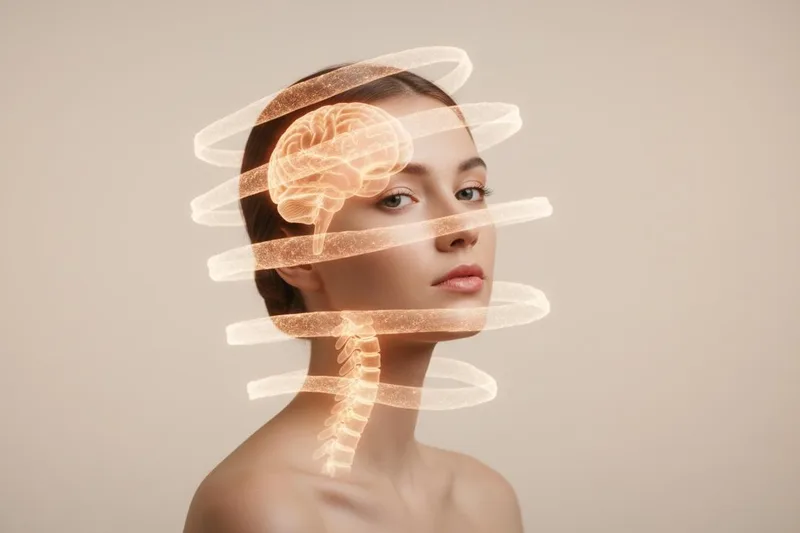
Have you ever thought about how delicate and important our brain and spinal cord are ? These are the control centers of our entire body. If we are not careful, even a small accident can cause great harm. Fortunately, our body has a wonderful protective system to protect these two most valuable organs. That protector is the meninges that we are talking about today. Simply put, these are three layers of protective membranes that surround our central nervous system (CNS).
What are the meninges? What are these three layers?
Just like an onion has a skin, the meninges are made up of three layers. Each layer has a specific function. Let's see what they are:
1. Dura Mater: This is the thickest, strongest layer of the brain . It's like a tough coat covering our brain and spinal cord. The Latin word "dura mater" means "hard mother." That's how protective it is. It's located directly under our skull and spinal cord. Its main function is to hold the brain and spinal cord tightly and keep them from getting damaged.
2. Arachnoid Mater: This is the middle layer . It is much thinner than the dura mater. "Arachnoid" means "spider." It gets its name because the fine fibers that connect this layer to the pia mater underneath look like the legs of a spider. This layer has no blood vessels or nerves.
3. Pia Mater: This is the innermost layer, the thinnest layer that is tightly attached to the brain and spinal cord . Like a sheet of cellophane, it is embedded in every crevice and fold of the brain. Many of the blood vessels that supply blood to the brain tissue pass through this layer.
In particular, the arachnoid mater and the pia mater are collectively known as the leptomeninges .
What are the spaces between the layers of the meninges?
There are three important spaces between these three membrane layers. These are not just empty spaces, they also have special functions.
- Epidural Space: This is between your skull and the dura mater. It is also the space between the spinal cord and the bones of the spine and the dura mater. You may have heard that an "epidural" is given for some surgeries or to reduce pain during childbirth. Analgesics and anesthesia are injected into this epidural space. Our spinal cord ends in the middle of the spine, between the first and second lumbar vertebrae. Beyond that, all that is left is the cerebrospinal fluid. A lumbar puncture , or as we colloquially call it, a "spinal tap," is performed from that area.
- Subdural Space: This is located between the dura mater and the arachnoid mater. Under normal circumstances, this is not really a "space" as much. However, if there is a severe blow to the head and bleeding inside the brain, such as a brain bleed, or due to another medical condition, this space can open up.
- Subarachnoid Space: This is located between the arachnoid mater and the pia mater. This space is filled with cerebrospinal fluid (CSF) . This fluid called CSF is very important. It protects our brain and spinal cord from various shocks, like a cushion. Also, this CSF helps to provide nutrients and remove waste products.
What are the main functions of the meninges?
Now you have a little idea of how important these membranes called meninges are. Let's take a look at their main functions:
- Protecting the Central Nervous System (CNS): In the event of a head injury or accident, the most important thing is to protect the brain and spinal cord by acting as a shock absorber , rather than directly sending the shock to the brain.
- Stabilizing the central nervous system: These membranes help keep the brain and spinal cord stable within the skull and spinal column, preventing them from moving around.
- Support for blood vessels, nerves, and the lymphatic system: The meninges help to support and support the blood vessels that supply blood to the brain and spinal cord (for example , the Middle Meningeal Artery) , nerves (for example, the Trigeminal Nerve , the Vagus Nerve ), and the lymphatic system (the system that removes waste products). They are also important for the proper flow of cerebrospinal fluid (CSF).
Special characteristics of each meningeal layer
Let's now look at these three layers in a little more detail.
More about Dura Mater
As we said before, this is the outermost, thickest, strongest membrane. It is made up of two layers of connective tissue. One side is attached to the skull, and the other side is attached to the arachnoid mater.
This dura mater has a special system of blood vessels called dural venous sinuses . These are the ones that drain dirty blood from the brain and return used CSF to the circulatory system.
The dura mater receives its blood supply mainly from the Middle Meningeal Artery . The trigeminal nerve, which is important for our facial sensations and chewing, also passes through it.
Another special thing about the dura mater is that it folds inward, forming four membranes called dural reflections . These are like little curtains inside the brain, separating the different parts of the brain (especially the cerebral hemispheres) and helping to keep them in order.
More about Arachnoid Mater
This is the middle layer beneath the dura mater. It is named so because it is very thin and looks like a spider web. It does not contain any blood vessels or nerves. However, it does have projections made of connective tissue that connect it to the dura mater. The subarachnoid space between the arachnoid mater and the dura mater is filled with cerebrospinal fluid (CSF), which provides a cushioning effect to the brain.
More about Pia Mater
This is the innermost, thin membrane that adheres tightly to the surface of the brain and spinal cord. It seems to have gone deep into every nook and cranny of the brain. Many of the blood vessels that supply blood to the brain tissue pass through this. It also helps to keep the `CSF` in one place. In the case of the spinal cord, this matrix also contributes to giving the spinal cord some rigidity and strength.
What are the diseases that affect the meninges?
The meninges, which perform such an important function, can be affected by various diseases. Some of them can be very dangerous. Let's look at some of the main conditions that are seen:
- Meningitis: This is a type of "brain fever" that we have all heard of. Simply put, it is an infection (inflammation) of the meninges. This infection can be caused by bacteria, viruses, or fungi . To find out exactly what it is , a lumbar puncture is usually done to test a sample of cerebrospinal fluid. For example, if a young child suddenly develops a high fever, stiff neck, and vomiting, these could be signs of meningitis. It is important to see a doctor right away. Very rarely, meningitis can also occur without an infection due to cancer, other inflammatory diseases, brain surgery, or certain medications.
- Subdural Hematoma: This is a collection of blood between the dura mater and the arachnoid mater due to a ruptured blood vessel. This condition is more likely to occur after a head injury, especially in the elderly, or in people who are taking blood thinners . Sometimes, even a minor fall can cause this type of bleeding.
- Bleeding in other meningeal layers: Because many blood vessels run through the layers of the meninges, a head injury can cause bleeding between any of these layers.
In addition to this, there are other situations:
- Meningioma: This is a type of tumor that develops in the meninges. These are usually non-cancerous (benign) , meaning they do not spread to other parts of the body. However, if these tumors grow large enough, they can invade the brain and become life-threatening. In that case, surgery may be needed to remove them.
- Meningeal Carcinomatoses: This is when cancer that started elsewhere in the body spreads to the meninges. This is a more serious condition.
There are other diseases that affect each of these layers separately. Because the meninges are the main shield that protects our brain, we must remember that any disease that affects this can be life-threatening .
Take-Home Message
So, now you understand how valuable these three membranes called meninges are to our brain and spinal cord. Like three guards protecting our most precious possession.
These three layers, the dura mater, the arachnoid mater, and the pia mater, together with the cerebrospinal fluid, protect our brain tissue from hitting the skull. They also perform many other important functions.
Therefore, if you get a head injury from an accident (such as a car accident, playing sports, or falling), don't take it lightly. Sometimes, even if you don't see a big injury from the outside, the meninges or brain tissue can be damaged from the inside and cause bleeding (Intracranial Hemorrhage). Therefore, if you get a head injury, you should definitely see a doctor and get advice. Then, the necessary tests can be done and, if there is a problem, treatment can be started quickly. Remember, our brain is a very valuable organ, and it is our responsibility to take care of it!
` Meninges, Brain, Spinal Cord, Dura Mater, Arachnoid Mater, Pia Mater, Cerebrospinal Fluid, Meningitis, Subdural Hematoma, Meninges, CSF, CNS, Brain Health, Spinal Cord




💬 Comments (0)
No comments yet. Be the first to share your thoughts here.
Add Your Comment