
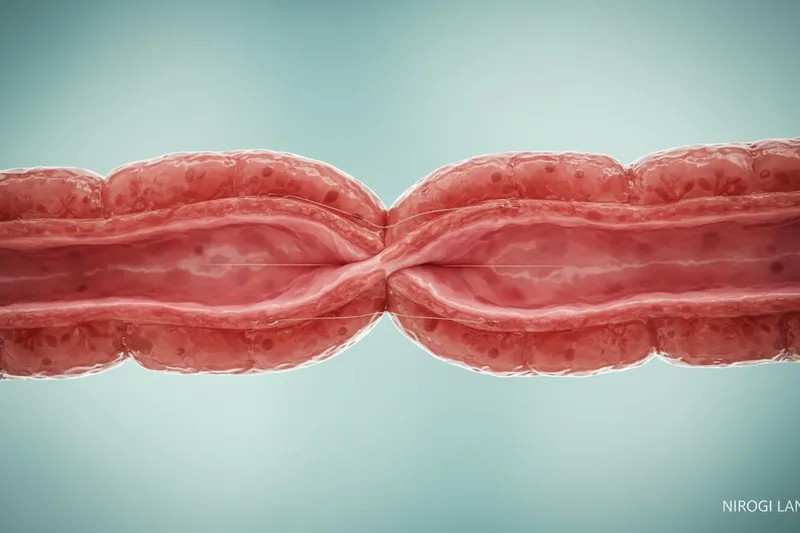
Did the doctor tell you or someone you know that you need to have a bowel operation? Did he use the word 'anastomosis' when he said that? When you heard this word, you probably felt a little scared, "What is this, is this a new disease?" But it's really nothing to be afraid of. It's a very common surgical procedure that surgeons do all the time. So today, let's talk about it simply, in a way that will clear up any questions and fears you may have.
What exactly is an anastomosis?
Simply put, an anastomosis is the connection of two roads. Imagine two rivers joining together and flowing as one river. Something like that. Or a separate pipe is connected to our house from the main pipe that brings water to our homes, right? That's a connection like that.
This is something that happens naturally in our bodies. For example, the blood vessels in our bodies are connected to each other and spread out like a network. Also, if we take our digestive system, the esophagus is connected to the stomach, the stomach to the small intestine, and the small intestine to the large intestine. These are called natural anastomosis.
However, in medicine, we mostly use this word to refer to the surgical connection of two body parts. Surgeons have to make these connections all the time. Let's see why.
Why is this kind of connection made during surgery?
There may be two main reasons for this.
1. Removing and reconnecting a damaged section: Imagine that part of your intestine has been damaged by cancer, a severe infection, or another medical condition. Then the surgeon has to cut out and remove that damaged section. Then the two ends of the remaining healthy intestine have to be reconnected. Otherwise, the food pipe will be cut. That's what we call an anastomosis.
2. Creating a new path to bypass a blockage (Bypass): Sometimes a blood vessel in the body can become blocked from the inside. The best example is when a blood vessel supplying blood to the heart becomes blocked by cholesterol deposits. What is done here is to create a new path to bypass the blockage. To do this, a piece of healthy blood vessel taken from another part of the body is taken and connected above and below the blockage to create a new path (bypass). These two new connections are called anastomosis.
Simply put, this is like removing the broken part of a broken road and rebuilding it, or building a new flyover to bypass the traffic on a road.
What are the most common surgeries for anastomosis?
This procedure is used in many types of surgery. Let's look at some of the most common examples.
Bowel Resection Surgery
This is the most common type of anastomosis. This is when a section of the colon or small intestine needs to be removed due to cancer, severe infections (such as diverticulitis), or injury. The remaining healthy parts are then reconnected. For example, an ileocolonic anastomosis is where the last part of the small intestine (ileum) is connected to the remaining large intestine.
Bypass Surgery
- Coronary Artery Bypass Surgery: As I mentioned earlier, when a blood vessel in the heart is blocked, a new route is created to bypass the blockage using a healthy blood vessel taken from the leg or inside the chest.
- Gastric Bypass Surgery: A weight loss surgery in which a small section of the stomach is removed and connected directly to the lower part of the small intestine. This shortens the food pipe and limits food absorption.
Creating an access for kidney dialysis
Patients with kidney failure need to have hemodialysis to clean their blood. This requires a large, strong vein to constantly take blood and return it to the body. To do this, a surgeon connects an artery and a vein in the arm to create a strong blood vessel (Arteriovenous Fistula) . This is also a type of anastomosis.
Organ Transplantation
When an organ, such as a liver, kidney, or heart, is transplanted, the new organ must be connected to the body's systems. This means that the blood vessels that supply and return to the organ, as well as other related vessels (e.g., the bile duct in a liver transplant), must be connected to the appropriate parts of the body. Each of these connections is called an anastomosis.
What are these connection methods?
There are three main ways surgeons connect these vessels. If you have these words in your report, you will now be able to understand.
| Type of Anastomosis | Simple explanation |
|---|---|
| End-to-end | This is like connecting two broken pieces of pipe directly together. The open ends of two pipes are sewn together to create a continuous pipe. This is the most common method used when connecting intestines. |
| Side-to-side | Here, the ends of the two pipes are closed, the two pipes are placed parallel, and they are connected together by opening them on both sides. Just like when two roads pass by, a side road is put between them. |
| End-to-side | The open end of one tube is connected to the side of the other tube, much like a new pipe being connected to a main water pipe. This method is commonly used in bypass surgery. |
What are the risks of an anastomosis surgery?
As with any surgery, there are some risks involved. But remember, surgeons are very well trained to manage these.
Common risks of any surgery:
- Bleeding
- Blood clots
- Infection
- Damage to nearby organs
Complications specific to anastomosis:
These are the things we need to be especially aware of. The likelihood of these happening is low, but it's important to be aware of.
1. Anastomotic Stricture:
Simply put, it is a narrowing of the connection. After surgery, scar tissue forms at the connection site as the wound heals. Sometimes this scar tissue can grow larger and narrow the passageway. This is called stenosis . If the intestines are connected, this can interfere with the passage of food. If the urethra is connected after bladder surgery, it can make it difficult to pass urine. But the good news is that this condition can often be cured without having to have another surgery, by inserting a device like a balloon into the narrowed area (dilation).
2. Anastomotic Leak:
This is a leak at the connection point. It's like water leaking from a water pipe. What happens here is that the two connected pipes don't seal properly, and the contents (for example, food and bacteria in the intestines) leak out. If the contents of the intestines leak into the abdominal cavity, it can cause a serious infection (peritonitis). This is a very serious condition. Therefore, doctors and nurses are very attentive to symptoms such as fever, severe abdominal pain, and nausea after surgery. If this type of leak occurs, another surgery is often needed to repair it.
The most important thing is to immediately report any unusual symptoms you experience after surgery (severe pain, fever, vomiting) to your doctor or hospital staff. If detected early, these complications can be managed very successfully.
Are there times when an anastomosis should not be performed?
Yes. In some cases, the surgeon decides not to connect the two tubes at once. The main reason for this is that the intestinal tissue is not in good health.
Imagine that part of the intestine was removed because of a severe infection. Then the remaining parts of the intestine may be swollen and weak. If two such weak tissues are sewn together, it is more likely to leak rather than heal properly.
In such cases, doctors create a temporary ostomy . This means that the end of the upper part of the intestine is brought to the surface of the skin of the abdomen, creating an opening for stool to exit through. An ostomy bag is attached to it to collect stool. The end of the lower part of the intestine is temporarily closed and placed inside the abdomen.
After a few months, when the body has healed well and the infection has gone, a second surgery is performed to connect the two parts of the intestine (anastomosis). Then the opening made in the stomach is closed. Then, you can have normal bowel movements again.
Take-Home Message
- Anastomosis is the surgical process of connecting two body parts (such as intestines or blood vessels) together. This is not a new disease to be afraid of.
- This connection is essential when removing a damaged section or building a new road to bypass an obstruction.
- Most anastomosis surgeries are very successful without any complications. Surgeons are very well trained for this.
- Complications such as leakage or stricture at the connection site are possible, but they are very rare. If detected early, they can be treated successfully.
- Tell your doctor immediately about anything unusual you feel after surgery (severe pain, fever). That's the most important thing you can do.
- If you have any further questions about this, don't hesitate to ask your surgeon. He or she will explain everything to you.


💬 Comments (0)
No comments yet. Be the first to share your thoughts here.
Add Your Comment