
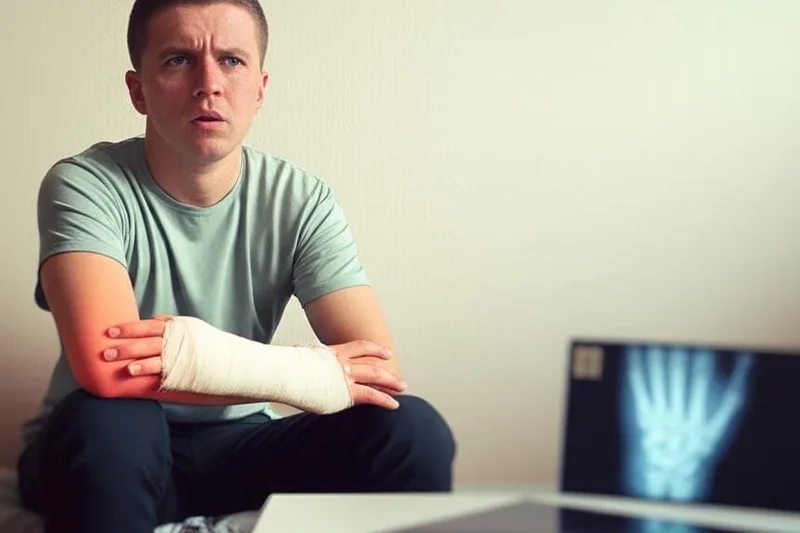
Has your wrist suddenly started to hurt? Or is it swollen and bruised like you fell? At such a time, if a doctor asks you to take an ``(X-ray)`` picture of your wrist, questions like what it is, how to do it, and is there anything to be afraid of may come to your mind. So today, let's talk about this ``(X-ray)`` of your wrist in simple terms.
What is a wrist X-ray?
Simply put, a wrist X-ray is a special picture that shows the inside of your wrist, the bones. It's like a photo, but it shows what's inside. The picture is in black and white.
If you look at your wrist, you'll see two long bones (the radius and ulna) at the base of your hand, and eight small bones (the carpal bones) that make up the wrist. These carpal bones are located in two rows of four at the base of your wrist. So doctors use these X-rays to diagnose any conditions or injuries in your wrist and to treat them properly.
So what is this X-ray?
An X-ray is a type of radiation. To be precise, it is a type of electromagnetic wave. These rays are sent through our bodies to take pictures of the inside of our bodies. This is the most common method of taking pictures used by doctors.
What happens is, an X-ray beam is sent through your body. The calcium in your bones absorbs the rays more, so the bones appear white. Other soft tissues, like muscles, absorb less, so they appear gray with varying degrees of hardness.
Why do we need a wrist X-ray?
A doctor may order an X-ray to help diagnose the cause of pain, swelling, or tenderness in your wrist. This can help identify a variety of conditions that may be affecting your wrist. Here are a few examples:
- Wrist fractures . Imagine you fall, hit your hand on the ground, and your wrist is swollen and painful. A doctor may ask you to take an X-ray to see if you have a broken bone.
- Dislocated joints .
- Degenerative conditions such as arthritis of the wrist.
- Conditions such as Carpal Tunnel Syndrome (in which a nerve passing through the wrist is compressed, causing numbness and pain in the fingers).
- Bone cysts.
- Infections of the bones, such as osteomyelitis .
- Bone cancer (these are very rare).
Also, after a broken bone in the wrist has been fixed (like by putting on a plaster cast), the doctor will still take an X-ray a few days later to see if the bone has set properly and healed properly.
Sometimes, if the doctor has any concerns about your little one's development, they may ask for a bone age test and an X-ray of the wrist. This can also help determine if there are any medical conditions that may be affecting your child's development.
Who does this wrist X-ray?
A radiologic technologist, or simply put, an X-ray technician, takes a wrist X-ray. These people are well-trained in how to care for patients, about radiation, how to protect themselves from radiation, the correct position to hold the patient when taking X-rays, and the procedures for taking X-rays. So you don't have to worry about anything, they take care of everything.
How does a wrist X-ray work?
As we discussed earlier, a picture is taken by sending a beam of X-rays through your body. This picture is then displayed on a special film (photographic film) or on a computer screen (digital platform).
Because the thickness of each part of your body is different, the amount of radiation absorbed by each part is also different.
- Bones absorb the most radiation, which is why they appear white .
- Because soft tissues like muscle, fat, and internal organs are less dense, they appear in varying shades of gray .
- Places where there is air appear black .
How do you prepare for an X-ray?
There is really no need to prepare much for a wrist X-ray. But the most important thing is to remove all jewelry from your hand and wrist, such as rings, bracelets, and watches. This jewelry can show up on the X-ray image and interfere with getting a clear picture.
Another important thing to remember is that if you are pregnant, you should definitely tell the technician who is taking the X-ray. Because a wrist X-ray uses very little radiation, it is generally considered safe during pregnancy. However, your doctor will decide whether or not to take an X-ray. If it is absolutely necessary, the technician will take steps to reduce the risk of radiation exposure to the fetus.
If you have any questions about this `(X-ray)` process, don't be afraid to ask the technician. They will explain everything to you.
What to expect when taking an X-ray?
The `X-ray` is taken in a special room in the `Radiology department` of the hospital. This room may be slightly cooled to protect the `X-ray` equipment. However, this test is very quick, taking no more than 15 minutes. You do not feel any pain when you take the `X-ray`. You do not even feel the radiation.
The technician will ask you to place your hand on the X-ray table. You may be given a sponge or something similar to hold your wrist in place while the X-ray is being taken, as even a slight movement can affect the clarity of the image. You may also be asked to hold your breath for a moment. The technician will then place the X-ray film or digital disc under the table, go into a small room or against a wall, and turn on the X-ray machine.
Usually, at least two pictures are taken during a wrist X-ray. One is a picture taken from above and below (a posteroanterior view), and the other is a picture taken from the side (a lateral view). Sometimes, a picture may be taken with the wrist slightly tilted (an oblique view). If you are having pain, tell the technician, who will help you with this.
What happens after the X-ray is taken?
After the X-ray of your wrist is taken, the technician will check to make sure each picture is clear. You will be asked to wait a moment while they review it. If any of the pictures are unclear, they will need to be retaken.
Then, a radiologist, a doctor who is specially trained to analyze X-ray images, will study these images carefully. He or she will review the images and send the results to your doctor. Your doctor will then call you to discuss the results and any necessary treatment.
Depending on the results, your doctor may need to do further tests or monitor your condition for a while.
What are the risks of a wrist X-ray?
An X-ray is a way for doctors to quickly and easily diagnose a condition in your wrist. A wrist X-ray uses very little radiation , and it passes directly through your body. Side effects from X-rays are rare.
However, if you are pregnant, the risk of problems from radiation exposure is slightly higher than for other people. So be sure to tell the technician if you are pregnant or think you may be pregnant. This risk is also slightly higher for young children . However, the technician can use a lower amount of radiation when taking an X-ray of a child.
There is a very small risk of cancer from excessive exposure to radiation. But this is no different from taking an ``(X-ray)`` or two. If you are very concerned about radiation exposure, talk to the technologist about it.
How long does it take to get the X-ray results?
If you had an emergency X-ray, you may get the results almost immediately. Otherwise, the radiologist will usually give your doctor the results within a day or two. Your doctor will then talk to you about it.
Can an X-ray show something like a sprain?
X-rays don't show the ligaments (tissues that connect bones together) in your wrist. However, a doctor may order an X-ray to check for broken bones (i.e., to make sure there is no fracture). The X-ray can show whether the bones in your wrist are aligned properly, or if they are out of alignment or have gaps between them. This can help determine if the ligaments are damaged or if you have a sprain. If there is any doubt, further tests, such as a CT scan or MRI scan, may be needed.
Take-Home Message
So, an X-ray is a very common imaging technique used by doctors today. If you have pain, swelling, or tenderness in your wrist, a doctor may order an X-ray to find out the cause.
Don't worry, a wrist X-ray is a quick, easy, and painless test. The X-ray technician will explain everything to you and answer any questions you may have. Although there is a small risk of radiation exposure, the amount of radiation you receive from a wrist X-ray is very small. The important thing is that once you have a proper diagnosis, your doctor can start the right treatment for you. So, follow your doctor's instructions and get well soon!
` Wrist, X-ray, fracture, joint, pain, radiation, diagnosis


💬 Comments (0)
No comments yet. Be the first to share your thoughts here.
Add Your Comment