
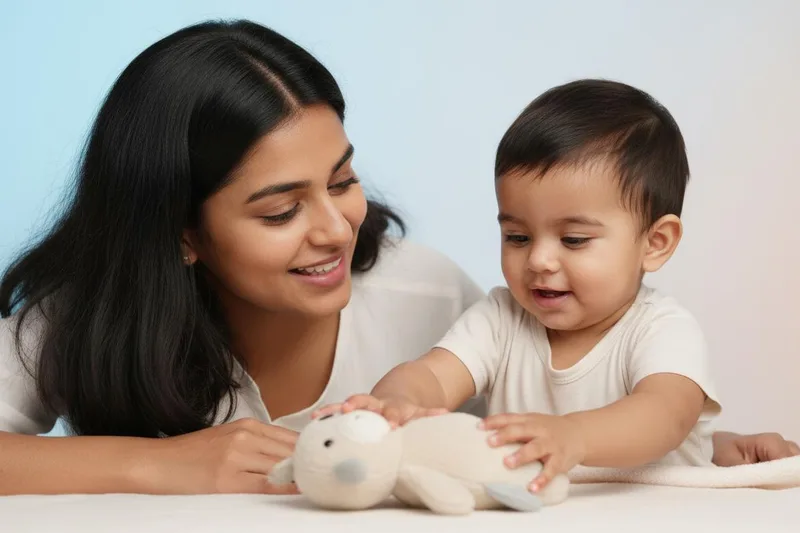
Your little one is growing up little by little, isn't he? He's learning new things every day, and it's so exciting to see. There are some important milestones in their development during this time. And we need to be very careful about their safety. Today, we'll talk about all of this very simply, in a way that you can understand.
Who is a toddler?
When you hear the word "toddler," you might think about how old a child is. We usually call children between the ages of 1 and 3 "toddlers." During this time, you'll notice your child gradually starting to do things on their own . They'll start to show a little independence. During this toddler period, your child will learn to:
- Eat alone.
- Walk without anyone's help.
- Use new words, repeat the words you hear, and say their name and surname.
- Understand simple commands like "no" and "stop".
- Get dressed without much help.
- Share toys with others and allow them to take turns playing.
But remember, every child grows and learns at their own pace . Some children may not have mastered these things by the age of 3. It's not a competition.
When does my little one need medical checkups?
During your baby's first year, your doctor will likely do regular checkups to make sure your baby is growing properly and meeting the milestones of the first year. As your baby gets older, these checkups are a little more frequent. You can talk to your baby's doctor to create a schedule for checkups that will work for your baby between the ages of 1 and 3. Checkups are usually scheduled around these times:
- At 1 year old.
- At 15 and 18 months.
- At 2 years old.
- At 30 months.
- At 3 years old.
What can you expect during a medical examination?
Just like medical checkups during infancy, well-child checkups focus on your child's development. These tests may include:
- Measuring your baby's weight, height, and head circumference . As well as a full body check, including eyes, ears, teeth, heart, and lungs.
- Providing necessary immunizations .
- Checking developmental milestones .
- Answering any questions or concerns you may have about your growing child.
- Talking about the next steps in their development.
- If necessary, order blood tests to check for low hemoglobin levels (anemia) and lead poisoning .
What are the important developmental milestones for toddlers?
Developmental milestones are things your little one can do at a certain age. These milestones are how we see how your child is doing:
- Moving (large and small muscle activities - `Gross and Fine Motor Skills`).
- Speaking (Language Development Skills).
- Learning (Cognitive Skills).
- Playing (Social and Emotional Skills).
Remember, every child develops at their own pace . This is not a competition, but a test of how quickly your little one reaches these milestones. Some children reach these milestones earlier than others. If you think your child is late in reaching these milestones, be sure to talk to your doctor . That way, you can identify any problems and address them.
15-18 Months Toddler Development and Safety
Between 15 and 18 months, your little one is learning to express their feelings with their newly acquired language skills. Throwing tantrums is a normal part of development for children at this age. It's a way for them to tell you that they're not happy when they don't get what they want. You can help calm your little one down by distracting them with toys and games. For example, if your little one is crying at the store for a toy, you can distract them by showing them something cute or singing a song that they like.
At this age, your child should be eating at the table with the rest of the family. They are learning to use utensils like a spoon and fork, and to stop drinking from a bottle and drink from a cup.
Signs of development seen at this age:
- Showing a variety of emotions , from acting recklessly to showing love to those you know.
- Expressing ideas in simple, single words (e.g., mom, dad, baby, food).
- Understands simple, one-step commands like "sit."
- Starting to walk and run .
- Drinking from a cup and eating from a spoon .
How do you protect a child of this age?
Do these things to protect your little one between 15 and 18 months:
- Close the stairs with gates , otherwise the little one might fall.
- When traveling in the car, place the child in a rear-facing car seat .
- Keep your home free of poisons . Be especially careful of cupboards that are high enough for small children to reach. Never store poisons in containers that look like food or drink bottles or jam jars . If your child drinks something poisonous, take the bottle and go to the nearest hospital immediately or call 1990 Ambulance Service .
- Avoid giving foods that can choke, such as raw carrots, unpeeled apples, grapes, peanuts, sausages, popcorn, and hard candy. Things like ripe avocados, mashed potatoes, boiled vegetables, tomatoes, and peeled or cooked fruits are better. Always cut round or coin-shaped foods into small pieces to avoid choking.
Development and safety of a 2-year-old child
Two-year-olds are full of emotions and are eager to show their feelings to others. They show love, happiness, anger, and protest.
Your child's understanding of rules may be very different from what you expect. At this time, set firm and consistent limits on behavior . Most two-year-olds ultimately want to please their parents. So, be sure to praise your child when they behave well or learn something new.
You may find that your child is very talkative, inquisitive, and very active. During this time, their vocabulary is growing rapidly . Reading books to your child can help them expand their vocabulary, improve their speaking, and develop their listening skills.
Although two-year-olds love to be with other children, they often play alone . The main way they learn at this age is through imitation .
Your child may start showing signs that they are ready for potty training . They may stay dry for longer periods of time during the day, or they may have a set time for their bowel movements. They may also be curious about the toilet and aware of their own bodily functions. Children usually learn to use the toilet when they are ready. Encourage your child and help them when needed . It is normal for children to master potty training in small steps.
Signs of development seen at this age:
- Imitating others, especially adults and older children .
- Sitting and playing near other children and gradually starting to include others in their play.
- Speaks in simple sentences of two to four words . (e.g. "The baby wants milk", "Give me the ball")
- Identifying shapes and colors .
- Following two-step instructions , such as "pick up your toys and put them in the box."
- Climbing up and down chairs and tables.
- Standing on tiptoes .
How do you protect a child of this age?
Follow these tips to protect your two-year-old child:
- To avoid burns , keep the temperature of the hot water tap below 49 degrees Celsius (120°F) .
- Install smoke and carbon monoxide detectors on every floor of your home, in every bedroom. Test the detectors once a month, and change the batteries every six months.
- If you must keep guns at home, keep them locked and empty .
- Protect electrical cords by taping them to the ground and covering electrical outlets . This is very important as young children will try to put their fingers or other objects into them.
- Never leave your child alone in the bathroom, bathtub, swimming pool, or anywhere with water . Be very careful if there are buckets of water in the bathroom.
- Never leave your child alone outdoors . Always have an adult supervise them when crossing the street or playing in the yard.
Development and safety of a 3-year-old child
Your three-year-old is becoming more social at this age, with his developing speech and motor skills rapidly developing. Your child is curious, often asking "why?" and sometimes asking the same thing over and over again.
Three-year-olds are developing a strong sense of self . Your child is recognizing the differences between boys and girls, and is imitating their adult role models. When playing, your child is interacting more with peers. Their vocabulary is growing to hundreds of words. Even if their pronunciation isn't perfect, others can understand about 75% of what your child says.
Motor skills demonstrate good coordination . Your child may like to cut with scissors, stack objects on top of each other, and draw circles.
Signs of development seen at this age:
- Allowing turns while playing.
- Identifying the familiar things around them.
- Speaking clearly so that others can understand and using two or three sentences in a conversation .
- Good use of imagination . Can make up stories and tell them, bring toys to life and make them talk.
- Being able to climb and descend stairs with one foot on each step .
- Being able to run and climb .
How do you protect a child of this age?
Do these things to protect your three-year-old child:
- Practice what to do in case of a fire at home (Fire Drills) .
- Make a habit of wearing a helmet when riding a bicycle.
- Talk about how to protect yourself from strangers (Stranger Safety) .
- When cooking, turn the handles of pots and pans so that they are not visible in front of the stove , so that the little one cannot touch them.
- Teach your child their name, address, and phone number . It's also a good idea to teach them how to call 119 (police) or 1990 (ambulance) in an emergency.
What things should a child know before going to preschool?
Starting preschool is another big milestone in your little one's life. This can be a mixed bag of emotions for both you and your little one. But making sure your child is ready can help make the transition easier. Here are some things to understand before your child starts preschool:
- Sharing with others .
- Being able to talk about their needs and wants .
- The ability to listen and pay attention without distraction.
- Ability to recognize some letters and numbers .
- Using good manners like "please" and "thank you".
Your child will learn a lot in the classroom, and not all of these skills need to be perfect before the first day. The most important way you can prepare your child is to teach them to manage their emotions in the classroom . This means they need to be able to say "I'll be right back" when you leave them, and to talk to the teacher if they need help.
What toys help with cognitive development in children?
Another important milestone we look at as your child grows is cognitive development . Cognitive development is the way your child uses their brain to learn about the world around them. Between the ages of 1 and 3, your little one develops several new cognitive skills, such as thinking independently, understanding commands, communicating with others, and using their imagination. Here are some games and activities that can help your child develop their cognitive skills:
- Using imagination through storytelling and play.
- Playing with dolls, stuffed animals, and toys .
- Playing with puzzles that have three or four pieces.
- Drawing with colored pencils .
- Building a tower from blocks .
- Using toys with moving parts like buttons and levers.
- Playing hide and seek .
- Sorting goods by size and color .
- Singing songs and rhymes .
What health issues should be considered when it comes to the development of children?
It is estimated that about 17% of children in the United States have a developmental delay or disability. Similar conditions can be seen in Sri Lanka as well. Therefore, it is important to be aware of this.
- Autism Spectrum Disorder: Autism is a neurodevelopmental disorder that affects the way people communicate, interact socially, and behave. Symptoms of autism in children include: problems with social skills, delays in language development and problem-solving, problems with fine motor skills and coordination, and attention deficit hyperactivity disorder.
- Intellectual Disability: Intellectual disability limits a child's ability to learn and perform at the same pace as their peers. Symptoms of intellectual disability in children include: inability to express their needs, difficulty remembering things, problem-solving, and failure to understand social rules. Intellectual disability can be seen with conditions such as Down syndrome, fetal alcohol syndrome, and Fragile X syndrome .
- Developmental Delay: Developmental delays are when your child takes longer to reach a certain developmental milestone. These milestones are used to determine how your child plays, learns, speaks, moves, and behaves. Examples include expressive speech delay, receptive speech delay, fine motor or sensory processing delay, or gross motor delay .
When a developmental delay is identified, early treatment is the best way to get your child back on track. If the delay is not identified early, your child may have difficulty learning when they start school. If you think your child has a developmental delay, be sure to see a doctor .
When should I see a doctor?
You know your child best. If you suspect that there is something wrong with his behavior or the way he learns, talk to a doctor immediately .
These are signs that your little one may have a developmental delay:
- He is losing his previous abilities . For example, he used to say a few words, but now he doesn't even say them.
- Not using two-word sentences (like `drink milk`) even after 2 years.
- Not understanding how to use common items like a spoon and fork.
- Not following simple instructions like "no" or "stop."
- Unsteadiness when walking .
- Difficulty interacting socially with other adults or children or poor eye contact .
If you suspect your child has a developmental delay , it's important to act quickly . This allows your doctor to examine your child and treat any developmental disorders.
Questions to ask the doctor
When you visit the doctor, you can ask questions like these:
- Is my little one developing appropriately for his age?
- What should I do if my little one misses some developmental milestones?
Take-Home Message
Your little one is growing up so fast, and they are becoming more and more connected to the world around them. Keep an eye on their developmental milestones between the ages of 1 and 3. If you think your little one is late in reaching their developmental milestones, don't be afraid to talk to your doctor . Every child is different, but giving them the support they need at the right time will give them a great boost for their future. Your love, attention, and encouragement are the most valuable things they can have!
` Toddler development, developmental milestones, child safety, 15-18 month old, 2 year old, 3 year old, preschool readiness




💬 Comments (0)
No comments yet. Be the first to share your thoughts here.
Add Your Comment