
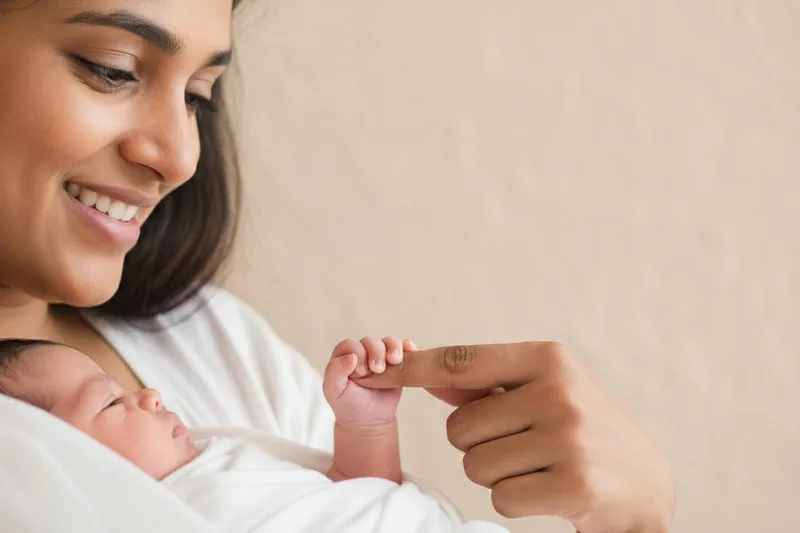
When you look at your newborn baby with love, you must have noticed some of the cute and amazing things he does, right? He jumps up and spreads his arms wide, he turns his head in that direction when you rub his mouth, he squeezes and holds on to your finger... things like that. Do you think that all of these are conscious and deliberate actions of the baby? Not really. Most of these are what we call "Newborn Reflexes." These are amazing things that happen automatically, without the baby's control. Today, we'll talk about this in more detail.
What are these newborn reflexes?
Simply put, this means that your baby's muscles are automatically and uncontrollably activated in response to a stimulus. This means that the baby is not doing these things on purpose. These responses occur automatically when a certain sound is heard, something is touched, or a certain sensation is felt. Think about it, even before the baby is born, some of these reflexes have been established in the mother's womb. These are often controlled by a part of the baby's brain called the brainstem.
So, why are these reflexes so important? Your baby's doctor uses these reflexes to assess your baby's health, especially the development and functioning of his nervous system . The presence of these reflexes, as well as their strength, is an important sign that your baby is healthy and developing well.
What are these two amazing things a baby does with their mouth? (Oral Reflexes)
Newborn babies have two main oral reflexes. Both are essential for survival.
1. Rooting Reflex
This is a baby's most basic survival instinct. It helps the baby find a nipple to suckle. If you gently stroke one of the baby's cheeks or one side of the mouth with your finger, the baby will automatically turn its head in that direction and open its mouth as if it is looking for milk. Isn't it amazing?
2. Sucking Reflex
This is another instinct that helps you survive. When you put a finger in your baby's mouth, or your breast during breastfeeding, the baby will automatically start sucking. Although this is a natural reflex, it is not an easy task for the baby. Imagine, a baby has to suck, breathe, and swallow at the same time. It takes a little effort for the baby to coordinate all three.
5 more important reflexes!
In addition to oral reflexes, your baby should have several other important reflexes.
1. Moro Reflex
This is also called the "startle reflex." This is actually a protective response for the baby. If a loud noise is suddenly heard (think of a door slamming shut), or if the baby feels like their head is being pulled back a little, the baby will suddenly jump and spread their arms and legs to the sides. The palms are turned upwards, and the thumbs are also extended. Sometimes the baby may even cry loudly. When the head is properly supported again, the baby will quickly bring their arms back to their body and calm down.
Important: Although this Moro reflex can sometimes look like infantile spasms , the two are completely different. Infantile spasms are a type of seizure. So if you have any doubts, seek medical advice.
2. Tonic Neck Reflex
This is also called the "fencing posture." You can see this when your baby is sleeping on his or her back. If you turn your baby's head to one side (either right or left), the arm on the side where the head is turned will be straight, with the palm slightly open. The arm on the other side will be bent at the elbow, with the palm slightly closed. It gets its name because it resembles the position of someone fighting with a sword.
3. Stepping Reflex
This is a very strange reflex. If you place your baby on your chest and allow him to have skin-to-skin contact right after birth, this reflex may help him "crawl" to find your breast. If you hold your baby upright and let his feet touch a hard surface (like a table), he will put one leg forward and the other leg behind him, pretending to "walk." This is not actually walking, it is just a reflex.
4. Babinski Reflex
This is a reflex that can be seen on the soles of babies' feet. If you gently rub the soles of babies' feet from the heel to the toes (like scratching with a key), their big toe will curl up and their other toes will spread out like a fan. This was discovered in 1896 by a neurologist named Joseph Babinski. That's why it's also called the "Babinski sign."
5. Grasping Reflex
There are two types of grasping reflexes - one in the hand and the other in the leg.
- Palmar Grasp: If you put your finger in your baby's palm, he will automatically grab it tightly. It's like a little monkey hanging on a branch. If you try to pull your finger away, he'll probably try to grab it even tighter!
- Plantar Grasp: The Babinski reflex mentioned earlier disappears after a while, and is replaced by the plantar grasp reflex. This reflex is present until we grow up. If you place your finger under the baby's toes, he will curl his toes and wrap them around your finger.
When will these reflexes go away?
Most of the time, these newborn reflexes gradually disappear by about four to six months. This is because, as the baby's brain develops, his central nervous system replaces these involuntary reflexes with voluntary movements that the baby can control.
For example, things like the Moro reflex and the stepping reflex should disappear by about two months of age. The grasping reflex and the tonic neck reflex may last a little longer, perhaps until about five or six months. However, by the time your baby is about a year old, most of these newborn reflexes should have disappeared.
Are all reflexes lost?
No, it doesn't. Some reflexes are with us from the day we are born and remain with us throughout our lives. They are:
- Blink reflex: We automatically close our eyes when exposed to a sudden burst of light.
- Sneeze reflex: We automatically sneeze when something, like dust, enters our nose.
- Yawn reflex: We automatically yawn when our body senses a lack of oxygen.
- Cough reflex: We automatically cough when the back of the throat or trachea is stimulated.
- Gag reflex: The feeling of nausea when something touches the back of the throat or inside the mouth.
Let's learn about the increased gag reflex in babies.
The gag reflex is there to protect us from choking and choking. This reflex can be triggered if something like food, a toy, or a finger touches the back of a baby's mouth . Gagging is common, especially when babies start eating solid foods. This will gradually decrease as they get used to solid foods.
However, some babies have a very sensitive gag reflex. This means they gag frequently and easily (hyperactive gag reflex). There can be several reasons for this:
- It's too early to start solid foods, or the baby isn't ready for them yet.
- Being born prematurely .
- Developmental delays or neurological conditions .
- Inability to sit properly without support.
- Having a tongue-tie (Tongue-tie / Ankyloglossia) .
- Having a condition called acid reflux .
- Having difficulty eating.
If your baby seems to be gagging more than other babies, it's best to talk to your pediatrician about it. He or she may refer you to a feeding specialist if necessary.
How is the Moro reflex tested?
Your baby's doctor will usually test these reflexes. When testing the Moro reflex, the doctor will carefully place the baby face up on a soft surface, slowly lift the baby's head, and then quickly drop it (but without letting the head hit the ground) and quickly hold it back.
Then, if the baby is healthy, he will have a startled look, spread his arms out to the sides, turn his palms up, and flex his thumbs. He may even cry. When his head is supported again, he will bring his arms close to his body, bend his elbows, and calm down. This is not a good idea to do at home often; let the doctor do it.
Is it true that babies imitate? (Imitation Reflex)
In the past, researchers thought that newborns could imitate what adults did. This was called the "imitation reflex." However, recent research has shown that there is no evidence that such a special imitation reflex exists. Most of the movements and actions of newborns are spontaneous and random. Although they sometimes seem like imitation, they are actually a reflex to the environment, not a deliberate imitation.
The most important thing for you to remember (Take-Home Message)
So, you probably understand that your little one comes into this world with a lot of these amazing reflexes that help him survive and protect himself for the first few weeks and months. Your baby's pediatrician will check these reflexes at regular checkups to see if they are still there and how strong they are. As your baby grows, learns new things, and starts to do things on his own, some of these reflexes will gradually disappear.
But remember this too, not all babies are the same. The time your baby shows these reflexes and the time they disappear may be unique to him. Therefore, if you have any doubts, questions, or concerns about your baby's development or his reflexes , never hesitate to talk to your doctor. They will guide you exactly.
` Baby, Newborn, Reflexes, Newborn Reflexes, Moro Reflex, Baby Development, Nervous System


💬 Comments (0)
No comments yet. Be the first to share your thoughts here.
Add Your Comment