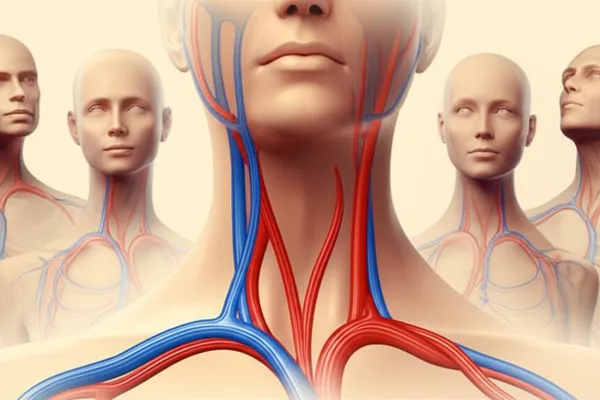
Let's learn about the Subclavian Artery, one of the most important arteries that carries blood to your shoulders, neck, and head!

Let's learn about the Subclavian Artery, one of the most important arteries that carries blood to your shoulders, neck, and head!

Hello! Have you ever wondered how your arms, neck, and some parts of your head get blood? Our bodies have a very amazing system of blood vessels. Today we are going to talk about one of the most important, but perhaps least talked about, parts of that system. That is the subclavian artery .

What is the subclavian artery? What does it do?

Simply put, your subclavian arteries are two main blood vessels that carry oxygen- rich blood from your heart to your upper body, including your arms, neck, and head. Think of them like two main pipes that carry water from a water tank to your home. They are located just below your collarbones (called your clavicles), one on each side. There are two on the right side and two on the left side.

So, the main job of this subclavian artery is to deliver oxygenated blood from the heart to your head, neck, and arms. A very important job, right?

We can understand its function by dividing this blood vessel into three parts:

  • The first part sends blood to parts of your chest, the thyroid gland, and the Circle of Willis, a major system that supplies blood to the brain.
  • The second part goes to the parts of your neck called the costocervical trunks .
  • The third part , which is the part a little further from where this blood vessel starts, supplies blood to your arms. That means blood goes to everything from your biceps, triceps muscles, shoulder muscles, forearm muscles, etc.

Where exactly is the subclavian artery located?

As we mentioned earlier, both of these blood vessels are located under your collarbones (the `clavicles`). However, the left subclavian artery and the right subclavian artery start slightly differently.

  • The right subclavian artery on your right side begins with a blood vessel called your brachiocephalic artery .
  • The left subclavian artery on your left side starts directly from the arch of your great aorta, the aortic arch .

These two blood vessels travel outward from the middle of your body, through two muscles in your neck called the ``anterior and middle scalene muscles.`` They extend to your first rib, and from there they become the ``axillary arteries,`` which are the blood vessels that go straight down your arm.

These subclavian arteries branch off into smaller branches. They are also very important:

  • Vertebral arteries: These supply blood to parts of your brain and the brainstem . These blood vessels are usually between 3 and 5 millimeters in diameter.
  • Internal thoracic arteries: These supply blood to the pericardium , breastbone, diaphragm , chest wall, and some parts of the abdominal wall. These are small blood vessels about 2 millimeters in diameter. Doctors sometimes use the left internal thoracic artery for coronary artery bypass grafts .
  • Dorsal scapular arteries: These supply blood to the muscles of your upper back and support your arms and shoulders.
  • Thyrocervical trunk: This runs up the sides of your neck and supplies blood to your neck and shoulders.
  • Costocervical trunk: This is also located on either side of the neck and sends blood to your arms, neck, and head.

How big is this subclavian artery? What is it made of?

The diameter of your subclavian artery, or the width of its cross-section, is between 0.7 and 1.0 centimeters (less than half an inch). It's small, but it does a lot of work, right?

Like other blood vessels, your subclavian artery is made up of three main layers.

1. Innermost layer (Tunica Intima): This is made up of a very thin, flexible layer of cells. It helps the blood flow smoothly.

2. Middle layer (Tunica Media): This is the muscular layer. This is what allows the blood vessels to contract and dilate. It also helps control blood pressure.

3. The outermost layer (Tunica Adventitia): This is also a strong covering made of thin, flexible cells. It provides protection to the blood vessel.

What are the common diseases that can affect the subclavian artery?

Sadly, even the subclavian artery, which performs such an important function, can develop certain diseases. Let's take a look at some of the main ones:

  • Atherosclerosis: Many people have heard of this. Simply put, it is a condition in which fat and cholesterol build up inside the blood vessels (we call it `plaque` ) and clog the blood vessels. It is like rust clogging a water pipe. If this happens in the subclavian artery, it obstructs the flow of blood.
  • Thoracic Outlet Syndrome: In this condition, the subclavian artery becomes narrowed ( stenosis) due to pressure from surrounding bone, muscle, or other tissue.) to change. Then the amount of blood going to the hands may decrease.
  • Takayasu's arteritis: This is a type of vasculitis . It causes inflammation, or swelling, of the subclavian artery, which can reduce the amount of oxygen reaching the head, neck, or arms.
  • Subclavian Steal Syndrome: This is also often caused by atherosclerosis . What happens here is that the subclavian artery becomes narrowed ( stenosis ), and some of the blood that should go to the brain is "stealing" away from the arm. That's why it's called a "steal."

What are the symptoms of a subclavian artery problem? How do you know?

If there is a problem with the subclavian artery, the symptoms may vary depending on the disease that is affecting it. However, there are some common symptoms that can be seen:

  • Blood pressure in one arm is significantly lower than in the other arm.
  • A change in the color of the hands or fingers (like turning blue or pale).
  • Numbness, pain, weakness , or just a feeling of something in the hand.
  • Swelling of the hand.
  • The hands can't stand the cold .
  • Feeling dizzy .
  • Sometimes fever can occur (especially in inflammatory conditions such as `Takayasu's arteritis`).
  • Fainting (especially in conditions like `Subclavian Steal Syndrome`).

What tests are performed to check the health of the subclavian artery?

If you have symptoms like these, when you see a doctor, he or she will likely run some tests.

  • First, we measure the blood pressure in both arms . We can see if there is a big difference.
  • Vascular ultrasound : This is a simple, painless test that can look at the way blood flows through blood vessels and whether there is any blockage.
  • A chest X-ray .
  • CT scan .
  • MRI (Magnetic Resonance Imaging – MRI) test.
  • Addison maneuver : This is a test to check for Thoracic Outlet Syndrome . The scalene muscle in your neck is stretched and the radial pulse in your arm is checked for a decrease.
  • AngiogramTest: This is a somewhat rare procedure. A special substance is injected into the blood vessels and an X-ray is taken.

What are the treatments for subclavian artery problems?

The good news is that if the subclavian artery is narrowed or blocked, there are treatments to restore it to normal. Doctors use a variety of methods to reopen this blood vessel. Treatment varies depending on the condition.

Subclavian artery disease (caused by `atherosclerosis`)

  • Aspirin and cholesterol-lowering medications .
  • Angioplasty : This involves inserting a small balloon into the artery and inflating it at the site of the blockage, removing the plaque that has built up on the artery wall. A stent , a small mesh-like structure, may then be placed in the area to prevent the blockage from recurring.
  • Bypass surgery is a surgical procedure that creates a new route for blood to flow around the blockage.

Thoracic Outlet Syndrome

  • Physical therapy : This means doing things like exercise to try to reduce the pressure.
  • Nonsteroidal anti-inflammatory drugs (NSAIDs) : Reduce pain and swelling.
  • Thrombolytics or ``clot-busting drugs``.
  • Anticoagulants : Medications given to prevent blood clotting.
  • Surgery is performed to remove the cause of the blood vessel blockage.

Takayasu's arteritis

  • Corticosteroids : Reduce inflammation.
  • Immunosuppressive drugs .
  • Opening a blood vessel through surgery or angioplasty .

Subclavian Steal Syndrome

  • Antiplatelet therapy : Stop blood platelets from clumping together and forming blood clots.
  • Anticoagulants : Prevent blood clots from forming.
  • Bypass surgery or angioplasty .

What are some simple things we can do to keep the subclavian artery healthy?

Just as you take care of your heart and the entire cardiovascular system, you should also take care of your subclavian artery. Following these tips will help you a lot:

  • Control your blood pressure and cholesterol levels . These are two of the main enemies that damage blood vessels.
  • Avoid using tobacco products completely. Smoking is very harmful to blood vessels.
  • Get regular physical exercise . Walking for at least 30 minutes a day is also very good.
  • Maintain a healthy body weight . Obesity also puts extra pressure on blood vessels.

So, the last thing to remember is...

Your subclavian artery is a very important part of your upper body, providing essential blood supply to keep you healthy. Just like a tree needs water, our arms, neck, and head need blood flowing through this blood vessel.

Eating a healthy diet and exercising regularly can help keep not only your subclavian artery but also all other blood vessels in your body strong. Regular check-ups with your doctor can also help detect any problems with your circulatory system early. If you suddenly find out that one of your blood vessels is narrowed, don't panic. Advanced medicine has the necessary treatments for it. The most important thing is to see a doctor without delay if you experience symptoms.

👩🏽‍⚕️ Additional questions (FAQs)

💬 What is the Subclavian Artery?

The subclavian artery is a major blood vessel that branches off from the aorta, the largest artery in our heart, and carries oxygenated blood to our neck, arms, and part of the brain. It is located just below our collarbone.

💬 Why do doctors insert central lines into patients with pneumonia?

When patients in the intensive care unit (ICU) need to receive a large amount of medication or nutritional fluids at once directly into the nearest large vein leading to the heart, doctors insert a tube (CVP line) through this subclavian vein.

💬 What happens if the subclavian duct is blocked?

If cholesterol builds up inside this artery and blocks blood flow (Subclavian Steal Syndrome), the blood flow to the arms may be cut off, causing numbness and loss of consciousness. Also, symptoms such as dizziness may occur due to decreased blood flow to the brain.

⚠️ Important: The medical articles and information on Nirogi Lanka are for general awareness only, and are by no means a substitute for professional medical advice, diagnosis, or treatment. For any medical problem you have, consult a qualified physician immediately.

💬 Comments (0)

No comments yet. Be the first to share your thoughts here.

Add Your Comment

Please calculate: 3 + 9 =
Let's learn about the Subclavian Artery, one of the most important arteries that carries blood to your shoulders, neck, and head!
How the Body WorksMarch 25, 2026

Let's learn about the Subclavian Artery, one of the most important arteries that carries blood to your shoulders, neck, and head!

Hello! Have you ever wondered how your arms, neck, and some parts of your head get blood? Our bodies have a very amazing system of blood vessels. Today we are going to talk about one of the most important, but perhaps least talked about, parts of that system. That is the subclavian artery .

What is the subclavian artery? What does it do?

Simply put, your subclavian arteries are two main blood vessels that carry oxygen- rich blood from your heart to your upper body, including your arms, neck, and head. Think of them like two main pipes that carry water from a water tank to your home. They are located just below your collarbones (called your clavicles), one on each side. There are two on the right side and two on the left side.

So, the main job of this subclavian artery is to deliver oxygenated blood from the heart to your head, neck, and arms. A very important job, right?

We can understand its function by dividing this blood vessel into three parts:

  • The first part sends blood to parts of your chest, the thyroid gland, and the Circle of Willis, a major system that supplies blood to the brain.
  • The second part goes to the parts of your neck called the costocervical trunks .
  • The third part , which is the part a little further from where this blood vessel starts, supplies blood to your arms. That means blood goes to everything from your biceps, triceps muscles, shoulder muscles, forearm muscles, etc.

Where exactly is the subclavian artery located?

As we mentioned earlier, both of these blood vessels are located under your collarbones (the `clavicles`). However, the left subclavian artery and the right subclavian artery start slightly differently.

  • The right subclavian artery on your right side begins with a blood vessel called your brachiocephalic artery .
  • The left subclavian artery on your left side starts directly from the arch of your great aorta, the aortic arch .

These two blood vessels travel outward from the middle of your body, through two muscles in your neck called the ``anterior and middle scalene muscles.`` They extend to your first rib, and from there they become the ``axillary arteries,`` which are the blood vessels that go straight down your arm.

These subclavian arteries branch off into smaller branches. They are also very important:

  • Vertebral arteries: These supply blood to parts of your brain and the brainstem . These blood vessels are usually between 3 and 5 millimeters in diameter.
  • Internal thoracic arteries: These supply blood to the pericardium , breastbone, diaphragm , chest wall, and some parts of the abdominal wall. These are small blood vessels about 2 millimeters in diameter. Doctors sometimes use the left internal thoracic artery for coronary artery bypass grafts .
  • Dorsal scapular arteries: These supply blood to the muscles of your upper back and support your arms and shoulders.
  • Thyrocervical trunk: This runs up the sides of your neck and supplies blood to your neck and shoulders.
  • Costocervical trunk: This is also located on either side of the neck and sends blood to your arms, neck, and head.

How big is this subclavian artery? What is it made of?

The diameter of your subclavian artery, or the width of its cross-section, is between 0.7 and 1.0 centimeters (less than half an inch). It's small, but it does a lot of work, right?

Like other blood vessels, your subclavian artery is made up of three main layers.

1. Innermost layer (Tunica Intima): This is made up of a very thin, flexible layer of cells. It helps the blood flow smoothly.

2. Middle layer (Tunica Media): This is the muscular layer. This is what allows the blood vessels to contract and dilate. It also helps control blood pressure.

3. The outermost layer (Tunica Adventitia): This is also a strong covering made of thin, flexible cells. It provides protection to the blood vessel.

What are the common diseases that can affect the subclavian artery?

Sadly, even the subclavian artery, which performs such an important function, can develop certain diseases. Let's take a look at some of the main ones:

  • Atherosclerosis: Many people have heard of this. Simply put, it is a condition in which fat and cholesterol build up inside the blood vessels (we call it `plaque` ) and clog the blood vessels. It is like rust clogging a water pipe. If this happens in the subclavian artery, it obstructs the flow of blood.
  • Thoracic Outlet Syndrome: In this condition, the subclavian artery becomes narrowed ( stenosis) due to pressure from surrounding bone, muscle, or other tissue.) to change. Then the amount of blood going to the hands may decrease.
  • Takayasu's arteritis: This is a type of vasculitis . It causes inflammation, or swelling, of the subclavian artery, which can reduce the amount of oxygen reaching the head, neck, or arms.
  • Subclavian Steal Syndrome: This is also often caused by atherosclerosis . What happens here is that the subclavian artery becomes narrowed ( stenosis ), and some of the blood that should go to the brain is "stealing" away from the arm. That's why it's called a "steal."

What are the symptoms of a subclavian artery problem? How do you know?

If there is a problem with the subclavian artery, the symptoms may vary depending on the disease that is affecting it. However, there are some common symptoms that can be seen:

  • Blood pressure in one arm is significantly lower than in the other arm.
  • A change in the color of the hands or fingers (like turning blue or pale).
  • Numbness, pain, weakness , or just a feeling of something in the hand.
  • Swelling of the hand.
  • The hands can't stand the cold .
  • Feeling dizzy .
  • Sometimes fever can occur (especially in inflammatory conditions such as `Takayasu's arteritis`).
  • Fainting (especially in conditions like `Subclavian Steal Syndrome`).

What tests are performed to check the health of the subclavian artery?

If you have symptoms like these, when you see a doctor, he or she will likely run some tests.

  • First, we measure the blood pressure in both arms . We can see if there is a big difference.
  • Vascular ultrasound : This is a simple, painless test that can look at the way blood flows through blood vessels and whether there is any blockage.
  • A chest X-ray .
  • CT scan .
  • MRI (Magnetic Resonance Imaging – MRI) test.
  • Addison maneuver : This is a test to check for Thoracic Outlet Syndrome . The scalene muscle in your neck is stretched and the radial pulse in your arm is checked for a decrease.
  • AngiogramTest: This is a somewhat rare procedure. A special substance is injected into the blood vessels and an X-ray is taken.

What are the treatments for subclavian artery problems?

The good news is that if the subclavian artery is narrowed or blocked, there are treatments to restore it to normal. Doctors use a variety of methods to reopen this blood vessel. Treatment varies depending on the condition.

Subclavian artery disease (caused by `atherosclerosis`)

  • Aspirin and cholesterol-lowering medications .
  • Angioplasty : This involves inserting a small balloon into the artery and inflating it at the site of the blockage, removing the plaque that has built up on the artery wall. A stent , a small mesh-like structure, may then be placed in the area to prevent the blockage from recurring.
  • Bypass surgery is a surgical procedure that creates a new route for blood to flow around the blockage.

Thoracic Outlet Syndrome

  • Physical therapy : This means doing things like exercise to try to reduce the pressure.
  • Nonsteroidal anti-inflammatory drugs (NSAIDs) : Reduce pain and swelling.
  • Thrombolytics or ``clot-busting drugs``.
  • Anticoagulants : Medications given to prevent blood clotting.
  • Surgery is performed to remove the cause of the blood vessel blockage.

Takayasu's arteritis

  • Corticosteroids : Reduce inflammation.
  • Immunosuppressive drugs .
  • Opening a blood vessel through surgery or angioplasty .

Subclavian Steal Syndrome

  • Antiplatelet therapy : Stop blood platelets from clumping together and forming blood clots.
  • Anticoagulants : Prevent blood clots from forming.
  • Bypass surgery or angioplasty .

What are some simple things we can do to keep the subclavian artery healthy?

Just as you take care of your heart and the entire cardiovascular system, you should also take care of your subclavian artery. Following these tips will help you a lot:

  • Control your blood pressure and cholesterol levels . These are two of the main enemies that damage blood vessels.
  • Avoid using tobacco products completely. Smoking is very harmful to blood vessels.
  • Get regular physical exercise . Walking for at least 30 minutes a day is also very good.
  • Maintain a healthy body weight . Obesity also puts extra pressure on blood vessels.

So, the last thing to remember is...

Your subclavian artery is a very important part of your upper body, providing essential blood supply to keep you healthy. Just like a tree needs water, our arms, neck, and head need blood flowing through this blood vessel.

Eating a healthy diet and exercising regularly can help keep not only your subclavian artery but also all other blood vessels in your body strong. Regular check-ups with your doctor can also help detect any problems with your circulatory system early. If you suddenly find out that one of your blood vessels is narrowed, don't panic. Advanced medicine has the necessary treatments for it. The most important thing is to see a doctor without delay if you experience symptoms.

👩🏽‍⚕️ Additional questions (FAQs)

💬 What is the Subclavian Artery?

The subclavian artery is a major blood vessel that branches off from the aorta, the largest artery in our heart, and carries oxygenated blood to our neck, arms, and part of the brain. It is located just below our collarbone.

💬 Why do doctors insert central lines into patients with pneumonia?

When patients in the intensive care unit (ICU) need to receive a large amount of medication or nutritional fluids at once directly into the nearest large vein leading to the heart, doctors insert a tube (CVP line) through this subclavian vein.

💬 What happens if the subclavian duct is blocked?

If cholesterol builds up inside this artery and blocks blood flow (Subclavian Steal Syndrome), the blood flow to the arms may be cut off, causing numbness and loss of consciousness. Also, symptoms such as dizziness may occur due to decreased blood flow to the brain.

⚠️ Important: The medical articles and information on Nirogi Lanka are for general awareness only, and are by no means a substitute for professional medical advice, diagnosis, or treatment. For any medical problem you have, consult a qualified physician immediately.

💬 Comments (0)

No comments yet. Be the first to share your thoughts here.

Add Your Comment

Please calculate: 3 + 9 =