
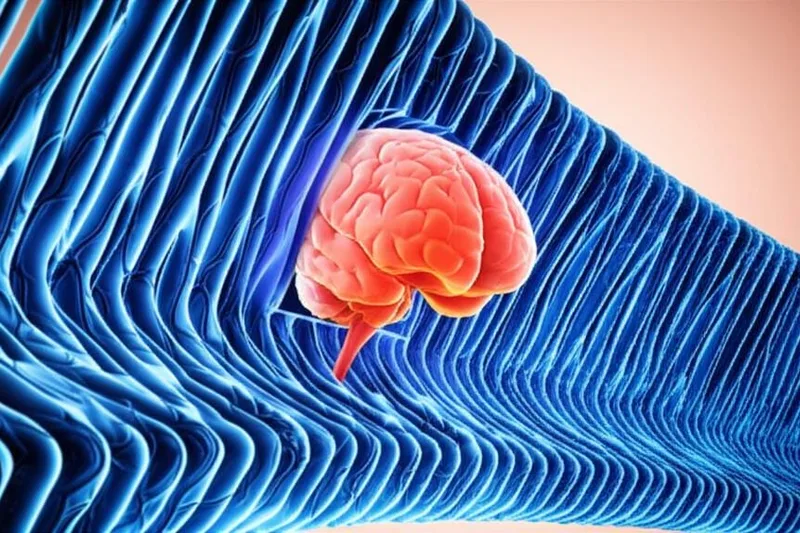
The brain is the most valuable and complex organ in our body, right? So keeping this brain healthy is very important. Just like our house has a wall and a gate to protect it, our brain also has a special security system. That is what we call the blood-brain barrier or ``Blood-Brain Barrier'', ``(BBB)'' for short. Today, let's talk about this wonderful protector in a little more detail .
What is the blood-brain barrier?
Simply put, your blood-brain barrier (BBB) is a protective layer of cells that lines the inside of the blood vessels in your brain. It's a very important part of the functioning of our brain and nervous system.
Although the name says "barrier," it's actually not just a wall. It's more like a filter, like a sentinel in the brain . Its main job is to keep out harmful substances and keep in the good ones. It also controls the way in which various chemicals (both those we make and those we take in from outside) enter and leave the brain. Isn't that amazing?
What happens at the blood-brain barrier (BBB)?
Inside our blood vessels, there is a special layer of cells called the endothelium. However, in the blood vessels inside the brain, this endothelium is a little different.
These endothelial cells that line the inside of the blood vessels in the brain are packed together so tightly that there's not even a tiny bit of space. That's how your blood-brain barrier (BBB) is formed. These cells are packed so tightly that nothing can get through them without help. The outer membrane of these cells is made of lipid-based materials. This is a very important point, and let's see why.
What are the things that can pass through the blood-brain barrier (BBB)?
Some things are very small, that is, they can pass through this `(BBB)`. Some other things can pass through because they are `(lipid-soluble)` . That is, the fatty layer of the blood-brain barrier can take them in without being repelled. However, it is difficult for larger particles, or for water-soluble particles, to pass through this `(BBB)` on their own.
Think about it, large particles can't get through those tightly packed endothelial cells, because there's not enough room. Water-soluble particles have a hard time getting through the BBB, because the BBB's cell membranes are lipid-based, and they repel water-soluble substances. So, if large, water-soluble particles like nutrients want to get into the brain, they need a special transport help .
Here are some types of drugs and substances that can pass through the BBB (either alone or with assistance):
- Alcohol
- Anesthetics
- Antidepressant medications
- Anxiolytics
- Antipsychotic medications
- Medications that treat seizures or epilepsy
- Caffeine
- Acetaminophen and many nonsteroidal anti-inflammatory drugs (NSAIDs)
- Sleeping pills and sedatives (e.g., barbiturates, benzodiazepines)
This list only includes a few drug classes that can cross the BBB. Many other drug classes can do this. In fact, the list of things that can cross the BBB is very long. According to current methods, nearly 5,000 chemical species (including drugs) have been identified that can cross the BBB. These are identified using very complex computer algorithms and programs.
So, what can't pass through the blood-brain barrier (BBB)?
Normally, pathogens , such as bacteria or viruses, as well as many toxic substances, cannot pass through the BBB. This is the greatest protection the BBB has.
What are the common conditions that affect the blood-brain barrier?
Although your blood-brain barrier (BBB) is very secure, it is not 100% perfect. It can be weakened by conditions like inflammation. Other medical conditions can also reduce the effectiveness of the BBB. If this happens, harmful substances or pathogens can enter the brain. (However, sometimes this can be beneficial. For example, antibiotics like penicillin used to treat brain infections can enter more easily when the BBB is weakened.)
Conditions that weaken the integrity of the BBB include both acute and chronic conditions.
Situations that immediately reduce the strength of `(BBB)`
These are health problems that come on suddenly or have occurred recently. Some examples are:
- Brain cancers
- Brain infections (e.g., Encephalitis, Meningitis)
- Head injuries, especially concussion and traumatic brain injury (TBI)
- Increased carbon dioxide levels in the blood (Hypercapnia)
- Cerebral hypoxia (lack of oxygen to the brain due to low blood oxygen levels)
- Stroke
- Seizures, especially a persistent seizure condition called ``Status Epilepticus''
Conditions that reduce the strength of the `(BBB)` over time
These are conditions that last a long time, sometimes months, years, or even a lifetime. Examples:
- Alzheimer's disease
- Amyotrophic Lateral Sclerosis (ALS)
- Chronic hypercapnia caused by conditions such as COPD (Chronic Obstructive Pulmonary Disease)
- Epilepsy
- Frontotemporal Dementia
- High blood pressure (Hypertension)
- Related conditions such as high blood sugar levels (Hyperglycemia) and Type 2 Diabetes
- High blood cholesterol levels (Hyperlipidemia)
- Multiple Sclerosis
- Neuromyelitis Optica (NMO)
- Parkinson's disease
Experts suspect that many other chronic conditions may affect the BBB, but further research is needed to confirm this.
What are the common signs or symptoms of blood-brain barrier (BBB) breakdown?
In fact, there is currently no clear way to directly diagnose a problem with the BBB. Some laboratory tests, especially those that examine the cerebrospinal fluid, can indirectly indicate a problem with the BBB. However, often conditions that involve a breakdown of the BBB are diagnosed with other symptoms unrelated to the barrier.
Experts are now trying to see if they can temporarily weaken the BBB using a technique called magnetic resonance imaging-guided focused ultrasound. If that can be done, some particles in the brain will be able to mix with the blood and be more easily detected. Perhaps those particles could be the key to early detection of things like brain cancer, Alzheimer's disease, and Parkinson's disease. It could also help some drugs get into the brain to treat things like cancer. However, this research is still in its early stages. Much more research is needed to determine whether this is actually possible.
Are there common treatments that target the blood-brain barrier (BBB)?
Currently, there are no treatments that directly target your blood-brain barrier (BBB). Instead, doctors treat underlying medical conditions that can disrupt the BBB. Here are some examples:
- Medicines for high blood pressure, high cholesterol, or high blood sugar levels.
- Treatment to restore blood circulation to the brain after an ischemic stroke, which occurs when blood supply to a part of the brain is interrupted due to a blockage of a blood vessel.
- Anticonvulsant medications.
- Treatment for brain cancer.
What can I do to maintain the health of my blood-brain barrier (BBB)?
In fact, there is no way to directly prevent disruptions to the `(BBB)`. Instead, the best thing to do is to avoid conditions or situations that can disrupt the `(BBB)`. Here are some things you can do:
- Eat a balanced diet and maintain a healthy weight. Conditions that affect circulatory health, especially stroke, can disrupt the blood-brain barrier. Maintaining a healthy weight that suits you and adjusting your diet according to your doctor's advice is very important. These can help prevent stroke, or at least delay or reduce its severity. It also helps protect your BBB.
- Don't ignore infections. Infections in places like the eyes and ears can spread and cause inflammation, disrupting the BBB. If that happens, the infection can enter the brain and cause serious, even fatal, conditions.
- Wear safety gear. Head injuries can disrupt the BBB. Wearing safety gear – especially helmets and seat belts (or other safety harnesses) when riding in vehicles – can help prevent head injuries that can damage your BBB.
- Manage your health conditions. Long-term conditions like Type 2 Diabetes, high blood pressure, high cholesterol, and epilepsy can compromise the BBB and the blood vessels around it. Managing these conditions, whether with medication or other treatments, is an important step you can take to protect your blood-brain barrier.
How do doctors use what they know about the blood-brain barrier (BBB)?
Your ``(BBB)`` is a very important factor when treating many medical conditions inside and outside the brain. Because, if many treatments – especially medications – can pass through the ``(BBB)``, they can indirectly affect your brain.
Sometimes, doctors have to work around the BBB. That's because the BBB sometimes does exactly what it's supposed to do! Drugs that can treat infections or cancer inside the brain may not be able to pass through the BBB.
As a solution, experts are using drugs that are specially designed to bypass the BBB. Like a "Trojan horse approach," the drugs are "loaded" onto immune cells or other particles that can pass through the BBB and delivered to the brain. Pretty clever, right?
We also use our own natural chemical processes to bypass the BBB. A good example of this is the use of the drug levodopa to treat Parkinson's disease. Parkinson's disease occurs when parts of the brain lack enough of the chemical dopamine, which is needed to control muscle movement. Dopamine cannot cross the BBB, but levodopa can. Once it enters the brain, levodopa is converted to dopamine. This relieves the symptoms of Parkinson's disease.
Who discovered the blood-brain barrier (BBB)? How did they discover it if it was so small?
Many sources attribute the discovery of the barrier to scientists such as Paul Ehrlich or Max Lewandowsky in the late 1800s and early 1900s. However, the term "blood-brain barrier" was first used in a 1921 paper by Lina Shtern (sometimes spelled "Stern") of Russia (now Latvia) and Swiss physician Raymond Gautier.
Stern and Gautier's research was supported by the first electron microscope images taken in the 1960s and 1970s, which clearly described the structure of the BBB in animal and human brains.
Finally, what to remember (Take-Home Message)
Your blood-brain barrier (BBB) is a layer of cells that surrounds blood vessels in many areas of your brain and acts like a filter. It's a very important protective wall for our brain. It helps keep a lot of the bad stuff out and a lot of the good stuff in.
However, this is not complete. Many medical conditions can affect this. Also, doctors need to be careful about this ``(BBB)`` when treating a disease anywhere in the body, not just the brain.
Although experts have discovered a lot about the BBB, more research is needed to fully understand how it works. Understanding its inner workings could open the door to finding effective treatments for many brain-related diseases. Then, your BBB will only be a barrier to things that are harming you, and not an obstacle to treatments that are helping you. So, don't forget that taking care of your overall health will indirectly help protect the health of this BBB!
` Blood-Brain Barrier, Brain Protection, Brain Blood Vessels, Nervous System, Brain Drugs, BBB Function


💬 Comments (0)
No comments yet. Be the first to share your thoughts here.
Add Your Comment