
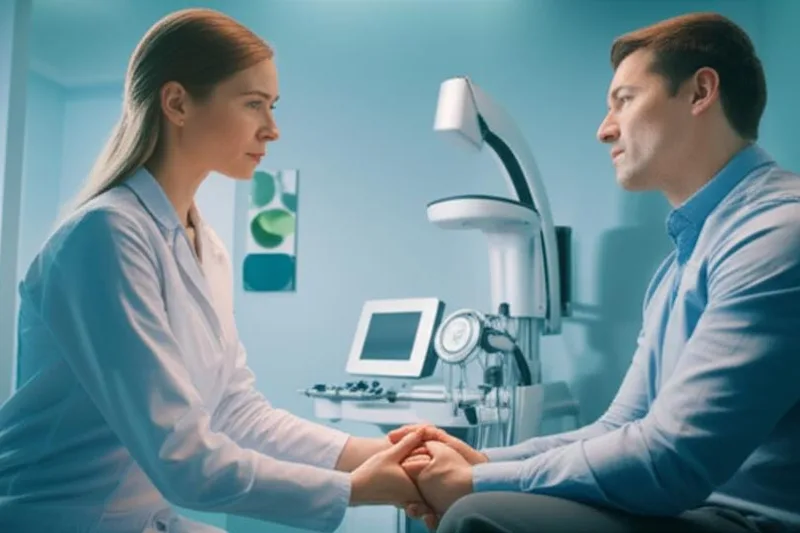
When a doctor tells you that you need to have an endoscopy, you might be a little scared and curious, right? You probably have a lot of questions in your head, like what is it, how is it done, and will it hurt? Don't worry, today we will talk about this endoscopy in a simple way. In a way that you can understand.
What is Endoscopy?
Simply put, an endoscopy is a procedure that allows you to look closely at the inside of your body. This involves using a long, thin tube-like instrument called an endoscope. This instrument often has a small camera and light attached to one end. The doctor inserts the instrument into your body and, when it reaches the area you want to examine, the images, which are then displayed on a monitor.
Think of it like putting a small camera inside your body to see what's inside. Some endoscopes have small channels, or tubes, through which you can insert small instruments to take a piece of tissue (called a biopsy) or even perform a minor operation.
What are the types of endoscopy?
There are many types of endoscopy. But they all work in the same way. That is, the doctor inserts an instrument called an endoscope through a natural opening in your body (for example, your mouth, nose, or anus) or through a small cut in your skin. This instrument allows the doctor to directly examine or treat the organ that needs to be examined.
The main differences are in things like:
- Name of the test: This name is often derived from the organ being examined. For example, an endoscopy to examine the large intestine (colon) is called a ``Colonoscopy''.
- Scope Type: It's the same. The name of the instrument is based on the organ being examined. So, the endoscope used for ``Colonoscopy'' is called a ``Colonoscope''. There are different types of ``Endoscopes''. Some are ``flexible'' , meaning they can be easily bent. Some are ``rigid'' , meaning they are straight. Some other endoscopes have channels inside them to take tissue samples, heal wounds, and perform other treatments, as mentioned earlier.
Also, things like the way the test is performed, the organ being examined, and where the instrument is inserted also differ.
So, let's see what these main types of endoscopy are?
Look, you've probably been called a doctor by one of these names.
- Anoscopy: This involves inserting an endoscope through your anus to look at your anus and rectum.
- Arthroscopy:A small incision is made over one of your joints and an endoscope is inserted through it to look for joint disorders, such as arthritis.
- Bronchoscopy: An endoscope is inserted through the mouth or nostril to look at the trachea and lungs.
- Colonoscopy: An endoscope is inserted through the anus and the entire large intestine (colon) is examined.
- Cystoscopy: An endoscope is passed through your urethra (the tube through which urine comes out) to look at your urethra and bladder.
- Enteroscopy: An endoscope is inserted either through the mouth (upper enteroscopy) or the rectum (lower enteroscopy) to view the small intestine.
- Esophagogastroduodenoscopy (EGD) or upper endoscopy: An endoscope is inserted through the mouth to look at the esophagus, stomach, and upper part of the small intestine.
- Hysteroscopy: An endoscope is inserted through the vagina to view the uterus.
- Laparoscopy: A small incision is made in the abdomen and an endoscope is inserted through it to view the organs of the abdomen and reproductive system.
- Laryngoscopy: An endoscope is inserted through the mouth or nostril to look at the larynx (voice box).
- Mediastinoscopy: A small incision is made above the breastbone to look at the area between the lungs, which contains the heart, esophagus, and trachea (the mediastinum).
- Neuroendoscopy: A small incision is made in the skull and the brain is examined.
- Proctoscopy (rigid sigmoidoscopy): An endoscope is inserted through the anus to examine the rectum and anal area.
- Sigmoidoscopy (flexible sigmoidoscopy): An endoscope is inserted through the anus to look at the lower part of the large intestine (the sigmoid colon) and the anal area.
- Thoracoscopy (also called pleuroscopy): A small incision is made in the chest to examine the lungs and the area around them, including the diaphragm, trachea, and chest wall.
- Ureteroscopy: An endoscope is inserted through the urethra to view the tubes (ureters) that carry urine from the kidneys to the bladder.
Wow! Look at how many types there are. But all of these are done to help you find the exact problem inside your body.
Advanced Endoscopy Methods
Nowadays, scientists are finding new ways to make this endoscopy easier and less damaging to the body. An example is capsule endoscopy . This does not involve putting a tube inside your body. Instead, you swallow a small capsule, like a vitamin pill. There is a camera inside the capsule. After you swallow it, it takes pictures as it passes through your esophagus, stomach, and small intestine. This helps find things like bleeding and tumors in your digestive system.
Why do we do an endoscopy?
Doctors use endoscopy for two main purposes. One is to screen for certain conditions and the other is to diagnose a disease .
You may have heard of colonoscopy. It is a very popular, early detection endoscopy. It checks for colon cancer.
One of the biggest benefits of endoscopy in diagnosing a disease is that, as mentioned earlier , it can take a piece of abnormal tissue and send it to the lab for testing (a biopsy) . This biopsy is the only way to tell for sure whether it is cancer or not.
In the past, endoscopy was mainly used to examine organs. But now, endoscopy is also used to treat various conditions, such as stopping bleeding from a stomach ulcer. In the past, if something like this happened, you would have to undergo major surgery.
What diseases can be diagnosed by endoscopy?
Endoscopy can diagnose diseases of the following systems:
- Digestive system: Gastrointestinal diseases, colon polyps, and colon cancer.
- Head and neck: Swallowing disorders and laryngitis.
- Joints: Arthritis, joint cracks and joint dislocations.
- Nervous system: Brain tumors.
- Respiratory system: Lung disease and infections.
- Urinary system: Urinary tract infections (UTIs) and kidney stones.
- Reproductive system: Abnormal uterine bleeding, endometriosis, and infertility problems.
Treatment through endoscopy
With some endoscopes, doctors can use special equipment to do things like:
- Wound healing.
- Medication.
- Liquid removal.
- Stopping bleeding inside the body.
- Removal of damaged tissue or tumors.
- Opening up confined spaces, widening narrowed limbs.
- Stents (small tubes placed to keep a blocked or damaged organ open).
- Surgery.
For example, in laparoscopy, doctors perform surgery through several very small incisions instead of one large one. This is sometimes called keyhole surgery . This is much less invasive than traditional surgery. This method is now the most widely used to treat many diseases.
How do you prepare for an endoscopy?
Your preparation will depend on the type of endoscopy you are having. You may be asked to do things like:
- Get the necessary tests done: Before a urinary tract test, you may be asked to do a urine test to check for a urinary tract infection (UTI). Before a hysteroscopy, you may be asked to do a pregnancy test.
- Give your medical history: You should tell your doctor about any other illnesses you have, medications you use, and vitamins.
- Fasting: You will be asked not to eat or drink anything for several hours before the endoscopy. Otherwise, you will be restricted in what you can eat or drink.
- Clean your bowel: Before having a colonoscopy or enteroscopy, it is called a bowel prep. This means removing all stool.
- Stop taking certain medications: Medications that thin the blood, such as warfarin (Coumadin® or Jantoven®) and aspirin, may need to be stopped a few days before the test. You may also need to change other medications you are taking for a few days. Be sure to follow your doctor's instructions exactly.
- Stop smoking: You may be asked to stop smoking and tobacco use before the test.
- Arrange for someone to drive you home: If you are given sedation or anesthesia during the test, you will not be able to drive if you go home the same day. Therefore, you will often need to arrange for someone to drive you home.
What happens during an endoscopy? Does it hurt?
An endoscopy usually takes between 30 minutes and 2 hours to perform. This varies depending on the type of test. Most people go home the same day as their endoscopy. However, some endoscopy procedures require an overnight stay in the hospital.
For most endoscopy procedures, doctors use moderate sedation . This means you will be asleep during the procedure and will not feel any pain.. In very rare cases, it is necessary to completely put people out of sleep (`(General anesthesia)`) (that is, to put a breathing tube `(Intubation)`). Some people can be given a medicine that numbs only a certain area (`(Local anesthesia)`) without putting people out of sleep, and a medicine that relaxes them (`(Sedative)`).
Once you feel very relaxed or asleep, the doctor will slowly insert the endoscope until it reaches the area they want to examine. Then, they will manipulate it and look at the organs and parts they want to examine on a monitor. If there are any abnormalities, they will record them and, if necessary, take a piece of tissue or perform treatment.
If an incision is made, it is closed.
Will it hurt? No. Because of the numbing medicine, you won't feel any pain during the test. In some tests, like a colonoscopy, you may feel a slight pinch when the tube is inserted. But that goes away quickly.
What happens after an endoscopy?
Your medical team will monitor your vital signs. You may feel a little drowsy from the sleep medication. But most people go home the same day. You'll need to be a little careful that day and avoid strenuous activity.
Depending on the type of endoscopy you had, ask your doctor what to expect during your recovery.
Are there any side effects?
Most side effects get better within the first couple of days . They depend on the type of test done and where the endoscope was inserted. For example, if the endoscope was inserted through the throat, you may experience hoarseness and a slight sore throat. If the endoscope was inserted through the intestines, you may experience a feeling of fullness, stomach cramps, and nausea.
Your doctor will tell you how to reduce these discomforts and give you painkillers if necessary.
How long does it take to know the results?
Your doctor will tell you when you can expect to know the results. They may talk to you about it the same day, or they may ask you to come back on a different day to discuss the results.
When should you see a doctor?
Endoscopy is a common procedure that is considered safe . However, in rare cases, complications such as internal injuries and infections can occur. If you experience any of the following , call your doctor immediately :
- Signs of infection: fever, chills, and shaking. If the incision site is red and swollen.
- If the stool is black and tarry .
- If there is severe pain or bleeding from the cut.
- If you have a persistent cough or cough up blood.
- If you have difficulty breathing .
- If you have chest pain .
Do you also dream about endoscopy?
It depends on the test being done. For tests that involve your digestive system (Gastrointestinal tract - GI tract), you may be asleep. For some other types, you may be awake, but you may be given medication to numb the pain.
Your doctor will explain to you whether or not you will be asleep during the test.
Even if you are given painkillers, having a tube inserted into your body may not seem like a pleasant experience. But think about the benefits. Sometimes, even a simple test like an ultrasound can clearly show a disease that would be missed. If that happens, you won't need to go back to the doctor and do more tests. Some biopsies can only be taken with an endoscopy. Endoscopy is now the best treatment for some diseases. It can speed up surgery and reduce recovery time.
The most important things you should know (Take-Home Message)
Most endoscopy procedures only take about 30 minutes . In most cases, you can go home the same day. The most important thing is to remember that by having this type of procedure, you are taking care of your health. There is no need to be afraid . If you have any questions or concerns, talk to your doctor. That will help you feel more at ease.
So, if you have to have an endoscopy, prepare well for it, follow the doctor's instructions, and everything will be fine!
👩🏽⚕️ Additional questions (FAQs)
💬 What is an endoscopy?
This is a test that allows the doctor to directly view the inside of the esophagus, stomach, and first part of the small intestine on a television screen (monitor) by passing a thin, flexible plastic tube with a camera and light through our mouth.
💬 Don't you suffocate when you put a camera in your mouth?
Absolutely not! The tube with the camera is passed through the same tube we swallow (the esophagus). You breathe through a separate tube (the windpipe). So you will not have any problems breathing normally throughout this test.
💬 Is this something you should do if you have gastritis?
If your gastritis is not getting better despite continued medication, this is the only and best test that can accurately determine whether you have bleeding ulcers or stomach cancer. Don't worry, you will be given some sedation for this.
` Endoscopy, Endoscopy, Diagnostics, Internal examination, Non-surgical treatment, Medical tests




💬 Comments (0)
No comments yet. Be the first to share your thoughts here.
Add Your Comment