
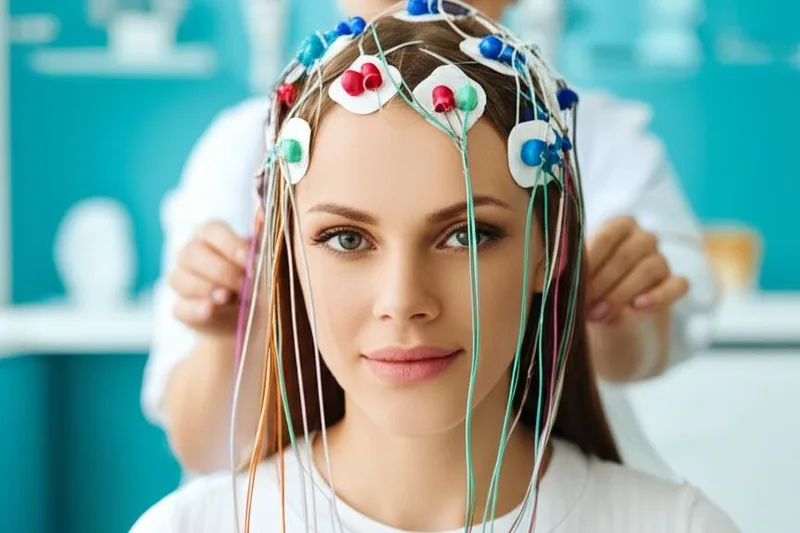
Sometimes when a doctor asks you to have an `(EEG)`, you can feel a little nervous and scared, right? 'What is this `(EEG)`? Why is this being done? Will it hurt?' Many questions probably come to mind. So today we will talk about this `(EEG)` test, that is, the Electroencephalogram `(Electroencephalogram)` test, in a simple way that you can understand. There is nothing to be afraid of, this is a painless and safe test in most cases.
What is this (EEG) test?
Simply put, an EEG is a test that measures the electrical activity in your brain. Just like an ECG is used to check the activity of your heart, it looks at how brain cells, called neurons, communicate with each other. This communication occurs through small electrical signals. So by looking at the patterns of these signals, doctors can find out if different parts of your brain are working properly or if there is a problem. Think of it like your brain is an incredibly complex computer, and an EEG is like looking at the messages in that computer.
Why is this (EEG) test done?
Now you may be wondering, 'Why am I being asked to do this?' Doctors often order an EEG test if you are having symptoms of seizures or if they suspect you have a condition like epilepsy. That is, if you suddenly lose consciousness, have convulsions, or have unexplained changes in behavior, an EEG can help determine if there is a change in brain activity.
Not only that, but this test can also help determine if certain symptoms are due to a thyroid condition. For example:
- Confusion. Do you suddenly feel like you are losing track of where you are, what time it is, or who is around you?
- Sudden loss of consciousness is what doctors call ``syncope''.
- Memory loss for no reason. Do you often forget small things?
- Unexplained changes in behavior. Do your friends notice that you are acting differently than usual?
Furthermore, people with certain medical conditions, such as Alzheimer's disease or dementia, those in a coma, brain infections such as encephalitis, those with traumatic brain injury, or those suspected of having brain tumors, can also have an EEG test to see if they have epilepsy and how their brain is functioning.
What types of EEG tests are there?
Okay, now let's see if there are different types of EEG tests. Yes, there are. Your symptoms and what your doctor is trying to find will determine which type of EEG you will do. Let's look at some of the main types:
- Routine EEG: This is often the first EEG done. It can take 20 to 30 minutes. You may be asked to open and close your eyes at various times, take deep breaths, or look at a flashing light. This test looks at how your brain activity changes as you do these things.
- Prolonged EEG: This is done if you want to get more information about something that a regular EEG can't find. For example, if you have symptoms like memory loss and want to know for sure if it's due to a seizure, you can do a prolonged EEG. This can take an hour or more .
- Ambulatory EEG: This is a very special test . You wear a small EEG machine and go about your normal activities. The machine records your brain activity for a day or several days. This gives the doctor a good idea of how your brain is functioning during your daily life. It's like someone following you around and watching your brain.
- Video EEG: This is done especially if you want to record how you are having a seizure, what you are doing, and what you are saying at the time. This is also called EEG monitoring, EEG telemetry, or video EEG monitoring. Since you are videotaped at the same time as the EEG, the doctor can compare the EEG waveform and your behavior.
- Sleep EEG: Sometimes, if you have trouble sleeping, you may want to consider a sleep study, called a polysomnogram, to see if it's due to a sleep disorder. This can provide information that a sleep study alone cannot. This is because some sleep disorders can only occur during sleep.
How does an EEG test work?
It's very simple. As I said before, an EEG measures the electrical signals that are exchanged between your brain cells. Do you know how it's done? They stick small metal plates on your scalp, that is, on your head. These are called electrodes. These electrodes are connected to an EEG machine with wires.
- These electrodes send information about the brain's electrical signals to the EEG machine.
- The EEG machine records these brain waves and displays them on a computer screen in the form of waveforms or traces. This shows the pattern of brain activity. Just like the rhythm of music, the brain also has different rhythms.
- These brain wave patterns change when you're awake, when you're sleeping, or when something happens that affects your brain cells.
- The graph you see on the computer screen is your EEG. The doctor then looks at it and checks for any unusual patterns.
How should I prepare for an EEG?
There is a little preparation before going for an EEG test. It can also vary depending on the type of EEG you are having. So the doctor or technician there will explain to you exactly what kind of test is being done, why it is being done, how long it will take, and whether you will need someone to take you home after the test.
But no matter what type of EEG you have, you should generally keep these things in mind:
- Tell your doctor about all the medications you take. Some medications can affect the results of an EEG. So don't hide anything.
- Wash your hair thoroughly the night before the test. However, do not use conditioner or styling products like gel. These can interfere with the electrodes' ability to detect brain activity. It is best to keep your hair clean and free of any hair products.
- Sometimes the doctor may tell you not to sleep well the night before the test. If you do, do it that way. The reason for this is that when you don't get enough sleep, some abnormal brain activity can appear. That means that sometimes if there is a problem, it will show up on the EEG when you have less sleep.
- You may also be advised not to consume caffeine-containing foods such as coffee, tea, and chocolate a few hours before the test, as this can affect brain function.
What happens during a general (EEG) test?
Imagine you just went in for a routine EEG. Here's what happens:
- You will be made to sit in a chair or lie down on a bed. You are told to make yourself comfortable. Don't worry, just relax.
- Then a technician will attach about 20 to 25 small electrodes to your scalp. These are attached with a special glue or paste. Don't worry, these electrodes won't hurt you, and they won't send any current. They're just there to record your brain activity.
- You will be told to relax with your eyes open or closed. Sometimes you will be told to be quiet.
- Sometimes you are asked to look at a bright light (photic stimulation). This can be used to see the activity of the part of the brain that controls vision.
- You can also ask them to breathe deeply (hyperventilation). That's called hyperventilation. When you ask them to breathe rapidly for a minute or two, they look at how their brain waves change as they do so.
A typical EEG test takes about 20 to 30 minutes. It can sometimes take up to an hour.
What happens after a general (EEG) test?
When the test is finished, the technician will carefully remove the electrodes from your head and clean the areas where they were attached. Unless your doctor tells you otherwise, you can go home and do your normal activities.
But the glue or paste on the electrodes can make your hair and skin feel a little sticky. So it's a good idea to wash your hair thoroughly again when you get home.
Are there any risks or side effects of having an EEG?
In fact, side effects from an EEG test are very rare. It is a very safe test.
However, some people may feel a little dizzy when they are asked to breathe deeply (hyperventilation) during the test. This is normal and will go away once breathing returns to normal.
Another thing is, if you have a certain type of epilepsy, that deep breathing (hyperventilation) or looking at lights, that is, photic stimulation, can very rarely cause a seizure. But don't worry, if that happens, the technician is trained to help, and the doctors are there. So don't worry too much about it.
Also, sometimes the skin may become a little red, itchy, or lose a little hair where the electrodes were applied. But that is also very temporary and will go away in a day or two.
When will I receive my test results?
The results of the EEG test are not available immediately. This is because the EEG recording needs to be carefully reviewed and analyzed by a specialist. You will be given a follow-up appointment with the doctor. During that appointment, the doctor will explain to you the brain wave patterns seen in the EEG test. The report usually comes back in a few days.
What do the EEG test results say?
Your doctor can best explain what your EEG results mean. He or she will look for abnormal brain wave patterns, brain dysfunction, or epileptic activity.
So, rather than getting your EEG report and worrying about what others say, it's best to talk to the doctor who ordered the test and explain it to you. The doctor will explain everything to you in simple terms.
What to do next if the EEG results are abnormal?
That depends on your condition. If your EEG results are abnormal, your doctor may refer you to a specialist, such as a neurologist . He or she can diagnose your condition, treat it, or help you manage it. They may also order further tests.
Finally, remember this.
An EEG, or electroencephalogram, is a safe, often painless test that measures brain activity. Doctors use this test to find the cause of symptoms like seizures, sudden confusion, or memory loss. Sometimes doctors use the term EEG for both the test and the results.
So, don't be afraid to get an EEG test. It can be an important step in finding the cause of your symptoms and getting you the treatment you need.
If you have any further questions or concerns, don't hesitate to ask your doctor. He or she can explain everything to you and dispel any fears you may have. Stay healthy!
` EEG, electroencephalogram, brain tests, mesmerism, fit, neurological diseases, brain waves





💬 Comments (0)
No comments yet. Be the first to share your thoughts here.
Add Your Comment