

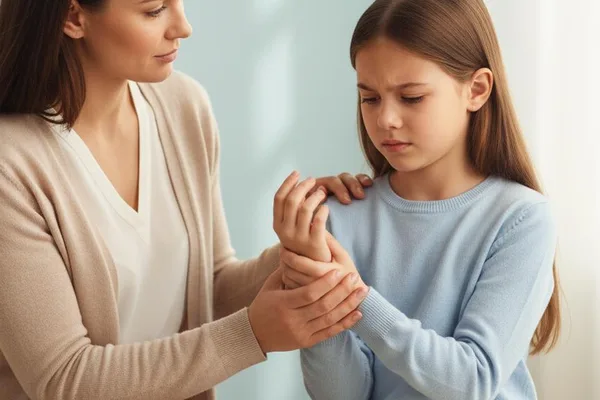
Does your child often complain about body pain? Perhaps it's a minor injury that seems to be getting worse and worse even after it's healed? Sometimes you might think, "This kid is lying, this can't be happening." But, this could actually be a medically recognized condition that affects children. We call it Amplified Musculoskeletal Pain Syndrome, or AMPS for short. In this article, we'll talk about it simply and in a friendly way.
Simply put, what is AMPS?
AMPS is a chronic condition that affects children. It causes severe pain. This pain can interfere with a child's ability to do daily activities, such as school and play. Some children may have this pain in one area of their body. For others, it may be localized and intermittent.
This condition often begins after a certain stressor has occurred. This can be an infection, illness, injury, or even mental stress. The surprising thing is that in many children, the initial injury or illness that caused the condition to begin has completely healed, but the pain only increases. This is because the part of our nervous system that detects and responds to danger in our body becomes overactive . Because of these overactive nerves, even normal pain to the child begins to feel magnified and amplified.
The good news is that many children can recover completely through physical therapy and counseling, which can help strengthen the child's body and nervous system. Therefore, it is important to recognize this condition early .
How does pain perception change in AMPS?
To understand this, let's first look at how we normally feel pain. Imagine that your arm is cut.
- A 'message' travels from the site of injury to the spinal cord through pain nerves.
- The spinal cord quickly sends that message to the brain.
- The brain recognizes it as "pain", and you feel the pain.
- When the wound heals, these messages stop being sent, and the pain goes away.
Very simple process, right?
But what happens in a child with AMPS is that this pain 'message' goes the wrong way. It's like a 'short circuit' .
- This pain message goes directly to our body's 'emergency warning system'. We call these the "fight-or-flight" nerves, or (autonomic nerves) . These are the ones that control things we don't control, like our heartbeat, breathing, and blood flow.
- Due to this incorrect message, the blood vessels in the area narrow (constrict).
- When blood vessels narrow, the amount of blood and oxygen reaching the nerves, muscles, and bones in that area decreases. Also, waste products like lactic acid accumulate there.
- All of this combined causes unbearable, extremely intense pain for the child.
- This severe pain can cause the child to become immobile rather than walking, running, or jumping. Over time, this can lead to muscle weakness, deconditioning, nutritional deficiencies, and other problems, such as dizziness when standing up suddenly.
What are the symptoms of AMPS?
The main symptom is pain . This pain can be constant or come and go. The child may have these symptoms suddenly, or they may develop gradually over weeks after an injury or illness.
Sometimes, the painful arm or leg can be so painful that it is impossible to use it. Also, even the slightest touch or rubbing of clothing in the area can cause a sharp, burning pain that is unbearable . This is called allodynia .
| Symptom category | Visible features |
|---|---|
| Pain and touch | Severe pain, joint pain, hypersensitivity to touch (allodynia), numbness. |
| Changes in appearance | Swelling (edema) of the painful area, skin discoloration (blue, purple), and skin temperature changes (cold or hot). |
| Problems with movement | Difficulty walking, inability to use the affected limb, stiffness, tremors. |
| Other common features | Fatigue, headache, dizziness, stomach pain, nausea, difficulty swallowing (dysphagia), and tachycardia. |
| Psychological effects | Conditions such as anxiety and depression. |
Is my child imagining this pain?
As a parent, it's only natural for you to have this problem, because from the outside, the child doesn't appear to have any injuries.
But this pain is 100% real. It is not something your child has imagined. Therefore, it is very important to definitely believe what your child is saying and take these symptoms seriously. You should see a doctor as soon as possible for a proper diagnosis and treatment.
Is there a specific cause for AMPS?
Doctors still don't know the exact cause of AMPS, but as we've discussed before, it's known that the condition occurs after some kind of physical or emotional stress. Sometimes, it can start without any obvious reason.
It is believed that factors such as the child's age, genetic influences, and hormonal changes may also play a role in this. This condition is especially common among girls and young children.
Doctor, how do you identify this as AMPS?
Diagnosing AMPS can be challenging because the symptoms can be so varied and can change over time. The doctor will first take a thorough medical history of the child and their family. They will also ask about recent illnesses, injuries, and stressful events at school or home.
The child will then be given a thorough physical examination to rule out other conditions, such as infections and fractures. There is no specific blood test to diagnose AMPS. However, the doctor may recommend tests such as these to rule out other causes:
- Bone scans: Check for decreased blood flow.
- MRI (Magnetic Resonance Imaging): Check for swelling or muscle atrophy.
- Nerve tests: Check the sensitivity and function of the nerves.
- X-ray: Check for bone thinning (osteoporosis).
How is AMPS treated?
AMPS treatment has two main goals. One is to manage pain. The other is to "train" the nervous system by redirecting misdirected pain signals back to the correct path.
The important thing to remember here is that painkillers alone cannot cure AMPS . Painkillers are only given to control the pain to a level where the child can participate in treatment. The real goal of treatment is to get the child back to normal, to be able to go to school, and to play with friends.
Treatment is a team effort. Your doctor and other specialists work together to help your child:
- Pediatric pain specialist
- Child psychologist or counselor
- Physical therapist
- Occupational therapist
The main treatments are:
1. Intense Physical Therapy: Even though the child may feel pain, this involves gradually engaging in exercises to strengthen the weakened muscles. Although the pain may be more intense at first, the body gradually gets used to it.
2. Occupational Therapy: Retraining the child to perform daily tasks on their own, such as brushing teeth and getting dressed.
3. Psychotherapy: The child is taught to live with the pain and manage the stress it causes.
4. Desensitization: Gently massaging the painful area, touching it with different objects (such as cotton, pieces of cloth). This re-teaches the brain that touch is not painful.
What to expect during treatment?
This can be a difficult journey. When treatment begins, the child's pain may increase at first. This is because the child begins to use the limbs and muscles that have not been used for so long. But as function begins to improve, the pain gradually decreases.
The most important thing is to follow the instructions given by the medical team without discouraging the child. Sympathizing with the child's pain and saying, "Oh, son, you're hurting, don't exercise," will only delay the child's recovery.
Most children are able to return to school and other activities after a treatment plan is developed. Children usually recover completely after intensive treatment. Very few children have a relapse.
Take-Home Message
- AMPS is not something that is imagined in a child's mind. It is real pain caused by a change in the functioning of the nervous system.
- There is no specific cause for this condition, and it is not the fault of the child or the parents.
- AMPS cannot be cured with painkillers alone. The main treatment is physical therapy and psychotherapy.
- It is normal for pain to increase during the initial stages of treatment. The goal should be to restore the child's function, rather than to eliminate pain.
- If your child has these symptoms, don't panic and seek advice from a qualified doctor as soon as possible. With proper treatment, most children make a full recovery.




💬 Comments (0)
No comments yet. Be the first to share your thoughts here.
Add Your Comment