

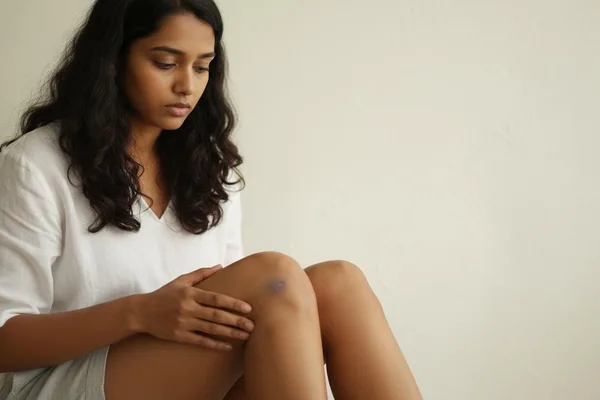
Have you ever hit your thigh hard while playing or falling somewhere? After a while, the area turned blue, swollen, and hurt so much that you couldn't even touch it? Many of us have experienced this. In medicine, this is what we call a thigh contusion. Although this is common, it can sometimes be a little serious. So let's talk about it all in simple terms today.
Simply put, what is a contusion?
The word 'contusion' simply means a bruise . It is an injury to the muscles and tissues in the upper part of your leg, namely the thigh. It usually happens when you receive a direct blow to the thigh. Imagine you are hit in the thigh by a ball while playing cricket, or you are hit by someone while playing rugby. This is when these bruises occur. Some of these injuries are very minor, but some can be quite serious. But the good news is that most of the time, these can be quickly treated with simple home treatments.
What really happens inside the body when you sprain your thigh?
When you sprain your thigh, what's really happening is that you're damaging the large muscles in the front of your thigh, called the quadriceps. These four muscles help you straighten your knee and bend your hip. So when you injure these muscles, the small blood vessels (blood vessels) inside them burst and some blood collects in the tissue. That's what causes the blue color we see on the outside. This type of blood collection is called a hematoma.
This bruise can sometimes cause other complications:
- Bone bruise: Sometimes, not only the muscle but also the underlying bone (the femur) can be bruised.
- Bone Fracture: If the blow is too hard, the bone may break.
- Muscle strain: Muscles can be severely damaged.
- Myositis Ossificans: This is a more serious, but very rare, condition in which bone tissue begins to form inside the injured muscle.
How do you know if this bruise is serious?
Most thigh bruises are minor. But if the blow is very hard, it can be a serious injury. If you have these symptoms, you should see a doctor right away , as it could be serious.
- If you have difficulty bending your knee more than 45 degrees and have severe pain.
- If it is difficult to put weight on the injured leg .
- If the injured area swells up very quickly .
If you have even the slightest doubt about the severity of the injury, the best thing to do is to see a doctor. That will also put your mind at ease.
What are the main types of thigh bruises?
Doctors divide these bruises into three main types based on their severity. You can easily understand this information by looking at a table.
| Type of bruise | Characteristics | Average time to recovery |
|---|---|---|
| Mild bruise | You can bend and extend your leg as usual. Your thigh may hurt a little. You may feel pain when you touch it with your hand. | Within 5-7 days |
| A moderate bruise | It is difficult and painful to bend the knee more than 90 degrees. The pain and swelling may last for several weeks. | From a few weeks to two months |
| Severe bruise | It is very difficult to bend the knee more than 45 degrees, there is severe pain. The thigh swells quickly. It may be difficult to walk without crutches. | A few months |
How does a doctor diagnose this? (How is it Diagnosed?)
When you go to a doctor, the first thing he or she does is carefully examine your wound.
- The priest will apply pressure to different areas of your thigh.
- They test how far you can bend your knee.
- It tests the strength of your quadriceps muscle.
Sometimes, tests can be done to look inside the wound.
- MRI scan: This can clearly see the muscles and other soft tissues.
- Ultrasound scan: This can also look inside the body.
- CT scan or X-ray: These tests may be done if there is a suspicion of a broken bone or a bruise.
How do you treat a thigh bruise?
Most of the time, these bruises heal with rest and simple treatments. Depending on the severity of the injury, your doctor may recommend these treatments.
RICE Method
This is the most important thing to do when you have a bruise. RICE stands for:
- R - Rest: Avoid any activities that increase the pain. Give your leg a rest. Stop running, jumping, and playing completely.
- I - Ice: Apply an ice pack to the injured area for 15-20 minutes several times a day. Do not apply the ice directly to the skin, but place a thin cloth over it. This will reduce swelling and pain.
- C - Compression: To reduce swelling , wrap the thigh in an elastic bandage. But don't wrap it so tightly that it stops bleeding.
- E - Elevation: Whenever possible, keep your legs elevated while sitting. This will help reduce swelling.
Painkillers
Your doctor may prescribe painkillers such as nonsteroidal anti-inflammatory drugs (NSAIDs) to reduce pain and swelling. However, do not continue to use these without medical advice.
Physical Therapy
Moderate to severe sprains sometimes require physical therapy. Here, you will be taught special exercises to strengthen your muscles and to help you bend and straighten your leg properly. You may also receive treatments such as massage or electrical stimulation (electrotherapy).
Surgery
This is very rarely necessary. If a condition like the previously mentioned ``Myositis Ossificans'' develops, surgery may be required to remove the extra bone that has formed.
How can I reduce the risk of this type of injury happening again?
- Train well: If you play sports, don't overload your muscles all at once. Train gradually.
- Warm-up and cool-down: Warm-up thoroughly before playing any sport. After playing, do stretching exercises and cool-down.
- Wear protective equipment: If you play sports like rugby or football, wear thigh pads.
Isn't it better to apply heat when you have a bruised thigh?
No. Never apply heat to a fresh injury. Heat can dilate blood vessels and increase swelling. This will delay healing. It is best to apply ice for the first two to three days.
Take-Home Message
- A thigh contusion is a common injury among athletes.
- The best thing to do when traveling with an injury is to follow the RICE (Rest, Ice, Compression, Elevation) method.
- If you have severe pain, can't put your leg down, and it's swelling rapidly, it could be a serious condition. See a doctor immediately.
- Do not return to sports until the injury is completely healed. Consult your doctor for advice.
- Do not apply heat to a newly injured area, apply ice instead.




💬 Comments (0)
No comments yet. Be the first to share your thoughts here.
Add Your Comment