
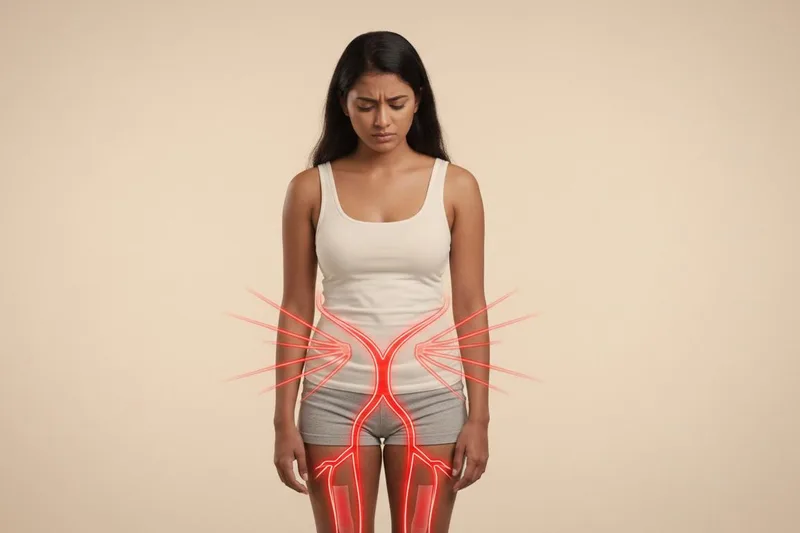
Do you also feel a sharp pain or a tingling sensation in your legs when you walk for a short distance? Does it subside after you stop and rest for a while, and then the pain reappears when you start walking again? This is a problem that many people have. The main cause of this can be a blockage in the main blood vessel that carries oxygen-rich blood to your legs. Today, we are talking about a very important, major surgery that is performed in such a situation.
What is Aortobifemoral Bypass?
Simply put, this is a surgery that surgeons perform on your abdomen (belly). Just like when a road is blocked, a new road is created, called a 'bypass' road, this surgery creates a new route to bypass the blocked or narrowed blood vessels (arteries) in your body. This allows blood to flow properly to your legs again.
In this procedure, the surgeon inserts an artificial blood vessel, called a graft, into your abdomen and connects it to the blocked blood vessel. This artificial blood vessel is usually made of a material like polyester. The word "aortobifemoral" itself suggests this.
- "Aorto" is the largest blood vessel in our body, the aorta . It starts from the heart and runs through the chest to the abdomen.
- "Femoral" refers to the arteries in your thighs . These start in the groin area and run down to the back of the knee.
- "Bi" means "two." That means this artificial blood vessel connects to both femoral arteries in both of your legs.
Imagine this graft, ``(Graft),'' like an upside-down "Y." The single upper part of it connects to the aorta in the stomach, and the two branches of the "Y" connect to the femoral arteries in the legs.
What kind of condition is this surgery performed for?
This surgery is mainly done to treat a condition called aortoiliac occlusive disease . This is when fat and other substances (like plaque) build up on the inner walls of the major blood vessels in your abdomen and pelvis over time. We call this `(Plaque)`. This build-up happens in the following ways:
- Abdominal aorta: This is the part of the aorta that goes down through the stomach.
- Iliac arteries: These are the arteries that branch off from the aorta at the navel (umbilicus) and go to the legs.
When blood vessels become narrowed or completely blocked by this buildup of fluid, your lower body, especially your legs, feet, and pelvic organs, are deprived of the oxygen-rich blood they need. This can lead to serious complications.
Although this surgery cannot completely cure the disease, it can restore good blood circulation to the legs, control symptoms, and greatly reduce the risk of serious complications.
| Complications due to decreased blood flow |
|---|
| Pain in the legs when walking (Intermittent claudication) |
| Severe pain in the legs even when at rest |
| Death of tissue in the leg (Gangrene) |
| Amputation |
Is this a serious surgery? Are there other options?
Yes, this is considered major surgery because it requires a large incision in the abdomen.
But there is a minimally-invasive alternative called aortoiliac stenting with bifurcation reconstruction (AISBR) . This involves placing a small mesh tube called a stent inside the blocked artery and inflating it to open the artery again. Some studies have shown that this method has fewer complications and a shorter hospital stay.
Your doctor will decide whether open surgery or stenting is right for you. Although stenting is usually reserved for people who cannot tolerate major surgery, with advances in technology, it is now often used instead of open surgery. However, sometimes, if stenting is not a good option for you, or if a previous stent has failed, open surgery may be necessary.
How do you prepare before surgery?
Your medical team will advise you on how to prepare for surgery. These are the things you should generally take care of.
- Quit smoking completely: Quitting smoking at least 3-4 weeks before surgery can help you achieve the best results. It is important to continue to quit smoking after surgery for the health of your heart and blood vessels.
- Talk to your doctor about medications: You should tell your doctor about any medications you are currently taking. He or she may ask you to stop taking some medications or change the dosage before surgery.
- Fasting: You will be advised to refrain from eating or drinking from midnight the day before surgery.
- Medical tests: You will be asked to undergo several tests before surgery.
- Ankle-brachial index
- Vascular ultrasound (an ultrasound scan of the arteries)
- Scans that check the health of the heart and coronary arteries.
What happens during the surgery?
The surgery can take between 2 and 6 hours. The following steps occur during this procedure.
1. You will be given general anesthesia to put you completely to sleep.
2. A large incision (laparotomy) is made along the length of your abdomen so that the surgeon can reach the aorta.
3. Two incisions are made in both groins to reach the femoral arteries.
4. The previously mentioned "Y" shaped artificial blood vessel `(Graft)` is inserted, the upper part of it is connected to the blocked area of the aorta from above, and the two lower parts are connected to the blocked areas of the two femoral arteries from below, and are sewn together.
5. Finally, the incisions in the abdomen and groin are closed with stitches or staples.
What happens after the surgery and when you go home?
You will have to stay in the hospital for between 4 and 7 days. During this time, the medical team will take good care of you. Also, it may take about 2 to 3 months to fully recover. However, after about 4 to 6 weeks, you will be able to gradually resume your normal activities.
Take care of these things when you get home.
- Take all painkillers and other medications prescribed by your doctor on time.
- Keep the incisions clean and care for them as directed by the doctor.
- Exercise as directed by your doctor. Gradually increasing the distance you walk helps with the healing process. But don't overdo it.
- Ask your doctor about the best time to resume activities such as driving, going to work, and lifting weights.
When to see a doctor immediately and go to the Emergency Treatment Unit (ETU)
It is very important to be vigilant if any problems arise during recovery.
| If you have these symptoms, call your doctor immediately. | |
|---|---|
| Fever | Nausea and vomiting |
| Pain, redness, or warmth around the incisions | Fluid leaking from cuts |
| Redness or swelling in the groin area or leg | Leg pain, numbness, or loss of feeling |
| Cold, pale, or blue skin on the legs or feet | Leg wounds that do not heal and get worse |
If symptoms of a heart attack or stroke appear, immediately call an emergency ambulance service or go to the nearest hospital Emergency Treatment Unit (ETU).
Symptoms of a heart attack:
- Chest pain or discomfort
- Difficulty breathing
- Nausea, stomach discomfort
- Heart palpitations
- Dizziness (vertigo) or fainting
Symptoms of a stroke:
- Numbness or weakness on one side of the body
- Difficulty speaking (Aphasia) or stuttering
- Loss of muscle control on one side of the face
- Sudden loss or blurring of vision or hearing
Take-Home Message
- Aortobifemoral Bypass is a major, but highly successful, surgery performed when the main artery that carries blood to the legs is severely blocked.
- This surgery involves creating a new path using a 'Y'-shaped artificial blood vessel to bypass the blocked blood vessel.
- Preparations such as quitting smoking before surgery can make the results more successful.
- It takes several months to fully recover after surgery, and it is very important to follow medical instructions during that time.
- If you notice any unusual symptoms during your recovery, such as fever, wound infection, or severe leg pain, notify your doctor immediately.


💬 Comments (0)
No comments yet. Be the first to share your thoughts here.
Add Your Comment