

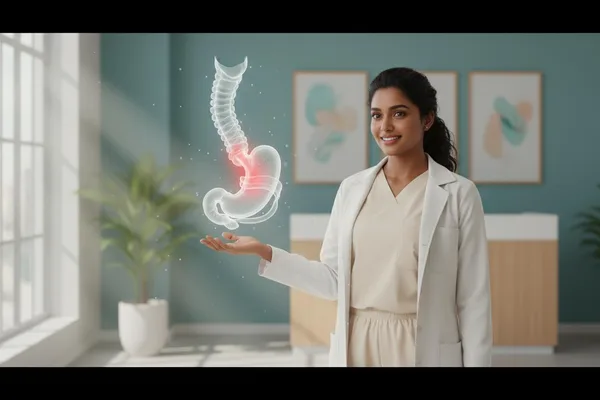
Do you also get frequent heartburn? Do you feel like something is stuck in your throat or chest? Do you feel like the food you eat is coming back up your throat? Many people call this "gastritis." This condition is medically known as Gastroesophageal Reflux Disease, or (GERD) for short. Are you unable to get rid of this problem despite taking medication and controlling your diet? Then this is something that could be very important to you. Let's look at a successful solution to this, surgery.
What is this Nissen Fundoplication surgery?
Simply put, this is a surgery performed to treat severe gastroesophageal reflux disease (GERD).
Think of it this way. When we eat, the food goes down the esophagus and into the stomach. Between the esophagus and the stomach is a valve called a sphincter that acts like a door. When we swallow, this valve opens and lets the food pass into the stomach. Then it closes tightly. It does this to stop the harsh acids in the stomach from coming back up into the esophagus.
But in someone with GERD, this valve doesn't work properly. It's loose. So the acid in the stomach easily comes up, that is, into the esophagus. That's why you get symptoms like heartburn and a sour taste in your throat.
Here's what happens in a Nissen Fundoplication. The surgeon takes the top part of the stomach (the fundus) and wraps it around the bottom part of the esophagus. It's like putting a band around something that's loose. This wrapping strengthens the loose valve again. Then the stomach acid stays in the stomach and doesn't come up.
Doctors usually recommend this surgery when other treatments, such as medication, fail to control GERD.
Are there different types of this surgery?
Yes, there are several main types of this surgery, depending on the amount of stomach tissue that is wrapped around the esophagus. Your surgeon will explain to you which method is best for your situation.
| Type of surgery | Simply explained |
|---|---|
| Nissen 360-degree wrap | This is the complete wrap method. The upper part of the stomach is wrapped completely (360 degrees) around the lower part of the esophagus. |
| Toupee 270-degree wrap | Here, the upper part of the stomach is wrapped around the back of the esophagus only (270 degrees). It is not wrapped around the entire circumference. |
| Anterior pain 180-degree wrap | In this method, a portion of the stomach is wrapped around the front of the esophagus by half (180 degrees) and connected to the diaphragm. |
What do I need to do before the surgery?
After deciding to have surgery, your doctor will order several tests. These are done to check if your esophagus is narrowed, how it is functioning, and whether you have a condition called a hiatal hernia . A hiatal hernia is a hernia in which part of the stomach pushes up through the diaphragm into the chest. This can make GERD symptoms worse. If you have this condition, the surgeon will repair it at the same time as the surgery.
These are the tests that are usually done:
- Upper Endoscopy: A tube with a camera attached is inserted through the mouth to examine the inside of the esophagus and stomach.
- Esophageal Manometry test: A test that measures how well the muscles in the esophagus contract, that is, how well they function.
- pH Monitoring Test: A test that measures how much acid is in your esophagus over a period of about 24 hours.
- Gastrointestinal (GI) X-rays: X-ray images are taken of the esophagus and stomach after you drink a special liquid (barium). The shape and function of the esophagus and stomach are examined.
Also, you will be instructed not to eat or drink anything after midnight the night before the surgery. It is very important to follow these instructions exactly.
How is the surgery done?
This surgery can be done in two main ways. You will be given general anesthesia, so you will not feel anything during the surgery, you will be asleep.
| Surgical method | How to do it |
|---|---|
| Open Surgery | A single incision is made in the abdomen. Through this, the surgeon wraps the upper part of the stomach around the esophagus. The incision is then closed with stitches or staples. |
| Laparoscopic Surgery | This is also called "keyhole surgery." Four to six small incisions are made in the abdomen. A laparoscope , a thin tube with a camera attached, is inserted through one of the incisions. The images from the camera are viewed on a monitor, and tiny surgical instruments are inserted through other incisions to perform the surgery. The incisions are then closed with stitches. This method is more common because it leaves less scarring, is less painful, and heals faster. |
This surgery usually takes about one to three hours to complete.
What are the benefits and risks of this surgery?
Benefits
The biggest advantage of this surgery is that it provides relief from severe GERD symptoms that other treatments have not been able to control. It also reduces the risk of developing Barrett's esophagus, a condition that can develop over time due to GERD. Barrett's esophagus is a precancerous condition that can lead to cancer of the esophagus.
Risks (Complications)
As with any surgery, there is a risk of infection. But the main risk is the possibility of symptoms returning after a while. According to some studies, about 10% of people who have this surgery may need to have another surgery.
What happens after the surgery? How long does it take to recover?
After the surgery, you will need to stay in the hospital for a day or several days.
- If you had open surgery, you may have a temporary nasogastric tube inserted through your nose to drain any fluid that collects in your stomach.
- You will be given saline (IV fluids) to keep your body from becoming dehydrated.
- Nutrition will be provided through saline until your intestines start working normally again (i.e., until you pass gas or stool).
Recovery Time
It is very important to rest for the first few days after surgery. After that, you can gradually resume your normal activities. However, if you are a heavy exerciser, your doctor will advise you to do only light exercise for a few weeks.
A child who has had this surgery can return to school in a few days, but should avoid running, jumping, or strenuous sports for at least three weeks.
Diet
You may have some sore throat in the first few days after surgery. Therefore, you will need to eat liquids and soft foods for the first 7-10 days .
- Start with liquids like protein shakes and smoothies.
- Then you can move on to bland foods like yogurt, scrambled eggs, pasta, and rice.
- It is very important to stay away from spicy, oily, and difficult-to-digest foods during this time.
If you have these symptoms, see a doctor immediately.
If you experience any of the following symptoms after going home after surgery, call your doctor immediately.
- If the cut is bleeding more than expected.
- If you see signs of infection :
- If there is excessive swelling around the incision.
- If you have a fever.
- If there is redness around the incision.
- If the skin around the incision feels warm to the touch.
- If you feel like your GERD symptoms that were present before surgery are coming back .
If you are someone who has taken medication, controlled your diet, and done everything but still suffers from this burning sensation in the chest and acid reflux problem, Nissen Fundoplication surgery may be a good solution for you. This can bring great relief to your life. To learn more about this, and to decide if this is right for you, be sure to talk to your doctor.
Take-Home Message
- Nissen Fundoplication is a surgery performed for severe GERD (acid reflux) that cannot be controlled with medication.
- This surgery involves strengthening the loose valve between the stomach and esophagus using a portion of the stomach itself.
- This surgery can be done either open or laparoscopically. The laparoscopic method is more common.
- You will need to get used to a liquid and soft diet for the first two weeks after surgery.
- The best way to know if this surgery is right for you is to discuss it with your doctor.




💬 Comments (0)
No comments yet. Be the first to share your thoughts here.
Add Your Comment