
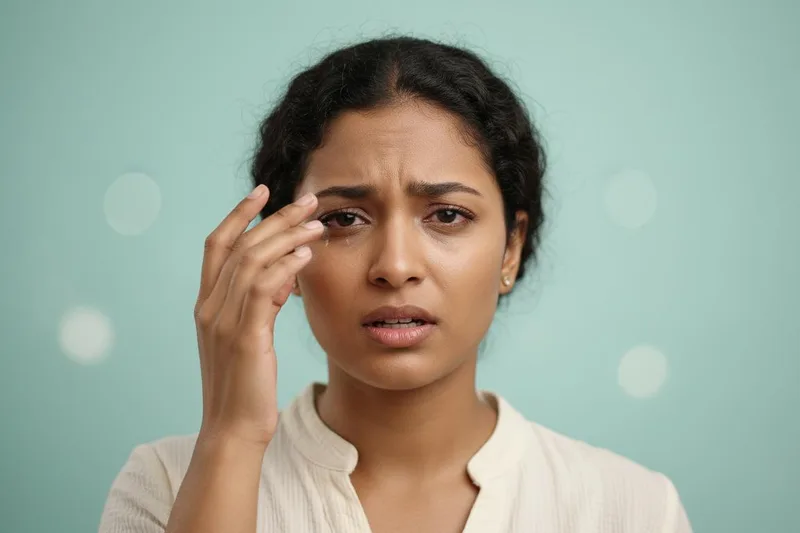
Have you ever felt that your eyes are very dry, like grains of sand? It happens when you stare at the computer all day or spend too much time in the AC, right? Sometimes when you ride a bike, even the wind and dust can make your eyes red and irritated. Artificial tears are something that many people use to help us in times like these. But before you just go to the pharmacy and buy an eye drop, it is very important for us to be a little aware of this.
Simply put, what are these artificial tears?
Artificial tears are special eye drops, gels, or ointments that are used to moisturize your dry eyes. Their main function is to lubricate the eyes by mimicking the action of our natural tears. You can usually buy these over-the-counter at a pharmacy.
Imagine, the surface of our eyes is covered with a thin layer of tear film. This is what keeps the eye moist, smooth, and protected. This tear film has three main parts:
- Lipid layer: This is on the outside. This part stops the tears from evaporating too quickly.
- Aqueous layer: This part in the middle contains the majority of tears. It cleans and moisturizes the eye.
- Mucus layer: The innermost layer that lines the eye. This helps to spread the tear film evenly over the surface of the eye.
So, dry eyes mean that the tear film is out of balance. Maybe there is not enough water, or the oil layer is weak and the tears evaporate too quickly. Artificial tears temporarily fill that gap and provide relief to the eye.
In what situations do we use Artificial Tears?
There are several reasons to use artificial tears. Some are related to our daily lives, and some are related to certain health conditions.
| Main objective | Description |
|---|---|
| Moisturize the eyes | It relieves dry eyes and provides freshness. |
| Reducing friction | It reduces the friction that occurs on the cornea when blinking, preventing damage to the eye. |
| Soothing inflammation and itching | It provides relief from uncomfortable burning, itching, and stinging in the eyes. |
| Reducing redness and swelling | Some types of artificial tears can also help reduce eye redness and minor swelling. |
Situations in everyday life that can cause dry eyes
- Environmental influences: If you spend a lot of time in a windy, smoky, dusty, or dry environment (e.g., in an AC room).
- Computer use: When we stare at a computer, tablet, or phone for long periods of time, we blink less often, which causes our eyes to dry out more quickly.
- Certain medications: Medications such as antihistamines and some antidepressants can cause dry eyes as a side effect.
- Aging: As we age, our body's tear production may naturally decrease.
But remember, if dry eyes are a persistent, long-term problem for you, you shouldn't just use eye drops from the pharmacy. It's best to see a doctor to find out the exact cause.
Are there different types of artificial tears? Which one is right for me?
Yes, artificial tears can be divided into two main types: those that contain preservatives and those that do not.
1. Types containing preservatives: The chemicals in these stop the growth of germs after the bottle is opened. Therefore, they can be kept for a longer period of time. However, the disadvantage is that some people's eyes can be sensitive to these preservatives. Frequent use can cause eye irritation and inflammation. Therefore, this type is not suitable if you use it more than 4-6 times a day.
2. Preservative-free types: These usually come in single-use vials. These are best for people with sensitive eyes and those who need to use eye drops several times a day because they do not contain chemicals that can be harmful to the eyes.
If you wear contact lenses, it is safest to use a preservative-free type, as some preservatives can damage contact lenses.
So it's wise to ask your doctor which brand and type is right for you. He or she will examine your eyes and recommend the best one for your needs.
How do you use these correctly and cleanly?
Putting in eye drops may seem like a simple thing, but if you don't do it right, you can end up getting germs in your eye. So follow these steps.
1. Hand washing: First, before doing anything, wash your hands thoroughly with soap and dry them with a clean cloth. This is very important.
2. Preparation: Tilt your head back slightly and look up. With the index finger of one hand, gently pull your lower eyelid down. This will create a small 'pocket' between the eyelid and the eye.
3. Applying the medication: Take the eye drop bottle with the other hand, place it inside the 'pocket' you have created, hold it over your eye, and apply the amount of drops as directed by the doctor, or as directed on the packet.
4. Most important: Do not let the tip of the bottle touch your eye, eyelid, hand, or anywhere else. Doing so will cause the bottle to become contaminated, and the next time you apply the medicine, the contamination could get into your eye.
5. Keeping the eye closed: After applying the medicine, close your eye for about a minute. Place one of your fingers on the corner of your eye near your nose and gently press it. This will help the medicine stay inside your eye without running down your throat.
6. Don't rub: Don't rub or rub your eyes after applying the medication. This can increase irritation.
7. Gels and Ointments: If you use gels or ointments that are a bit thick, your vision may become blurry for a while. This is normal. Therefore, it is best to use these at night before going to bed.
Are there any risks or side effects to using these?
Artificial tears are generally very safe, but sometimes minor side effects can occur.
- Blurred vision: This can happen, especially after applying thick gels or ointments. If this happens, do not drive or operate machinery until your vision is completely clear.
- Eye irritation: Sometimes, eye irritation, itching, and redness may increase slightly after applying the medication. This often happens when using products that contain preservatives.
- Allergies: Although this is a rare occurrence, it is something to watch out for. Not only the eyes, but also things like itching, swelling, difficulty breathing, and dizziness can occur.
If you experience symptoms of anaphylaxis (especially difficulty breathing), go to the nearest hospital emergency room (ETU) immediately. This is an emergency that should not be delayed.
When should I see a doctor?
Artificial tears are used for temporary relief. If you experience these symptoms, see a doctor without delay.
- If you use these everyday without the advice of a doctor.
- If your eye discomfort (itching, burning) does not improve even after using artificial tears.
- If you have pain in your eyes, signs of an infection (yellow or green discharge), or a change in vision.
- If you experience any side effects or allergies after using these.
- If you suddenly lose your vision or show signs of a severe allergy, go to an ETU immediately.
Take-Home Message
- Artificial tears are a liquid that mimics our natural tears and provides temporary relief from dry eyes, inflammation, and minor discomfort.
- There are two types, those with preservatives and those without (preservative-free). The preservative-free type is best if you use it frequently or have sensitive eyes.
- Wash your hands thoroughly before and after putting an eye drop in your eye. Do not let the tip of the bottle touch your eye or anywhere else.
- If dry eyes are a persistent problem for you, don't just buy a pill from the pharmacy, but definitely see a doctor to find the root cause. It could also be a symptom of another condition.
- If you show signs of a severe allergy (difficulty breathing, facial swelling), go to a hospital immediately.





💬 Comments (0)
No comments yet. Be the first to share your thoughts here.
Add Your Comment