

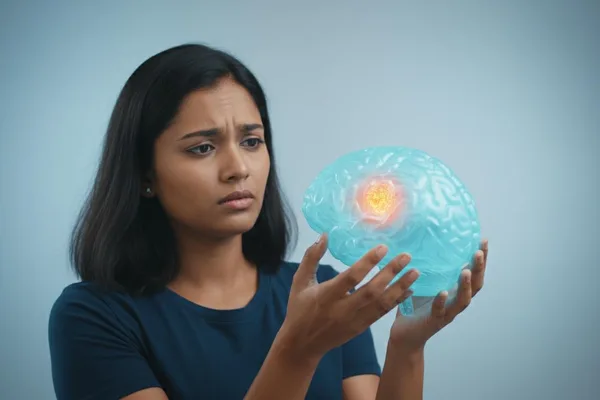
Have you ever heard someone say that they have a 'brain lesion' or a 'brain lesion'? Perhaps you have heard a doctor say that while looking at a report from a friend. So you may have a question about what a 'brain lesion' is. Simply put, this is a place where the brain tissue has been damaged in some way. This damage can be due to an accident to the head, or due to some disease or condition. For example, a stroke is a condition that damages the brain, that is, causes a brain lesion.
What happens with this brain damage?
Imagine that our brain is like the main communication center in the country. Everything in the body is controlled, all information goes back and forth through this center. This communication takes place through electrical and chemical signals. Now imagine, what happens if a wire breaks in one place in this center, or if there is some kind of obstruction? The same thing happens when a part of the brain is damaged. Communication in that damaged area is impaired. As the damage becomes more extensive, this obstruction also increases. This is why each and every symptom, for example, loss of body sensation, changes in eyesight, and slurred speech, occurs.
The important thing is that different parts of the brain control different functions. Therefore, the symptoms vary depending on where the damage occurs. A doctor will listen to your symptoms and guess where in the brain the problem is.
Different parts of the brain and symptoms of damage
Let's look at the symptoms that occur when the main parts of the brain are damaged. This is a bit complicated, but I will explain it in a table like this to make it easier to understand.
| Brain Area | Functions Controlled | Symptoms if Damaged |
|---|---|---|
| Cerebrum - Frontal Lobe (front of the head) | Planning, attention, learning, personality, movement control, speaking (word formation) | - Learning difficulties - Attention problems - Irritability, changes in behavior - Stuttering, difficulty speaking (Broca's Aphasia) - Loss of consciousness on one side or part of the body - Loss of smell (Anosmia) |
| Cerebrum - Temporal Lobe (On both sides of the head) | Listening comprehension, memory, language comprehension | - Difficulty understanding what is said (Wernicke's Aphasia) - Problems accurately identifying what is heard |
| Cerebrum - Parietal Lobe (Top of the head) | Sensations such as touch, pain, temperature, mathematical ability, writing | - Numbness in the limbs (but this is often a nerve problem) - Inability to write (Agraphia) - Inability to calculate (Acalculia) - Inability to recognize one's own fingers - Left-right switching |
| Cerebrum - Occipital Lobe (Back of the head) | Vision, recognizing what is seen | - Vision loss due to a problem in the brain, even though the eyes are good (Cortical blindness) - Inability to recognize colors (Achromatopsia) - Inability to recognize faces (Prosopagnosia) - Difficulty recognizing what you see |
| Cerebellum (Back of the skull, lower part) | Body balance, fine control of movements, eye movement | - Difficulty controlling muscle movements when speaking (Dysarthria) - Dizziness - Paralysis - Tremors - Seeing two things at once (Diplopia) |
| Brainstem (The part that connects the brain to the spinal cord) | Breathing, heart rate, blood pressure, maintaining consciousness | - Breathing and heart rate problems - Changes in blood pressure - Difficulty keeping your eyes focused - Loss of consciousness or coma |
What causes this kind of brain damage?
There are many reasons why brain damage can occur. Let's break them down into two parts.
Due to medical conditions
- Stroke or Transient Ischemic Attacks (TIAs).
- Brain tumors can be cancerous or benign.
- Immune system diseases like Multiple Sclerosis (MS) .
- Age-related diseases, such as Alzheimer's disease and Parkinson's disease .
- Epilepsy and seizures.
- Infections of the brain caused by microorganisms such as bacteria, viruses, and fungi.
- Some congenital conditions.
Due to external causes and accidents
- Head injuries, especially concussions and serious traumatic brain injuries.
- As a side effect of some surgeries, radiation therapy, or chemotherapy.
- Ingestion of toxins such as heavy metals.
How does a doctor diagnose this condition?
Usually, after a doctor has listened to your symptoms, they will perform a neurological exam. This will test your arm and leg strength, reflexes, and sensation (whether you can feel anything).
Only after this examination will they be referred for scans to see exactly if there is brain damage.
- CT (Computed Tomography) Scan
- MRI (Magnetic Resonance Imaging) scan
- PET (Positron Emission Tomography) scan
These are the most commonly used types of scans. Your doctor will explain to you in detail which tests you need to have and why.
How is it treated?
There are many causes of brain damage, and the treatments vary. Treatment depends on the cause of the damage.
- Sometimes, something like a mild concussion will heal on its own with plenty of rest.
- If it is due to an infection, it can be treated with antibiotics.
- If it's a brain tumor, it may be possible to remove it with surgery, depending on its location.
- Some lesions are so small that they don't even cause symptoms, and therefore don't require treatment.
However, sometimes if the damage to the brain is severe or caused by an incurable disease like Alzheimer's, it's difficult to reverse the damage. So, it's important to talk to your doctor about the best treatment option for you.
Can situations like this be prevented?
We can prevent brain damage from some causes, especially accidents and things related to our lifestyle.
- Eat a well-balanced diet. Stroke is a leading cause of brain damage. A good diet can help reduce that risk by keeping your blood vessels healthy.
- Stay active and maintain a healthy weight. Exercise and weight control can help prevent conditions like high blood pressure.
- Wear safety gear. Wearing a helmet is mandatory when riding a bicycle or motorbike. Wearing a seat belt when riding in a vehicle can be a life-saving measure. These protect you from head injuries.
- Manage your chronic conditions well. For example, if someone with epilepsy takes their medication exactly as prescribed by their doctor and controls their seizures, they can minimize brain damage.
When should you see a doctor immediately?
Brain damage is a life-threatening emergency. A stroke is an emergency that requires immediate attention. If someone close to you shows signs of a stroke (e.g., mouth drooping to one side, numbness in one arm, slurred speech), take them to a hospital's Emergency Department (ETU) immediately.
In addition, seek medical advice immediately if you have the following symptoms:
- A sudden, unbearable, and increasingly severe headache.
- Unexplained vision changes (double vision, blurring, seeing lights before the eyes).
- A seizure that lasts more than 5 minutes or multiple seizures in a row.
- Loss of consciousness, nausea, or headache after a blow to the head or body.
- A sudden change in a person's behavior or state of mind.
Take-Home Message
- A brain lesion is a site of damage to brain tissue.
- Symptoms depend on where the brain damage occurred.
- There can be many causes, including accidents, strokes, infections, and diseases like Alzheimer's.
- Tests such as MRI and CT scans are used to diagnose this.
- Treatment depends on the cause of the damage. Some are curable, while others are incurable.
- If you experience symptoms such as sudden severe headache, vision changes, loss of consciousness, or seizures, see your doctor immediately.




💬 Comments (0)
No comments yet. Be the first to share your thoughts here.
Add Your Comment