
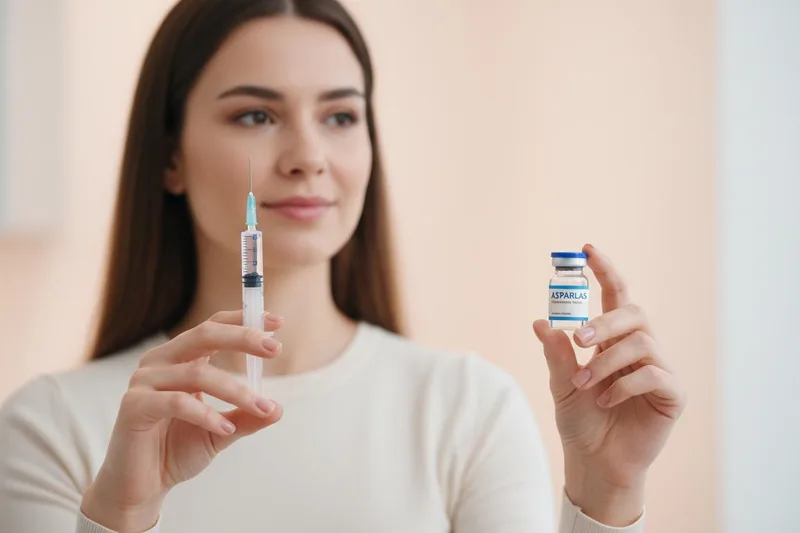
When your doctor tells you or a loved one that you have leukemia , it's normal to be curious, and maybe even a little scared, about the treatment. Today we're going to talk about a special medication that can be given to you at such a time. Its name is Calaspargase Pegol. You may know it by the brand name ASPARLAS. Let's take a look at what this medication is, what it does, and what you need to know about it when taking this treatment.
What kind of medicine is this? (What is this medication?)
Simply put, Calaspargase Pegol is a medicine used to treat cancer conditions like leukemia . It is given to the body as an injection. Its main function is to slow down or stop the growth of cancer cells.
Imagine, unlike normal cells in our body, some cancer cells (especially leukemia cells) require a special nutrient (an amino acid) from outside that they cannot produce themselves to survive. The name of this amino acid is asparagine. The Calaspargase Pegol injection breaks down this nutrient called asparagine in our blood and prevents cancer cells from getting it. It's like blocking the food pipe that goes to cancer cells. When the food is gone, the cancer cells cannot grow and eventually they are destroyed. This is how this medicine fights cancer.
This medicine can also be used for other medical purposes. You can ask your doctor any questions you have about it.
Things you need to tell your doctor before starting this medication
It is very important to inform your doctor about your complete health history before starting this treatment. This medicine may interact with some of your medical conditions. Therefore, if you have any of the following, do not hide it and tell your doctor.
| Situation you need to report | Why is that important? |
|---|---|
| Bleeding disorders | This medicine may slightly increase the risk of bleeding, so your medical team should be especially careful if you already have such a condition. |
| Diabetes or blood sugar problems | This medication can increase blood sugar levels, so if you have diabetes, you need to take special steps to control it. |
| A history of blood clots | It is important to let your doctor know about the medication, as it can increase the risk of blood clots. |
| A history of pancreatitis | Because this medication has a small risk of causing pancreatitis, it is essential to tell your doctor if you have had such a condition before. |
| Liver disease | The liver is the body's metabolizer. If you have liver disease, your medication dosage may need to be adjusted or you may need special monitoring. |
| Any type of allergy (Allergies) | Be sure to tell your doctor if you have any allergies to Calaspargase pegol, other medications, foods, dyes, or preservatives. |
| If you are pregnant or trying to get pregnant | This is very important. This medication can harm the baby during pregnancy. We will talk about that in more detail. |
| If the baby is breastfed | The medicine can pass to the baby through breast milk. Therefore, breastfeeding is not recommended during and after treatment. |
How will the medicine be given to you?
This is not a medicine you can take home. It is given as an intravenous injection . This means that your medical team (doctors and nurses) will give you this treatment in a hospital or clinic. They will monitor you closely.
The most important thing is to keep your treatment appointments. If for any reason you are unable to attend your scheduled appointment, please call your medical team immediately and let them know.
Can this medicine be given to small children?
Yes, this medicine can be prescribed to children as young as one month old for certain selected medical conditions. However, special precautions must be followed at that time. Your child's doctor will explain this to you in detail.
What to do if you overdose?
Since this is given in a hospital, the chances of this happening are very low. However, if you suspect that you have taken too much of the medicine, report it to the hospital's Emergency Treatment Unit (ETU) immediately. Alternatively, you can call the National Poisons Information Centre at the Colombo National Hospital for advice.
Other things that may interact with this medicine (Interactions)
Some things you take can affect how this medicine works. In particular, medicines containing the hormones estrogen and progestin can interact with this medicine. These hormones are commonly found in birth control pills.
However, this list is not complete. Therefore, give your doctor a complete list of all the medications you are taking (prescribed by your doctor for other conditions, over-the-counter medications, pain relievers), vitamins, herbal products (such as decoctions, arishta), and supplements . You should also tell your doctor if you smoke, drink alcohol, or use other drugs.
Things to consider during treatment
Your medical team will monitor you very closely while you are taking this medicine.
- Regular medical monitoring: You will need to have regular blood tests to check your body's condition and how the medicine is working.
- Blood sugar levels: As we mentioned earlier, this medication can increase blood sugar levels. This risk is even higher in people who already have diabetes. Talk to your doctor about ways to reduce this risk and whether you need to change your diet or medications if you have diabetes.
- Allergic Reactions: Sometimes, severe allergic reactions can occur when the medicine is given intravenously. This is called ``Infusion reactions''. To reduce this risk, your medical team will give you other medicines (such as piritan) before giving you Calaspargase Pegol. So follow their instructions exactly.
What you need to know specifically about pregnancy and breastfeeding
This is a very important part.
You should avoid becoming pregnant during treatment and for 3 months after the last dose. This medicine can cause serious birth defects in an unborn baby.
- Before starting treatment, you need to take a pregnancy test to make sure you are not pregnant.
- As we mentioned earlier, hormonal birth control pills may not work well with this medication. Therefore, talk to your doctor about another effective birth control method that is right for you.
- Avoid breastfeeding during treatment and for 3 months after the last dose.
Side effects that may occur due to medication
Like any medicine, this can cause side effects. However, not everyone gets them. The most important thing is to be aware of any unusual symptoms and seek medical advice immediately if necessary.
| Side effect | Symptoms you may see |
|---|---|
| Serious side effects that should be reported to your medical team immediately | |
| Severe allergic reactions or Angioedema | Skin rash, itching, swelling of the face, eyes, lips, tongue, hands or feet, difficulty swallowing or breathing. |
| Abnormal bleeding | Black tarry stools, brown or blood-stained vomit, red or dark brown urine, small red or purple spots on the skin, and excessive bleeding from even a minor injury. |
| Blood clot | Leg pain, swelling or a feeling of warmth, difficulty breathing, chest pain. |
| Infusion reactions | Chest pain, difficulty breathing, fainting, feeling dizzy. |
| Liver injury | Pain in the upper right side of the stomach, loss of appetite, nausea, light-colored stools, dark yellow or brown urine, yellowing of the skin or eyes, unusual tiredness. |
| Pancreatitis | Severe pain in the upper abdomen (this pain may also spread to the back), pain that increases when eating or touching the abdomen, fever, nausea, vomiting. |
| Side effects that are usually not dangerous, but should be reported to the doctor if they persist | |
| Diarrhea | If your stomach bloating persists or is severe, tell your doctor. |
This list does not include all possible side effects. If you experience anything unusual that is not on this list, don't be afraid to talk to your doctor about it.
Where is the medicine stored?
This is very simple. Since you are not allowed to take this medicine home, you do not have to worry about storing it. It is stored and maintained by the medical team in the hospital or clinic under appropriate conditions.
Take-Home Message
- Calaspargase Pegol (Asparlas) is a powerful, specialized drug that fights leukemia and cancer.
- Before starting treatment, it is essential to tell your doctor about your complete health history and all other medications, vitamins, and herbal products you are taking.
- Be aware of possible serious side effects (especially allergic reactions, bleeding, blood clots, severe stomach pain) during treatment. If you notice any symptoms, inform the medical team immediately.
- Avoid taking this medicine during pregnancy. Use effective birth control during treatment and for 3 months after treatment. Also avoid breastfeeding during this time.
- The doctors and nursing staff who are treating you are there to help you. Never hesitate to talk to them about any questions, fears, or concerns you may have.




💬 Comments (0)
No comments yet. Be the first to share your thoughts here.
Add Your Comment