

Have you ever seen a doctor or nurse, after an accident or when a critically ill patient is brought to the hospital, hold a finger or toe on the person's hand or foot for a while and then release it? They wait for the finger to change color again. You may have thought, "What is this doing?" That simple test is called the Capillary Replenishment Time (CRT) . It may seem like a simple test, but it is a very important test that gives doctors a lot of valuable information that can save a person's life.
Simply put, what is Capillary Refill Time (CRT)?
Before we understand this, let's understand a little bit. We have blood vessels that carry blood throughout our bodies. The smallest of these blood vessels, like the threads of a spider's web, are called capillaries . These are the ones that carry oxygen and nutrients to every cell in our body, to every tiny part of it. It's like the little side roads that branch off from the main road and lead to every house.
Now imagine that you press your fingernail for a while. Then that spot turns pale, doesn't it? Do you know why? When you press, some blood is temporarily drained from those tiny capillaries. As soon as you take your hand away, those capillaries fill with blood again and return to their old pink color in a few seconds.
That's what Capillary Refill Time (CRT) is for. It's the time it takes for a patch of skin that has been pinched and palpated to fill with blood again and return to its normal color. By measuring this time, a doctor can quickly assess whether blood is flowing well to distant parts of the body, such as the hands and feet, or whether peripheral perfusion is good.
Why is this test so important? Let's learn about the dangerous condition called 'Shock'!
There is a main reason why CRT testing is so important in emergencies. That is, it helps to detect shock, a potentially life-threatening condition.
What is this shock ?
Simply put, this is a condition where the organs in our body (such as the brain, heart, and kidneys) do not receive enough oxygen-rich blood. Just like when the power goes out in a house, the lights, fans, and refrigerators all stop working, when the blood supply to our organs suddenly decreases, they cannot function properly. This is very dangerous and can be life-threatening if not treated quickly.
There can be many reasons for a state of shock. In an emergency, there may be no time to do lab tests or scans. That's when a quick test like a CRT comes to the aid of doctors.
| Situations that can lead to shock | |
|---|---|
| Reason | A simple explanation |
| Severe bleeding (Hemorrhage) | A lot of blood coming out of the body, as if from a major accident. |
| Severe dehydration | Dangerously low levels of water and salt in the body due to diarrhea, vomiting, or excessive sweating. |
| Severe allergy (Anaphylaxis) | A very severe allergic reaction caused by a food, medicine, or insect sting. |
| Severe burns | Large amounts of fluid are removed from the body due to skin burns. |
| High body temperature (Hyperthermia) | A dangerous rise in body temperature due to factors such as excessive sun exposure. |
| Hypothermia (low body temperature) | Body temperature drops dangerously due to exposure to extreme cold. |
How is the CRT test performed?
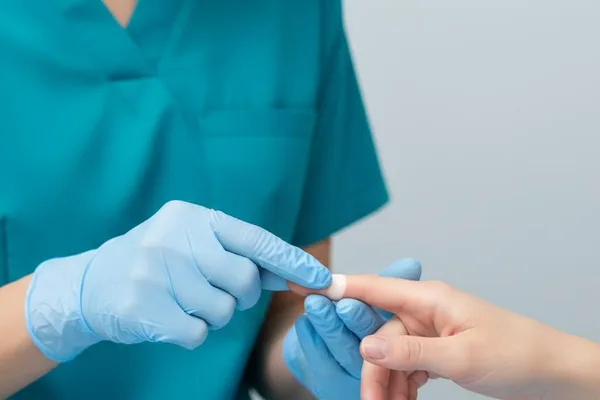
This is a very simple and painless procedure. Usually, a doctor or nurse will follow these steps:
1. Elevating the arm or leg: First, place one of the patient's arms or legs slightly above the heart.
2. Finger pressing: Then, press firmly on the top of a finger or toenail for about 5-10 seconds. The area will then turn pale.
3. Time measurement: Next, the finger that was pressed is suddenly released, and the time it takes for the pale area to fill with blood again and return to the same color as the surrounding skin is measured in seconds. A watch is usually used for this.
The important thing is that the number of seconds obtained from this simple test tells a big story about the condition of the patient's circulatory system.
Do you always look at this with your finger?
Most of the time, yes. But there are some special cases where it is impossible to see this with a finger. Imagine that a person is brought to the hospital with a cold body, his limbs and even his hands and feet turning blue due to extreme cold. Since such a person's body temperature is very low (Hypothermia), blood circulation in the limbs may have decreased naturally. In such a case, looking at the CRT with a finger may give the wrong idea.
In such cases, doctors perform this test by tightening the skin around the sternum, the bone in the middle of the chest, because that central part of the body has a better blood supply than the limbs.
What do the results say? Normal and abnormal conditions
The results of this test come back in seconds. The results for a normal healthy person may vary slightly with age.
- Newborns: 2 seconds or less.
- Adults (children and young people): About 2-3 seconds.
- Older adults: May take a little more than 3 seconds.
What if my CRT value is within the normal range?
Imagine that someone is critically ill, but their CRT is normal, meaning about 2 seconds. Does that mean they don't have any disease? No. It means that the doctor understands that there is currently no major problem with the patient's circulatory system, so the cause of the disease may lie elsewhere. Then they start looking for other causes.
What if the CRT value is abnormal? (If the time is too long)
This is where you need to pay attention. If a person's CRT is higher than the normal range (e.g. 4, 5, or more seconds) , it's a red flag to the doctor . It means that the blood flow to the body's peripheral parts is severely impaired, meaning that shock is occurring or has occurred.
At times like this, doctors will quickly run other tests to further confirm the cause and assess the severity of the condition.
- Pulse Oximetry: A device that measures the oxygen level in the blood by attaching a clip-like device to the finger.
- Regularly measure blood pressure and pulse rate.
- Checking the patient's level of consciousness.
- Measuring urine output: This is important to know if blood is flowing properly to the kidneys.
It is by combining the information from all of this that doctors can form a complete picture of the patient's condition.
How is it treated?
If the CRT value is abnormal and shock is confirmed, the patient needs to be treated immediately . This treatment depends on the cause of the shock and the severity of the patient's condition. These are some of the treatments that are usually given in an emergency treatment unit (ETU).
- IV Fluids (Saline): Fluids and salts are administered intravenously (through a cannula) to try to restore blood pressure.
- Supplemental Oxygen: Oxygen is given through a nasal cannula or a face mask to increase the low oxygen levels in the blood.
- Blood Transfusion: If a lot of blood has been lost, such as in an accident, blood is given externally.
- Breathing tube (Intubation): If the patient has difficulty breathing on their own, a breathing tube is inserted and connected to a ventilator .
- Medications: Depending on the cause, medications such as antibiotics are given if it is an infection, and steroids are given if it is an allergy.
The goal of all these treatments is to restore blood supply to the body's organs as quickly as possible, prevent further damage, and save lives.
Take-Home Message
- Capillary Refill Time (CRT) is a simple medical test that can be performed in a few seconds, is painless, but provides very valuable information.
- This mainly checks whether blood circulation is good to distant parts of the body, such as the limbs.
- A CRT value that is higher than normal (prolonged) may be a sign of a dangerous condition such as shock . This is an important warning to doctors.
- This test is just one small piece of a larger puzzle. The doctor takes many other things into account (blood pressure, pulse, symptoms) to make a complete decision about a patient.
- The next time you see a doctor performing this test, now you know how important that simple procedure can be.




💬 Comments (0)
No comments yet. Be the first to share your thoughts here.
Add Your Comment