
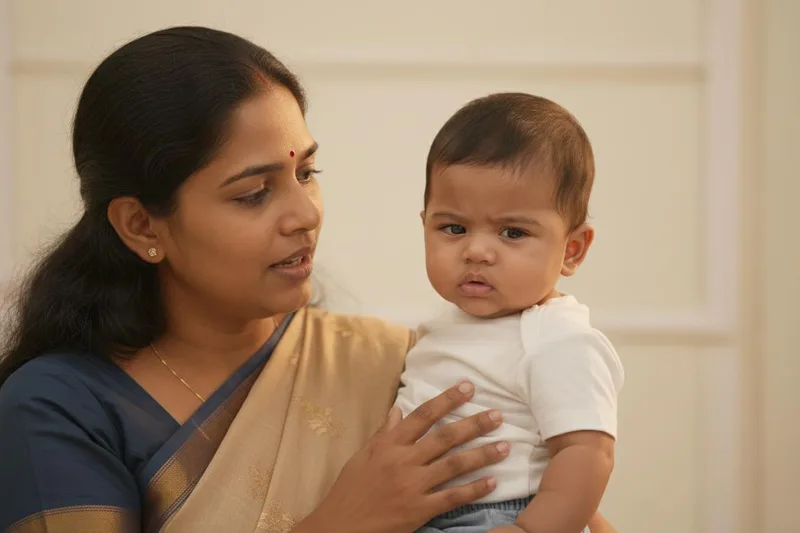
As a mother, you may be familiar with these things. When you go to feed your baby, he or she may eat a little and then say he or she is 'full', vomits frequently, or complains about a stomachache. Sometimes the baby may not gain weight properly. In such cases, your doctor may recommend a special test to see how long your baby's food stays in his or her stomach and how long it takes for it to pass through to the small intestine. That's what we call a 'Gastric Emptying Study' (GES).
What is Gastric Emptying Study (GES)?
Simply put, this measures how long it takes for your child's food to travel from their stomach (gut) to their small intestine. Think of it this way: Like a car stuck in traffic, sometimes the food we eat can get stuck in our stomach and travel very slowly. Or, like speeding on the highway, sometimes the food can move out of our stomach too quickly. Both of these can be problems. This test measures that speed.
This uses a special scanner called a ``Gamma Camera''. After the baby eats, this speed is measured by taking pictures of the baby's stomach with this camera. This test has several other names, but the most commonly used name is 'Gastric Emptying Study'.
What diseases can be detected with this test?
This is the best and most practical way to find out if your baby's stomach is working properly. Doctors most often use this test to diagnose a condition called Gastroparesis .
Gastroparesis means that your child's stomach takes longer than usual to empty. Normally, it takes about an hour and a half to two hours for food to move from the stomach to the small intestine.
This test can also detect several other conditions:
- Dumping Syndrome: This occurs when food in the stomach moves into the small intestine faster than expected.
- Gastroesophageal Reflux: This can also be thought of as the contents of the stomach coming back up into the throat.
Below are some reasons why a doctor might ask your child to have this test.
| Symptom | Description |
|---|---|
| Frequent vomiting | Vomiting for no apparent reason after eating or at any time of the day. |
| Stomach pain | If the child often complains of stomach aches or discomfort. |
| Not gaining weight | If the child is not gaining weight appropriately for his or her age. |
| Early Satiety | If you start eating and then say "I'm full" after a while. |
If you have symptoms like these, this test can be very helpful in identifying and starting treatment for a condition like gastroparesis before it can cause complications.
How to prepare the baby for the test?
This doesn't require much preparation, but you need to be careful about these things.
- Stop eating and drinking: Do not let your baby eat or drink anything after midnight the night before the test. The stomach should be completely empty when the test begins.
- About medications: If your child is taking any medications, be sure to talk to your doctor about it and get advice on whether they should be stopped before the test.
- Explaining to the baby: If the baby is old enough to understand, simply explain that this will not hurt and that you will be taking small pictures.
- Solutions to boredom: Since this test will take several hours, don't forget to bring your baby something they like, such as a favorite toy, book, or tablet, to keep them occupied.
What happens during the test?
Although I was a little scared when I heard this, it's a very simple process.
1. First, a radiologist or technician will take the baby to the examination room and dress him in a gown provided by the hospital.
2. Then give the baby a small meal. This is usually something like a scrambled egg and two slices of bread with jam . They also give them some water to drink.
3. A very small amount of a harmless, radioactive substance called ``Tracer'' is added to the egg food. This does not change the taste, color, or smell of the food. There is nothing to worry about, this is a very small amount and this is what allows the scanning machine to see how the food moves through the stomach.
4. The baby will be given 10 minutes to eat this food. You must help him eat the food during this time. Unfortunately, if the baby vomits during this time, the test will not be able to be done that day and will have to be repeated another day.
5. After the meal, the technician will take the baby to the scanning room and take several pictures of the abdomen. Each picture will take about a minute.
6. After that, pictures are taken again hourly, that is, at 1 hour, 2 hours, and 4 hours . During this time, the baby cannot eat or drink anything else. You have to wait until the last scan is finished.
How long does the test take?
This test, performed after giving food, usually takes about 4 to 5 hours .
What do you do after the test?
Once the final scan is done, you and your baby can go home. There are no restrictions on what you eat or drink that day. You can go about your day as normal.
Is there any risk in this?
Many mothers are afraid of radiation. But there is really nothing to be afraid of. The amount of radiation used in this test is very, very low. Doctors say that it will not harm the baby in any way.
But there is one thing you need to be very careful about. If you are pregnant, or if you have even the slightest suspicion that you are pregnant, do not go into the room where this test is being performed. Ask someone else to stay with the baby. Because this radiation is not good for the baby in the womb.
When will I receive the report? How can I find out about the results?
The radiologist will review the scan images, prepare a report, and send it to your child's doctor within a few days.
Normally, it takes about an hour and a half to two hours for the food we eat to travel from the stomach to the small intestine. If the report says that the food has been emptied within that time, that is normal.
If the results are abnormal, meaning that if food is delayed in passing through the stomach, it is ``Gastroparesis'', or if it is rapid, it is ``Dumping Syndrome'', your doctor will talk to you and clearly explain the next steps and treatment.
Can this test detect cancer?
This is a question that many parents ask. Rarely, delayed emptying of the stomach can be a sign of cancer. However , it is extremely rare for a child to develop this condition for such a reason. Also, this test is not used to detect cancer; there are other specialized tests for that.
What can I do to keep my baby calm during the test?
This can be a difficult test for a young child, as it can take hours and they can't eat or drink. There are a few things you can do to keep them calm and happy.
- Practice staying still: The day before the test, try playing a game of "Let's not move at all?" to get your baby used to staying still. This will help him get used to it when the scan is done.
- Stay close to you: Usually, either the mother or the father is allowed to go with the baby to the scan. It's a big boost for the only baby you have with you.
- Bring something familiar from home: Bringing something familiar from home, such as your baby's favorite toy or a small blanket, will help reduce the strange feeling he or she may have in the hospital.
- Say it won't hurt: Always remind your baby, "This won't hurt at all, son/daughter."
Take-Home Message
- Gastric Emptying Study (GES) is a painless test that measures the time it takes for food from the stomach to move into the small intestine.
- This helps to determine whether children with symptoms such as frequent vomiting, stomach pain, and weight loss have conditions like Gastroparesis.
- Since the test will take 4-5 hours, bring toys or books to keep your child occupied.
- The amount of radiation used in this test is very low, so it will not harm the baby.
- If you are pregnant or suspect you are, do not be with the baby during the test.
- If you have any questions about the test or the results, don't hesitate to ask your doctor.


💬 Comments (0)
No comments yet. Be the first to share your thoughts here.
Add Your Comment