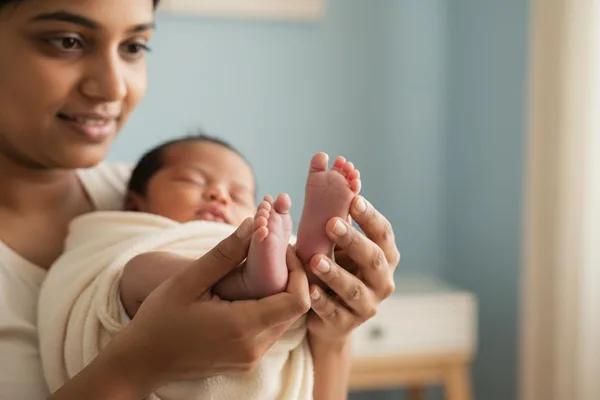
Does your baby have clubfoot? Let's learn everything about Clubfoot! (Congenital Talipes Equinovarus)

Does your baby have clubfoot? Let's learn everything about Clubfoot! (Congenital Talipes Equinovarus)

Does your newborn baby have one or both legs bent inward and pulled in? Sometimes it is very common for a mother or father to feel very scared and sad when they see that the sole of the foot is turned to the side or upwards. This condition is what we medically call Clubfoot, or `(talipes equinovarus)`. This is a condition that is seen in babies and is present at birth. So, let's not be afraid of this, but learn the exact details.

Simply put, what is Clubfoot?

Clubfoot is a condition that is present at birth. Simply put, it is a condition in which the foot or feet of a baby are turned inward. If you look at the baby's foot, you will see that the sole of the foot is turned to the side, and sometimes even upwards.

This is because the tendons, the tissues that connect muscles to bones, in a baby's leg and foot are shorter and tighter than normal. This tightness causes the foot to look like it's twisted inward. About half of babies with clubfoot have this condition in both legs. This is not as scary as you might think. This condition affects about one in 1,000 newborns. This means it's a common condition.

In the past, this required major surgery. But with the advanced medical science we have today, it can be almost completely cured with non-surgical methods and very minor surgeries .

What are the main types of clubfoot?

Clubfoot can be divided into two main types. Knowing this is important when deciding on treatment.

Clubfoot type Simple explanation
Isolated (or Idiopathic) Clubfoot This is the most common type. It means that the baby has no other health problems other than Clubfoot. The word 'idiopathic' means that the exact cause is unknown.
Non-isolated clubfoot This type occurs with other health conditions. For example, it can be seen with conditions such as a joint problem (arthrogryposis) or a nervous system problem (spina bifida) .

What are the symptoms of clubfoot?

The main symptom is that one or both of the baby's feet are turned inward, meaning towards the other leg. In addition, you will be able to see these things.

  • The foot looks like a kidney .
  • Having a deep crease on the inside of the foot.
  • The arch of the foot is higher than normal (cavus foot deformity).
  • The calf muscle of the affected leg appears smaller than the other leg .
  • The affected leg is shorter than the other .
  • Ankle stiffness.
  • Inability to fully bend or extend the leg.

The most important thing is that this condition does not cause pain to the baby. Therefore, the baby may not cry or show any discomfort.

Causes and risk factors for clubfoot

Researchers are still unable to say exactly what causes this, but they believe it may be a combination of both genetic and environmental factors .

Factors that increase risk

  • Being a boy: Boys are about twice as likely to develop clubfoot than girls.
  • Family history: If someone in the family (mother, father, sibling) has had clubfoot, the baby is at higher risk of developing it too.
  • Other birth defects: This can occur with other conditions such as ``Spina bifida`` or ``cerebral palsy``.
  • Problems during pregnancy: Conditions such as oligohydramnios, a decrease in the amount of amniotic fluid surrounding the baby during pregnancy.
  • Maternal behavior during pregnancy: Smoking, drinking alcohol, or using other drugs during pregnancy can also increase the risk.

What will be the impact on the baby if left untreated?

Clubfoot is not something that will heal on its own. Therefore, it is absolutely important to treat it before the baby starts walking. If left untreated, the baby may develop problems like these in the future:

  • Walking difficulties: Normally, we walk using the soles of our feet. However, a child with clubfoot may learn to walk on the side or top of their foot.
  • Foot infections: Walking abnormally can lead to foot injuries and infections.
  • Skin lesions (Calluses): The skin on the feet can thicken and form calluses.
  • Arthritis: Conditions such as arthritis, which causes swelling, pain, and stiffness in the joints, may develop in the future.

Therefore, starting treatment as soon as clubfoot is diagnosed is the best thing you can do for your baby's future.

Identifying Clubfoot and Starting Treatment

In most cases, your doctor can detect this condition during an ultrasound scan during your pregnancy. Knowing this early on will help you plan for the treatment you need after your baby is born.

Sometimes, even if it is not visible on the scan, the doctor will detect it during the first physical examination after the baby is born. Sometimes, an X-ray may be recommended to confirm the condition.

The best time to start treatment is within the first week or two after the baby is born. Starting treatment as soon as possible can prevent many future problems.

Treatment methods for clubfoot

A team of doctors usually comes together to treat clubfoot.

  • Pediatric Orthopedist: A doctor who specializes in bone and joint problems in children.
  • Orthopedic Surgeon: A doctor who treats bone and joint problems through surgery.
  • Physical Therapist: A person who helps build strength in the baby's legs and help them move properly.

There are several main treatment methods.

Ponseti Method

This is the most widely and successfully used treatment method in the world. This is a process that takes about two to three months.

1. Stretching the foot and applying a cast: The specialist doctor gently stretches the baby's foot to bring it into the correct position. Then, a cast is applied from the toes to the top of the thigh.

2. Weekly plaster change: Once every week (between 4-7 days), the old plaster is removed, the leg is pulled into the correct position a little more, and a new plaster is applied. After about 5-7 plasters are applied in this way, the leg is mostly in the correct position.

3. Achilles Tenotomy: Before applying the final cast, the doctor performs a minor surgery. In this, the Achilles tendon in the heel is cut slightly. This does not even require stitches. This allows the tight, shortened tendon to be released and allowed to grow to the desired length.

4. The final cast: The final cast is applied after the surgery. It is left in place for about 3 weeks and then removed.

French Method

This is similar to the Ponseti method, but instead of plaster, tape and splints are used. This treatment is done by a physical therapist. This is something that needs to be done daily. The physical therapist also teaches parents how to do this at home.

Wearing special shoes (Bracing)

After the foot is completely corrected using the Ponseti method or the French method, there is a high chance that it will regress back to its old form. This is what these special shoes (braces) are used to prevent.

This usually consists of a metal bar connected to two shoes ("boots and bar").

  • You need to wear this all day long (about 23 hours) for the first 3 months .
  • After that, the baby should wear this while sleeping at night and during naps until they are about 4 years old .

It is extremely important to wear these shoes exactly as the doctor tells you, otherwise the chances of the foot getting sprained again are very high.

Surgery

Sometimes, clubfoot can be very severe. Or, other methods may not give the desired results. In such cases, surgery is recommended. It is best to perform this surgery before the baby starts walking.

What will the baby's future be like after treatment?

This is the biggest problem every parent has. If diagnosed early and treated correctly, the results are very successful.

Your baby will be able to wear regular shoes, walk, run, jump without pain, and play and compete like other children.

However, there may still be slight changes in the leg that had clubfoot.

  • The affected foot may be about one shoe size smaller than the other foot.
  • The calf area of ​​that leg may be a little thin .
  • That leg may be a little shorter than the other leg.

But these changes usually don't have a big impact on the baby's daily activities.

A few tips to make using the brace easier

Using a brace for a long time can be a challenge for both you and your baby. These tips may help.

  • Make it a game: Play with your baby while the brace is on. Do things like kicking with your legs, bending and stretching your legs, etc.
  • Make it part of your routine: Make it a habit to put the brace on when you put your baby to sleep. This will help your baby understand that it's time to put the brace on when it's time to sleep.
  • Do not apply lotion: Do not apply creams or lotions to the areas where the brace is applied. They can worsen skin problems. It is normal for the skin to become slightly red. However, if it looks like a blister, it may mean that the heel is slipping inside the shoe. Tell your doctor about it.
  • Stop slipping: Tighten your shoelaces. Sometimes wearing a pair of socks can help keep your shoes in place.

If you have any concerns, never be afraid to talk to your baby's doctor or physical therapist about it.

Take-Home Message

  • Clubfoot is a common condition that is present at birth. It is not your fault.
  • This condition does not cause pain to the baby, but it must be treated.
  • The most successful results can be achieved by starting treatment as soon as possible, within the first few weeks after the baby is born.
  • The Ponseti method is a highly successful, non-surgical treatment method used throughout the world.
  • Once the foot is corrected, it is extremely important to wear a special brace for the prescribed period of time to prevent re-strain.
  • With the right treatment, your child can live a happy, healthy, and active life like every other child.

Clubfoot, talipes equinovarus, congenital clubfoot, baby's clubfoot, Ponseti method, pediatrics

⚠️ Important: The medical articles and information on Nirogi Lanka are for general awareness only, and are by no means a substitute for professional medical advice, diagnosis, or treatment. For any medical problem you have, consult a qualified physician immediately.

💬 Comments (0)

No comments yet. Be the first to share your thoughts here.

Add Your Comment

Please calculate: 2 + 6 =
Does your baby have clubfoot? Let's learn everything about Clubfoot! (Congenital Talipes Equinovarus)

Does your baby have clubfoot? Let's learn everything about Clubfoot! (Congenital Talipes Equinovarus)

Does your newborn baby have one or both legs bent inward and pulled in? Sometimes it is very common for a mother or father to feel very scared and sad when they see that the sole of the foot is turned to the side or upwards. This condition is what we medically call Clubfoot, or `(talipes equinovarus)`. This is a condition that is seen in babies and is present at birth. So, let's not be afraid of this, but learn the exact details.

Simply put, what is Clubfoot?

Clubfoot is a condition that is present at birth. Simply put, it is a condition in which the foot or feet of a baby are turned inward. If you look at the baby's foot, you will see that the sole of the foot is turned to the side, and sometimes even upwards.

This is because the tendons, the tissues that connect muscles to bones, in a baby's leg and foot are shorter and tighter than normal. This tightness causes the foot to look like it's twisted inward. About half of babies with clubfoot have this condition in both legs. This is not as scary as you might think. This condition affects about one in 1,000 newborns. This means it's a common condition.

In the past, this required major surgery. But with the advanced medical science we have today, it can be almost completely cured with non-surgical methods and very minor surgeries .

What are the main types of clubfoot?

Clubfoot can be divided into two main types. Knowing this is important when deciding on treatment.

Clubfoot type Simple explanation
Isolated (or Idiopathic) Clubfoot This is the most common type. It means that the baby has no other health problems other than Clubfoot. The word 'idiopathic' means that the exact cause is unknown.
Non-isolated clubfoot This type occurs with other health conditions. For example, it can be seen with conditions such as a joint problem (arthrogryposis) or a nervous system problem (spina bifida) .

What are the symptoms of clubfoot?

The main symptom is that one or both of the baby's feet are turned inward, meaning towards the other leg. In addition, you will be able to see these things.

  • The foot looks like a kidney .
  • Having a deep crease on the inside of the foot.
  • The arch of the foot is higher than normal (cavus foot deformity).
  • The calf muscle of the affected leg appears smaller than the other leg .
  • The affected leg is shorter than the other .
  • Ankle stiffness.
  • Inability to fully bend or extend the leg.

The most important thing is that this condition does not cause pain to the baby. Therefore, the baby may not cry or show any discomfort.

Causes and risk factors for clubfoot

Researchers are still unable to say exactly what causes this, but they believe it may be a combination of both genetic and environmental factors .

Factors that increase risk

  • Being a boy: Boys are about twice as likely to develop clubfoot than girls.
  • Family history: If someone in the family (mother, father, sibling) has had clubfoot, the baby is at higher risk of developing it too.
  • Other birth defects: This can occur with other conditions such as ``Spina bifida`` or ``cerebral palsy``.
  • Problems during pregnancy: Conditions such as oligohydramnios, a decrease in the amount of amniotic fluid surrounding the baby during pregnancy.
  • Maternal behavior during pregnancy: Smoking, drinking alcohol, or using other drugs during pregnancy can also increase the risk.

What will be the impact on the baby if left untreated?

Clubfoot is not something that will heal on its own. Therefore, it is absolutely important to treat it before the baby starts walking. If left untreated, the baby may develop problems like these in the future:

  • Walking difficulties: Normally, we walk using the soles of our feet. However, a child with clubfoot may learn to walk on the side or top of their foot.
  • Foot infections: Walking abnormally can lead to foot injuries and infections.
  • Skin lesions (Calluses): The skin on the feet can thicken and form calluses.
  • Arthritis: Conditions such as arthritis, which causes swelling, pain, and stiffness in the joints, may develop in the future.

Therefore, starting treatment as soon as clubfoot is diagnosed is the best thing you can do for your baby's future.

Identifying Clubfoot and Starting Treatment

In most cases, your doctor can detect this condition during an ultrasound scan during your pregnancy. Knowing this early on will help you plan for the treatment you need after your baby is born.

Sometimes, even if it is not visible on the scan, the doctor will detect it during the first physical examination after the baby is born. Sometimes, an X-ray may be recommended to confirm the condition.

The best time to start treatment is within the first week or two after the baby is born. Starting treatment as soon as possible can prevent many future problems.

Treatment methods for clubfoot

A team of doctors usually comes together to treat clubfoot.

  • Pediatric Orthopedist: A doctor who specializes in bone and joint problems in children.
  • Orthopedic Surgeon: A doctor who treats bone and joint problems through surgery.
  • Physical Therapist: A person who helps build strength in the baby's legs and help them move properly.

There are several main treatment methods.

Ponseti Method

This is the most widely and successfully used treatment method in the world. This is a process that takes about two to three months.

1. Stretching the foot and applying a cast: The specialist doctor gently stretches the baby's foot to bring it into the correct position. Then, a cast is applied from the toes to the top of the thigh.

2. Weekly plaster change: Once every week (between 4-7 days), the old plaster is removed, the leg is pulled into the correct position a little more, and a new plaster is applied. After about 5-7 plasters are applied in this way, the leg is mostly in the correct position.

3. Achilles Tenotomy: Before applying the final cast, the doctor performs a minor surgery. In this, the Achilles tendon in the heel is cut slightly. This does not even require stitches. This allows the tight, shortened tendon to be released and allowed to grow to the desired length.

4. The final cast: The final cast is applied after the surgery. It is left in place for about 3 weeks and then removed.

French Method

This is similar to the Ponseti method, but instead of plaster, tape and splints are used. This treatment is done by a physical therapist. This is something that needs to be done daily. The physical therapist also teaches parents how to do this at home.

Wearing special shoes (Bracing)

After the foot is completely corrected using the Ponseti method or the French method, there is a high chance that it will regress back to its old form. This is what these special shoes (braces) are used to prevent.

This usually consists of a metal bar connected to two shoes ("boots and bar").

  • You need to wear this all day long (about 23 hours) for the first 3 months .
  • After that, the baby should wear this while sleeping at night and during naps until they are about 4 years old .

It is extremely important to wear these shoes exactly as the doctor tells you, otherwise the chances of the foot getting sprained again are very high.

Surgery

Sometimes, clubfoot can be very severe. Or, other methods may not give the desired results. In such cases, surgery is recommended. It is best to perform this surgery before the baby starts walking.

What will the baby's future be like after treatment?

This is the biggest problem every parent has. If diagnosed early and treated correctly, the results are very successful.

Your baby will be able to wear regular shoes, walk, run, jump without pain, and play and compete like other children.

However, there may still be slight changes in the leg that had clubfoot.

  • The affected foot may be about one shoe size smaller than the other foot.
  • The calf area of ​​that leg may be a little thin .
  • That leg may be a little shorter than the other leg.

But these changes usually don't have a big impact on the baby's daily activities.

A few tips to make using the brace easier

Using a brace for a long time can be a challenge for both you and your baby. These tips may help.

  • Make it a game: Play with your baby while the brace is on. Do things like kicking with your legs, bending and stretching your legs, etc.
  • Make it part of your routine: Make it a habit to put the brace on when you put your baby to sleep. This will help your baby understand that it's time to put the brace on when it's time to sleep.
  • Do not apply lotion: Do not apply creams or lotions to the areas where the brace is applied. They can worsen skin problems. It is normal for the skin to become slightly red. However, if it looks like a blister, it may mean that the heel is slipping inside the shoe. Tell your doctor about it.
  • Stop slipping: Tighten your shoelaces. Sometimes wearing a pair of socks can help keep your shoes in place.

If you have any concerns, never be afraid to talk to your baby's doctor or physical therapist about it.

Take-Home Message

  • Clubfoot is a common condition that is present at birth. It is not your fault.
  • This condition does not cause pain to the baby, but it must be treated.
  • The most successful results can be achieved by starting treatment as soon as possible, within the first few weeks after the baby is born.
  • The Ponseti method is a highly successful, non-surgical treatment method used throughout the world.
  • Once the foot is corrected, it is extremely important to wear a special brace for the prescribed period of time to prevent re-strain.
  • With the right treatment, your child can live a happy, healthy, and active life like every other child.

Clubfoot, talipes equinovarus, congenital clubfoot, baby's clubfoot, Ponseti method, pediatrics

⚠️ Important: The medical articles and information on Nirogi Lanka are for general awareness only, and are by no means a substitute for professional medical advice, diagnosis, or treatment. For any medical problem you have, consult a qualified physician immediately.

💬 Comments (0)

No comments yet. Be the first to share your thoughts here.

Add Your Comment

Please calculate: 2 + 6 =