
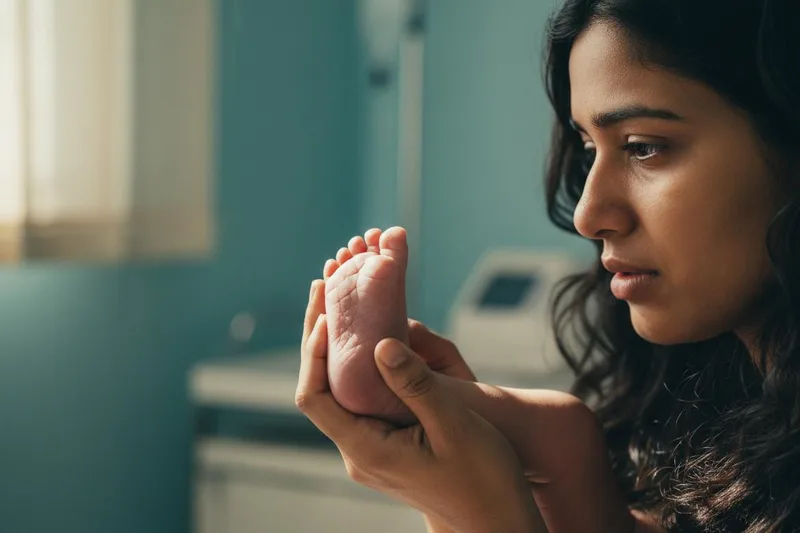
As a mother, you may be a little worried if you notice that one or both of your newborn's legs are bent inward and bent. Sometimes you may even see that the sole of the foot is turned up or to the side. This is what we medically call 'clubfoot'. Some people also call it 'talipes equinovarus'. Don't worry, this is a birth defect that occurs in newborns, but it can be treated and improved. Roughly speaking, about one in 1,000 newborns will experience this clubfoot condition.
So, what is clubfoot? Simply put...
Clubfoot is a deformity of your baby's foot or both feet. The main thing is that the foot turns inward. Imagine, the sole of the baby looks like it's turned towards the other leg. Sometimes the sole can be completely turned up or to the side.
This is because the tendons in the baby's leg and foot, the tissues that connect the muscles to the bones, are shorter and tighter than normal. This causes the foot to twist and turn inward. About half of babies with clubfoot have this condition in both legs.
In the past, major surgery was the main treatment for this condition. But now, doctors are successfully treating it with a combination of non-surgical methods and minimally invasive surgery.
What are the main types of clubfoot?
There are two main types of clubfoot:
1. Isolated or Idiopathic Clubfoot: This is the most common type. If your baby has only clubfoot without any other health problems, it is called 'isolated clubfoot'. The word ' idiopathic ' means that the exact cause is unknown .
2. Nonisolated Clubfoot: In this type, clubfoot occurs with other health problems. For example, it can be seen with conditions such as ``Arthrogryposis``, which is a problem with the joints, or ``Spina Bifida``, which is a defect in the neural tube. Neural tube defects are problems with the baby's brain, spine, and spinal cord.
What are the signs of a baby with clubfoot?
In most cases, the main characteristic of clubfoot is that one or both legs are turned inward. This means that the baby's foot is turned towards the other leg.
In addition, you may see things like this on your baby's feet:
- The foot may look like a kidney .
- There may be a deep line or crease on the inside of the foot.
- You may see a foot that is higher than normal (doctors also call this ``Cavus Foot Deformity'').
Some other features are:
- The calf muscle in the affected leg is smaller than the other leg.
- The affected leg is shorter than the other.
- Feeling of stiffness in the ankle area.
- Difficulty moving the leg completely.
Why does clubfoot develop? What are the causes?
Researchers have yet to find the exact cause of clubfoot, but it is believed to be caused by a combination of both genetic and environmental factors.
- Genetics: Genes determine how our bodies shape, grow, and function. If there is a problem with one or more of these genes, which are passed down from parents to children, a condition like clubfoot can occur.
- Environmental factors: The mother's use of drugs and smoking during pregnancy can increase the risk of birth defects such as clubfoot.
Who is at higher risk of developing clubfoot?
Statistically, boys are twice as likely to develop clubfoot as girls. Also, if someone in the family has had clubfoot, the baby may be at increased risk.
Some other risk factors are:
- The baby has another birth defect, for example, Spina Bifida or Cerebral Palsy.
- Having a genetic condition such as `Trisomy 18` (also called `Edward Syndrome`).
As for the mother, the risk of having a baby with clubfoot may increase in the following situations:
- If there is a decrease in the amount of amniotic fluid surrounding the fetus in the uterus during pregnancy, a condition called ``Oligohydramnios''.
- Infections such as Zika virus during pregnancy can cause birth defects.
- Smoking, drinking alcohol, or using other drugs during pregnancy.
How does clubfoot affect the baby?
One of the things that many parents worry about is whether it will be painful for the baby. Clubfoot is not painful for the baby . In fact, most babies don't even notice it for the first few months of life.
However, this condition can cause problems when standing and walking . Also, it does not get better on its own . Therefore, it is essential to treat clubfoot and correct this problem before babies reach walking age.
If left untreated, clubfoot can cause the following problems:
- Walking difficulties: Babies with clubfoot often walk in an unusual way. Normally, we walk using the soles of our feet. However, a baby with clubfoot may walk on the sides or tops of their feet.
- Infections can occur in the feet .
- Foot problems such as calluses, which are thickened skin on the soles of the feet.
- Joint diseases such as arthritis can cause pain, stiffness, and swelling.
When is clubfoot diagnosed? How?
Often, your doctor can detect clubfoot during an ultrasound scan during your pregnancy. This scan can take pictures of the developing fetus in the womb, so if it is detected right away, you can plan for any necessary treatment after the baby is born.
Sometimes, the doctor may notice this during the first physical examination after the baby is born. If this happens, the doctor may also recommend an X-ray to confirm the diagnosis.
When should treatment for clubfoot begin?
Doctors recommend starting treatment for clubfoot as soon as possible . Starting treatment early can help prevent problems that the baby may have later. It is best to start treatment within the first two weeks of the baby's birth.
Who treats clubfoot?
Treating your baby's clubfoot often requires the help of a medical team. This team usually includes:
- Pediatric Orthopedist: A doctor who specializes in problems related to children's bones and joints.
- Orthopedic Surgeon: A specialist in surgery related to bones and joints.
- Physical Therapist: Someone who helps develop the baby's leg strength and correct movement.
How is clubfoot treated?
There are several ways to treat clubfoot. Your medical team will discuss these options with you and help you choose the best option for your baby. The main treatments are:
- Ponseti Method: A method that corrects the curvature of the foot by placing plaster casts on the baby's leg.
- French Method: A method of correcting the curvature of a baby's foot using splints and tape.
- Bracing: A method of using special footwear (brace) to help keep the foot at a correct angle.
- Surgery: If other methods are not successful or the condition is severe, surgery may be performed.
Now let's look at each of these methods in a little more detail.
Ponseti Method
This `(Ponseti Method)` is a very popular and successful treatment method all over the world. In this , a weekly plaster change is done. This treatment usually takes about two to three months. Your medical team will try to start this treatment within the first two weeks after the baby is born.
This treatment is performed by an orthopedic surgeon. Here's how he does it:
1. The baby's foot is gently pulled into the correct position .
2. Then, a plaster is applied to the foot. This plaster goes from the tips of the toes to the top of the thigh.
3. In this way , a new plaster is applied every four to seven days . Each time, the surgeon brings the foot into a slightly more correct position.
Before applying the final cast, the surgeon usually performs a small incision (Achilles tenotomy) in the Achilles tendon . This involves:
- The Achilles tendon in the baby's heel – the tissue that connects the heel to the muscles in the heel area – is cut in a very quick, minor surgery . The incision is so small that stitches are not even needed.
- Then a new plaster is applied. It takes about three weeks for this tendon to heal.
The goal of this surgery is to allow this tendon to grow to a normal length. After the last cast was removed, the tendon has returned to a normal length.
While your baby is recovering, you may also need to do these things:
- Doing stretching exercises to keep the feet in the correct position.
- Wear special shoes or a foot brace for several years.
French Method
This method is similar to the Ponseti Method, but instead of plaster , splints and tape are used. A splint is a device that provides support and protection to the bones.
This treatment is done by a physical therapist. He or she can start this treatment as soon as the baby is born. However, this treatment is not done once a week, it has to be done every day . But you don't have to go to the physical therapist every day. The physical therapist will see the baby several times a week and teach you how to apply this splint and tape at home.
How to do the French Method:
1. The baby's foot is gently pulled into the correct position .
2. Then, the foot is held in place using tape and a splint.
3. Do this process every day for two months .
4. After that, this is done a little less often (as the physical therapist says) until the baby is 3 months old.
Babies who receive treatment using the French method often also have to undergo the previously mentioned Achilles tenotomy surgery.
After three months, you will see a good improvement in your baby's foot. To keep the foot in the correct position and prevent the clubfoot condition from recurring, parents should continue this method until the baby is 2 or 3 years old .
Bracing - Special footwear
After your baby has completed either the Ponseti Method or the French Method, the medical team may recommend using a brace . Even if the treatment is successful, the baby's foot may return to the wrong position. A brace helps to keep the foot at the correct angle and prevent it from turning to the wrong side.
This brace usually looks like a pair of shoes connected by a metal bar . It is also called "boots and bar". The most important thing here is:
- The brace should be worn every day for the first three months. After that, it should only be worn during sleep and naps, usually until about four years of age.
- It is important to follow the doctor's instructions exactly . If the brace is not worn when the baby is born, the foot may return to the clubfoot position.
There are several types of braces. Your doctor can discuss these options with you and help you choose the brace that is best for your baby.
Surgery
Sometimes, a child may have a severe clubfoot condition . Or, you may have tried non-surgical methods but they have not worked. In such cases, surgery can correct the problem. It is best to have this surgery done before the child starts walking.
During surgery, the surgeon:
1. Stretches the baby's heel tendon and corrects other foot problems.
2. Pins are inserted into the foot to bring it into the correct position.
3. A plaster is applied to the leg after surgery.
A few weeks after surgery, the surgeon:
1. Remove the plaster and the sticks.
2. A new plaster is applied to the baby's foot. This will need to be kept in place for about another four weeks.
3. The last plaster is removed .
Even after this treatment, there is a small chance that the foot will revert to a clubfoot position. Therefore, your doctor may recommend using a brace or special shoes to keep the foot in the correct position.
What are the risks of clubfoot surgery?
Like any surgery, clubfoot surgery can have some risks. These include:
- Nerve injury
- Infection
- Bleeding
- Leg stiffness/stiffness
Your doctor will talk to you about these risks.
Is there a way to prevent clubfoot?
There is no way to completely prevent clubfoot, as we have seen that it also has a genetic influence. However, by following good health habits before and during pregnancy, you can give your baby a healthy start.
- Consider getting a preconception checkup before you get pregnant. This is where a doctor helps make sure you are as healthy as possible when you get pregnant.
- If you have a high risk of having a baby with clubfoot or other birth defects, talk to a genetic counselor , who specializes in birth defects and genetic conditions.
- Get tested for infections like the Zika virus. Treating these infections before getting pregnant increases the chances of a healthy pregnancy and baby.
When you are pregnant:
- Attend all prenatal care appointments on time.
- Use mosquito repellent to protect yourself and your unborn baby from diseases like Zika.
- Avoid smoking and drinking alcohol. Use only medications approved by your doctor.
What is the outlook for babies with clubfoot? (Outlook)
Clubfoot is not a condition that will heal on its own . Therefore, it is essential to start treatment early to get the best results. Babies who start treatment early have much better results. They can wear regular shoes, walk, run, and play without pain. Some children even play sports!
However, if you only have clubfoot in one leg, you might see things like this:
- The affected leg may be slightly smaller than the other and have slightly less movement .
- The muscles in the calf area of the leg that had clubfoot may be slightly smaller .
- Your child may tire more quickly and complain that their legs hurt than children without clubfoot.
- The affected leg may be slightly shorter than the other leg , but this usually does not cause any major problems.
If your child has another condition along with clubfoot, the outlook may depend on the treatment for that other condition.
Can clubfoot recur?
Yes, clubfoot can recur . This risk is especially high if the treatment plan is not followed properly. If it seems like the foot is going back into a clubfoot position, see your child's doctor right away. He or she will advise you on what to do next. You may need to repeat some of the steps in the treatment plan.
How can parents help their child deal with a brace?
Using the brace correctly is the best way to get the best results for your child. However, wearing a brace for hours a day can be a bit of a challenge for children. Here are some tips to help parents make putting on the brace easier:
- Make it a game: Play with your baby while they are wearing the brace. Do things like slow exercises, kicking games, etc. You can also use the bar on the brace to do knee flexion and extension exercises.
- Make it part of your routine: After the first three months, your baby will only need the brace when they are sleeping at night and when they are napping during the day. Make the brace part of their bedtime routine. Then they will understand that going to sleep means putting on the brace.
- Add a pad to the bar: Adding a soft pad to the metal bar will make the brace more comfortable for both you and your baby. It also helps protect furniture and appliances in your home.
- Don't apply lotions: Applying creams or lotions can make skin problems worse. It's normal for your baby's feet to be slightly red. However, if they develop blisters, it could be a sign that the heel is slipping out of the brace. Tie the shoes tightly to prevent slipping. Also, check your baby's feet regularly for blisters.
- Prevent slipping: Sometimes the foot keeps slipping out of the brace. Check that the strap is tight. Wearing a pair of socks can also help keep the shoe in place. A physical therapist can advise you on other ways to keep the shoe in place.
What else should you ask the doctor about clubfoot?
Ask your child's doctor for a referral to an orthopedic surgeon who specializes in the Ponseti Method. This treatment requires a high level of skill and experience. If your medical team recommends the French Method, ask for a referral to a physical therapist who specializes in that method.
Here are some other questions you can ask your child's doctor:
- When should my baby start treatment?
- What is the best treatment for my baby's clubfoot?
- How long will the treatment take?
- Will my child walk normally?
- What can I do to prevent clubfoot from coming back?
As a parent, when you see something unexpected happening to your unborn baby or newborn, you may wonder what to do next. During your entire pregnancy, you've been thinking about the cute clothes your baby will wear, not the plasters, splints, or braces they'll need to wear.
Finally, remember this...
Clubfoot is a common birth defect, but treatment is very effective . The most important thing is to follow the treatment plan exactly . Doing so greatly increases the chances of success. With the right treatment, most children with clubfoot can walk, run, play, and even compete without pain. Talk to your doctor about the best treatment for your child's clubfoot condition. Don't panic, and face it with courage. Your little one will recover soon!
` Clubfoot, Birth defects, Foot deformities, Ponseti method, Child health, Orthopedics, Ponseti Method, Talipes Equinovarus


💬 Comments (0)
No comments yet. Be the first to share your thoughts here.
Add Your Comment