
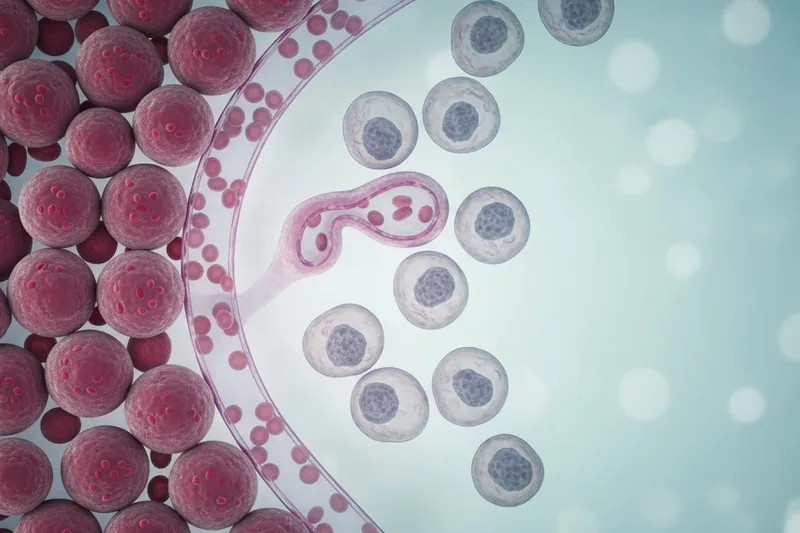
Have you ever thought that cells in our body can die? Sometimes they do. Especially when the cells don't get the blood they need. In medicine, when cells die, we call it `(Coagulative Necrosis)`. Don't worry, this may sound like a complicated word, but let's talk about it simply.
What is `(Coagulative Necrosis)`? Let's understand it simply
Simply put, `(Coagulative Necrosis)` means that the cells in our body die due to the lack of blood flow . Think of it, our cells are like little factories. These factories need raw materials to work. Similarly, our cells also need oxygen and nutrients to work. Who carries these to the cells? That is the blood.
So, if for some reason this blood flow stops, or if it decreases too much, the cells cannot do their job. Just like a car without fuel. After a while, these cells become lifeless, that is, they die. That is what we call `(Coagulative Necrosis)`.
The important thing is that even though cells die in this way, the structure of those cells and tissues remains intact at first. It is only later that our body's immune system comes in and removes these dead cells.
Where can this condition `(Coagulative Necrosis)` occur?
This can actually happen anywhere in our body. But it doesn't just happen in one place. That is the brain . The way brain cells die is a little different. Apart from that, this `(Coagulative Necrosis)` can be seen in every other organ. For example, it is commonly seen in places like the heart, kidneys, spleen, liver, and intestines.
What happens after cells die?
We have already said that in `(Coagulative Necrosis)`, even though the cells die, their original shape remains the same for a while . It's like a burnt house, the walls are there, but there's nothing inside. But our body is very amazing. It doesn't just exist. Our body's defense army, called our immune system , gradually recognizes these dead cells, removes them from there, and cleans up the area.
Is this also used for cancer treatment?
Yes, don't be surprised. In some cancer treatments, doctors intentionally induce ``Coagulative Necrosis'' of cancer cells. That is, they kill the cancer cells. Do you know how this is done?
One method is to use heat . There is a treatment called ``Ablation therapy``. In this, cancer cells are destroyed by applying high heat. Another method is ``High-Intensity Focused Ultrasound - HIFU``. In this too, high-intensity sound waves are used to damage and kill cancer cells. Sometimes, extreme cold is also used to do the same. These methods destroy cancer cells by disrupting their blood supply, causing them to undergo ``Coagulative Necrosis``.
What are the causes of `(Coagulative Necrosis)`?
There could be many reasons for this situation. Let's look at the main ones.
Myocardial Infarction
This is a prime example of `(Coagulative Necrosis)`. You've probably heard of heart attacks. A heart attack is caused by a blockage in one or more of the coronary arteries that supply blood to the heart. These arteries are the ones that supply oxygen and nutrients to the heart muscle cells. So when these arteries become blocked, the heart muscle cells don't get blood. Then those cells start to die. That's `(Coagulative Necrosis)`. If not treated quickly, permanent damage to the heart can occur, and even death can occur.
Restriction of blood flow to other organs
As well as the heart, blood flow to organs in our body such as the kidneys, spleen, liver, and intestines can also be impaired. There can be several reasons for this:
- Atherosclerosis: Over time, fat deposits build up inside the arteries, thickening the artery walls and narrowing the blood vessels. This reduces the amount of blood that reaches the organs.
- Blood clots: If a blood clot forms inside a blood vessel and becomes blocked, blood cannot flow through it.
- Hernias: In some types of hernias, a part of the intestine, such as the intestine, can become trapped and stop bleeding.
- Infections: Some severe infections can also reduce blood flow to tissues.
- Injuries or trauma: A major injury or accident can damage blood vessels and stop blood flow.
Can cancer cause ``Coagulative Necrosis''?
Yes, cancer can also cause this condition. Some cancers grow very quickly . As they grow, the tumor does not get the blood supply it needs. This means that new blood vessels do not form as quickly as the tumor grows. Then, some parts of the tumor lose blood and the cells die. This is called ``Coagulative tumor cell necrosis''. This can also be a sign that the cancer is actually a little more aggressive .
What are the symptoms of `(Coagulative Necrosis)`?
The symptoms seen in this vary depending on the organ that is damaged and the severity of the damage .
For example, after a heart attack, damaged heart muscle tissue does not regenerate. Instead , scar tissue forms. This scarring can affect the heart's function. It can also cause other problems.
- Abnormal heartbeat
- Heart failure
- Kidney disease
- Stroke
Therefore, if you have had organ damage due to a medical condition, it is very important to ask your doctor about possible recurrences . This way, if a new problem arises, you can quickly identify it.
How is this condition diagnosed? (Diagnosis)
Usually, to accurately diagnose Coagulative Necrosis, a small sample of the affected tissue is taken and examined under a microscope . This is called a biopsy.
However, it is even more important to assess how the damaged organ is functioning . For example, in the case of the heart, the doctor uses various scans to see how the heart is working.
- Cardiac CT `(Cardiac CT)`
- Echocardiogram
- MRI `(MRI)`
These tests can check many things about the heart, such as its shape, size, and how it pumps blood.
How is Coagulative Necrosis treated?
The main focus of treatment is to prevent further damage and help restore organ function .
In a situation like a heart attack, doctors first try to restore blood flow to the heart if possible. They also work to restore normal heart function. In the long term, your doctor may prescribe certain medications.
- Control high blood pressure (ACE inhibitors)
- Lower cholesterol levels (statins)
- Prevent blood clots (antithrombotic therapy)
- Reduce the workload on the heart (beta-blockers)
It is very important to use these medications exactly as directed by your doctor.
The doctor also advises you to make some lifestyle changes to improve your heart health.
- If you have diabetes, control it well.
- Eat a heart-healthy diet.
- Reduce stress.
- Maintain a healthy weight.
- Reduce alcohol consumption.
- If you smoke, stop it completely.
What can we do to survive this situation?
The best way to prevent Coagulative Necrosis is to maintain good overall health . If you already have any chronic conditions (e.g., diabetes, high blood pressure), it is important to work with your doctor to manage those conditions and reduce your risk of complications.
Think about it, our body is like a car. If we maintain it properly, service it, and take good care of it, it can run for a long time without any problems. That's how our body is.
What will be the future health status of someone with `(Coagulative Necrosis)`? (Prognosis)
This really depends on the extent of the damage to the tissues . If the damage is minor, you may recover quickly. However, if the damage is extensive, there may be long-term effects. That's why it's important to diagnose the disease early and start treatment.
When should you see a doctor?
If you have had a heart attack or other medical condition that has caused organ damage, it is important to continue to seek medical care and advice . Follow your doctor's instructions exactly and take your medications exactly as prescribed. This will help you control your condition and prevent further problems in the future.
When should you call an emergency room (e.g. 1990 Suwaseriya)?
A heart attack is an emergency! Its symptoms are:
- Feeling of pressure, pain, or discomfort in the chest.
- Shortness of breath.
- Pain spreading to the jaw, upper back, or arms.
If you or someone you are with has any of these symptoms, call 1990 (or your local emergency number) immediately . Time is of the essence when treating a heart attack. Even a few minutes late can cause permanent damage or even death. Therefore, it is important to act quickly and not panic.
Finally, things to remember (Take-Home Message)
Coagulative Necrosis is a condition that occurs when our cells and tissues lose their blood supply. The best way to prevent this is to follow a healthy lifestyle and have regular medical checkups . If you have any chronic conditions (e.g., diabetes, high blood pressure), keeping them well controlled can reduce the risk of complications like Coagulative Necrosis.
Remember, taking care of your health is the most important thing. Because there is nothing more valuable than health!
` Coagulative Necrosis, cell death, blood supply, heart attack, cancer, myocardial infarction, atherosclerosis


💬 Comments (0)
No comments yet. Be the first to share your thoughts here.
Add Your Comment