
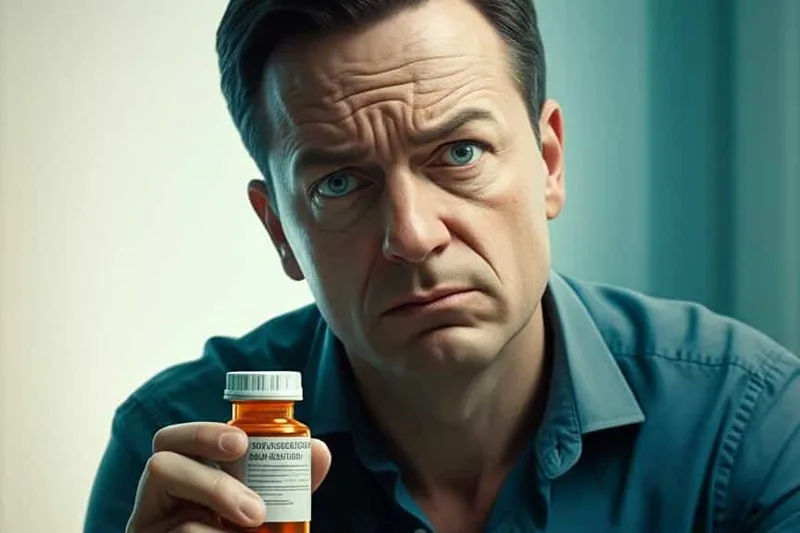
Has your doctor prescribed you medication to control your triglyceride levels? After taking the medication for a while, do you feel like, "That's enough, I can stop taking this medication"? You're not the only one who feels that way. But suddenly stopping the medication without talking to your doctor can be much more dangerous to your health than you think.
Why is this medicine so important?
Simply put, having too many triglycerides in your blood is not good for your heart. Just like dirt clogs the water pipes in your home, these triglycerides can build up in your blood vessels and block the flow of blood. This is what leads to serious diseases like heart attacks and strokes .
The medicine your doctor gives you is designed to reduce this dangerous level and protect your heart and blood vessels. In other words, this medicine is like a shield that protects your life.
Research has found that about 50% of patients, or one in two , stop taking their medication for good, about a year after starting medication to lower triglycerides. But doing so puts their health at risk again.
Main reasons and solutions for wanting to stop medication
Many people decide to stop taking their medication for a number of reasons. Let's look at what they are and what can be done about them. Remember, all of this should only be done after talking to your doctor and following his advice.
1. "I'm getting side effects from this medication!"
This is a very common thing to hear. Some medications, for example, a class of medications called `Fibrates`, can cause stomach upset and bloating. Medications like `Niacin` can sometimes cause the face, neck, and upper chest to suddenly turn red and feel hot. We call this `flushing` . It's normal to feel scared when something like this happens.
Solution:
The best thing to do if you experience something like this is to see your doctor and explain the situation. Never stop taking your medication on your own. Your doctor may:
- The dose of the medicine you are given will be changed.
- They tell you to change the time you take the medicine.
- Or they will switch you to another medication that is more suitable for you and has fewer side effects.
2. "It's hard to afford these medications!"
This is also a really big problem. Especially when taking medication for a long time, the monthly cost can be difficult for some people to afford. Because of this, some people stop taking the medication halfway.
Solution:
Talk openly with your doctor about this too. Don't be shy. Doctors often:
- You may know of a cheaper brand or generic version of the same medicine.
- Or, they may recommend another medication that is just as effective and less expensive.
- You can also be advised on ways to obtain these medicines for free through clinics in government hospitals.
3. "There are too many medications to take per day!"
Not only for triglycerides, but you may also be taking medication for diabetes, blood pressure, and other illnesses. 3 in the morning, 2 at noon, 4 at night... Sometimes it gets boring when you have to take so many medications. You may not even remember what medication is for what.
Solution:
There is a very simple solution to this. At least once a year, or whenever a new medicine is added to your medication, put all the medicines you take (vitamins, Panadol, even Ayurvedic medicines) in a bag with their original packets/bottles and take them to the doctor. Point to them and say, "Doctor, this is what I am taking now," and ask if I still need all these medicines. There may be some medicines that I no longer need. The doctor will look at them all and explain them to you.
4. "Now my report is good, I'm healthy! Why else would I need medicine?"
This is the biggest mistake many people make. After taking medication for a few months and seeing their triglyceride levels return to normal on their blood test, they think, "Okay, now I'm fine. I don't need any more medication."
Solution:
Think of it like an umbrella. When it rains, we raise the umbrella and don't get wet. If we close the umbrella after a little rain, we still get wet even if it rains again. Medicines are the same. Your triglyceride levels are under control and the report is good because you are taking the medicine properly. If you stop taking it, the levels can rise dangerously again in a few days. That means your heart loses its protection.
Remember, this is not a short-term treatment. This is part of a lifelong health management plan. Taking this medication along with a good diet and exercise will help you stay healthy.
An easy-to-remember summary
To make things easier for you, let's look at this in a table.
| Reason for stopping medication | What to do (after discussing with the doctor) |
|---|---|
| Side effects (e.g., stomach upset, flushing) | Talking about changing medication dosages, switching to another medication, or managing side effects. |
| High cost of medicines | Ask about another brand or type of medicine that is cheaper and of the same quality. |
| Increasing the amount of medication taken daily | Show your doctor all the medications you are taking and have them check for any that are no longer needed. |
| Thinking "I'm fine now" | Understanding that the disease is under control due to medication, talk to your doctor about a long-term maintenance plan. |
Take-Home Message
- Never stop taking medication that controls your triglyceride levels without first asking your doctor.
- High triglyceride levels are a serious risk factor for heart attacks and strokes. Taking medication is a way to protect yourself from that risk.
- Talk openly with your doctor about any concerns you have about your medication (side effects, price, dosage). There is a solution to almost every problem.
- Good blood test results do not mean that the treatment is successful, but it does not mean that it is time to stop treatment.
- Don't forget that along with medication, a healthy diet and regular exercise are also essential for the health of your heart.




💬 Comments (0)
No comments yet. Be the first to share your thoughts here.
Add Your Comment