

You've probably seen robots in science fiction movies that do the same things as humans. But have you ever heard of a robot actually performing an operation, that is, a surgery? This is not just something that happens in movies anymore, it's something that really happens in medicine. This advanced technology is what we call 'da Vinci' robotic surgery. But don't worry, a robot won't be operating on you alone. Let's see what this technology really is and how it works.
What is this 'da Vinci' robotic surgery?
Simply put, this is a surgical procedure that uses a robot to augment the doctor's hands with greater dexterity and precision. Just as a skilled artist uses a very fine brush to paint a beautiful picture, the doctor uses these robotic hands to perform surgeries on very delicate, hard-to-reach areas of the body with great precision.
In this method, the robot is equipped with three or four arms with surgical instruments and an endoscopic camera that can see inside the body. These instruments are inserted into the body through a few very small incisions . There is no need to perform large "open surgeries" like in the past. This means that the impact on the wounds after the surgery is less, and recovery can be faster.
The most important thing is that this robotic device only moves when the doctor controls it. The robot never does anything on its own. The doctor has full control.
Named 'da Vinci' in honor of the famous Leonardo da Vinci's studies of the human body, the technology was approved by the US FDA in 2000 and is still used today as the world's leading robotic surgical system.
What are the parts of this 'da Vinci' robot?
There are three main parts to this 'da Vinci' system. Let's see what they are.
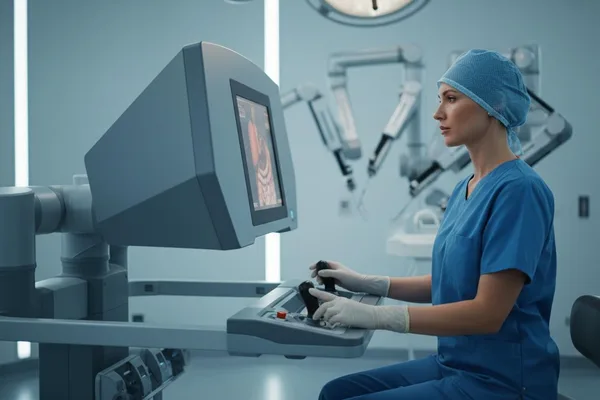
- Control center: This is where the doctor sits during the surgery. It looks like he's playing a video game, but it's much more advanced. The screen here gives you a 3D, very clear, and magnified view of the surgical site. This is where the doctor precisely controls the robotic arm.
- Patient cart: This is the area closest to your bed during surgery. The robotic arm and all the other equipment needed for the surgery are located in this cart.
- Vision cart: This is the brain of the entire system. It houses all the software and hardware needed to operate the machine. It also has a separate screen so that others in the operating room can watch the surgery.
What kind of surgeries are performed with the 'da Vinci' robot?
This technology is used by various specialists for various surgeries. However, this is not a facility available in all hospitals. You can talk to your doctor to find out if this method is suitable for you. The table below shows some of the surgeries that are commonly used with this method.
| Type of surgery (Medical Term) | Simple explanation |
|---|---|
| Hysterectomy | Hysterectomy |
| Gallbladder removal (Cholecystectomy) | Gallbladder removal surgery |
| Mitral valve repair | Mitral valve repair |
| Polypectomy | Removal of small growths (polyps) in the body |
| Colostomy | Surgery to connect part of the large intestine to the outside of the body |
| Splenectomy | Spleen removal surgery |
How is a 'da Vinci' surgery performed?
Although there are slight variations depending on the type of surgery you are having, every da Vinci procedure begins the same way.
1. First, an anesthesiologist will give you general anesthesia and put you to sleep during the surgery. You won't feel anything.
2. The surgical team then prepares the 'da Vinci' robot and brings the patient cart to your bedside.
3. The doctor makes several very small incisions (perhaps about a centimeter) where the surgery is needed.
4. Next, surgical instruments and a camera are carefully inserted into the body through those small incisions.
5. Then the devices are attached to the robot arms.
6. Now the doctor sits in the control center. From there, he clearly sees the inside of the body on a screen and uses the controls to move the robotic arms to perform the surgery.
7. Once the surgery is completely finished, the doctor will remove the instruments and sew up the small incisions.
What are the advantages and disadvantages of this method?
Like anything, this method has both advantages and disadvantages.
Advantages of this method
This method has several advantages over traditional surgery.
| The main advantages of 'da Vinci' surgery | |
|---|---|
| Benefits during surgery | |
| Less bleeding | Because the incisions are small, bleeding is very minimal. |
| Less damage to tissues | Precise control minimizes unnecessary damage to surrounding tissue. |
| Benefits after surgery | |
| Less pain and scarring | Since there is no big incision, there is less pain and it seems like there are no scars left. |
| Get well soon | The hospital stay is shorter, and you can resume normal activities sooner. |
| Fewer complications and infections | The risk of infection is low because the wounds are small. |
Disadvantages of this method
There are risks with any surgery. This method also has two disadvantages:
- Longer time: Preparing the robot and performing the surgery may take a little longer than a typical surgery.
- Cost: Because this is a new and advanced technology, the cost may be slightly higher than a regular surgery.
When do you need to see the doctor?
After surgery, don't forget to go to follow-up clinics on the days your doctor tells you to come. It's very important for your recovery.
In addition, if you experience any of the following symptoms, notify your doctor immediately.
- If the incision area is discolored, swollen, red, oozing pus-like fluid , or is in severe pain (these may be signs of infection).
- If you have a fever over 100.4 degrees F (38 C).
- If there is excessive bleeding.
If you have any doubts, don't be afraid to talk to your doctor.
What to do in an emergency?
If you have any of the following symptoms, it could be an emergency. Don't waste time and go to the nearest hospital's Emergency Department (ETU) immediately.
- Difficulty breathing
- Severe chest pain
- Sudden loss of consciousness (fainting)
- Uncontrollable bleeding
- Even with painkillers, the pain is getting worse and worse.
Take-Home Message
- The 'da Vinci' surgery is a highly precise surgical procedure performed by a doctor using a robotic machine.
- The robot doesn't do anything on its own, the doctor has complete control.
- The incisions in this method are very small, so there is less pain, less scarring, and faster recovery.
- Not all hospitals have this facility. If you need surgery, talk to your doctor about whether this method is right for you.
- If you develop symptoms such as fever, wound swelling, or excessive bleeding after surgery, notify your doctor immediately. If you experience difficulty breathing, go to the ETU immediately.




💬 Comments (0)
No comments yet. Be the first to share your thoughts here.
Add Your Comment