

You've probably seen it in the movies, right? When someone's heart suddenly stops, the doctors rush in, put a device like two iron rods in their chest, shout 'Clear!' and give them a 'shock.' Then the person starts to shake and start breathing again. What exactly is that? How does it save a life? That's the life-saving treatment, defibrillation, that's what we're talking about today.
Simply put, what is defibrillation?
Defibrillation is the process of administering an electric shock to the heart to restore a normal rhythm, or arrhythmia, in the event of a very dangerous and life-threatening heart rhythm disorder. It is like restarting a computer when it has 'hung'. When the heart's electrical system is disrupted and the heart starts to quiver, this electric shock stops the disruption for a moment and gives the heart a chance to resume its normal rhythm.
This treatment is especially necessary in two dangerous disorders:
- Ventricular Tachycardia - Pulseless: This is when the lower chambers of the heart (ventricles) beat too fast, but so fast that the heart doesn't have time to pump blood to the body.
- Ventricular Fibrillation: This is the most common cause of Sudden Cardiac Arrest . This is when the heart muscle stops beating properly and starts quivering. As a result, the heart does not pump any blood.
In both of these situations, the sooner defibrillation treatment is administered, the greater the chance of saving the patient's life.
Who needs this treatment?
Anyone with the above-mentioned dangerous heart rhythm disorders may need this treatment. In a hospital, this is done by the medical team. However, even outside the hospital, even a regular person can receive this life-saving treatment using a device called an Automated External Defibrillator (AED), which is available in public places like airports and large shopping malls. The device itself provides instructions.
However, some people are at a much higher risk of developing this dangerous heart rhythm. Such people need to carry a defibrillator with them at all times.
Personal Defibrillators
There are two main types of these:
1. Wearable Cardioverter Defibrillator: This is a device that is worn under clothing, like a vest. The sensors here touch the skin and constantly monitor the heart's rhythm. If a dangerous irregularity is detected, the necessary electric shock is delivered at that moment.
2. Implantable Cardioverter Defibrillator (ICD): This is a small device that is surgically implanted under the skin of the chest. It also constantly monitors the heart's rhythm and, in case of a dangerous situation, delivers an electric shock to restore the heart to normal. Many people confuse this with a pacemaker. A pacemaker only controls the heart's rate. But an ICD, in addition to controlling the rate, can also deliver a 'shock' to stop a life-threatening rhythm.
How is defibrillation treatment performed?
Let's look at the steps involved in an emergency. This is usually done in a hospital's Emergency Treatment Unit (ETU) or Intensive Care Unit.
The most important thing is that until the defibrillator is ready, the patient must be given CPR (Cardiopulmonary Resuscitation) , that is, chest compressions and artificial respiration.
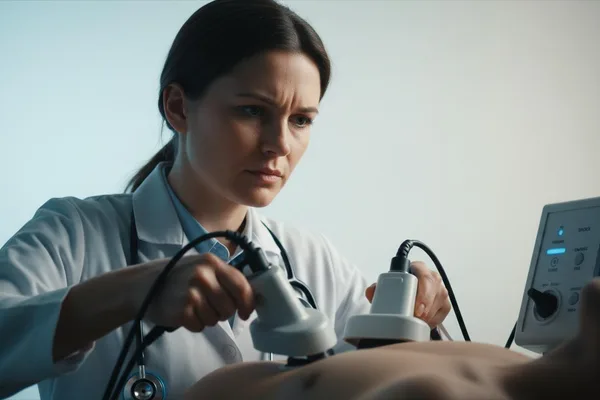
During the treatment, the person administering the electric shock will shout "Clear!" and warn the patient not to touch the patient or the bed they are on. Doing so could cause them to be electrocuted.
| Steps | What is happening? |
|---|---|
| 1. Attaching the Pads | Two sticky pads connected to the defibrillator are placed on the patient's chest in the correct locations. One is placed below the right shoulder and the other below the left nipple. |
| 2. Rhythm analysis | The device analyzes the heart's electrical rhythm and determines whether there is a dangerous rhythm that requires a shock. |
| 3. Giving electric shock | The doctor or trained person, after warning everyone to stand back ("Clear!"), presses a button on the device and delivers an electric shock. |
| 4. After treatment | After the shock is given, CPR is immediately resumed for two minutes. Then the pulse and heart rhythm are checked. If necessary, more shocks and medications (e.g. epinephrine, amiodarone) are given. |
What happens after treatment? How is recovery?
Even if defibrillation treatment saves lives, the journey to recovery can be a long one, lasting months, even years . After a sudden cardiac arrest and defibrillation treatment, many people may experience some degree of disability.
- Physical discomfort: Rib fractures in the chest can occur during CPR. Extreme fatigue and difficulty walking are common.
- Other complications: Some people may experience problems with memory and speech.
- Rehabilitation: This requires physical therapy, occupational therapy, and speech therapy.
If you see someone suddenly losing consciousness and falling, call 1990 immediately and call an ambulance! In the meantime, if you can, perform CPR.
People who survive Ventricular Fibrillation are more likely to have it again. So your doctor will find the cause and treat it, and will often recommend that you have an ICD implanted. If you have an ICD, it is important to see your doctor for regular checkups and take your medications exactly as prescribed.
Are there any risks in this?
The main risk is that defibrillation therapy is given to a heart rhythm that does not require it . For example, if this 'shock' is given to someone who has a pulse, or to someone who does not have Ventricular Fibrillation, it can cause a dangerous irregularity in a healthy heart and lead to cardiac arrest. This is why only trained medical professionals or specially designed AED devices are used for this purpose.
Take-Home Message
- Defibrillation is a life-saving treatment that restarts the heart by delivering an electric shock in the event of a dangerous cardiac arrhythmia.
- This is like 'restarting' the heart.
- In the event of a cardiac arrest, it is very important to start CPR and bring a defibrillator as soon as possible. Time is life.
- If someone suddenly falls, call 1990 immediately.
- Recovering from this condition is a long process, and medical advice, rehabilitation treatment, and patience are very important.
- If you have an ICD device implanted, it is essential to maintain regular contact with your doctor and undergo regular checkups.




💬 Comments (0)
No comments yet. Be the first to share your thoughts here.
Add Your Comment