

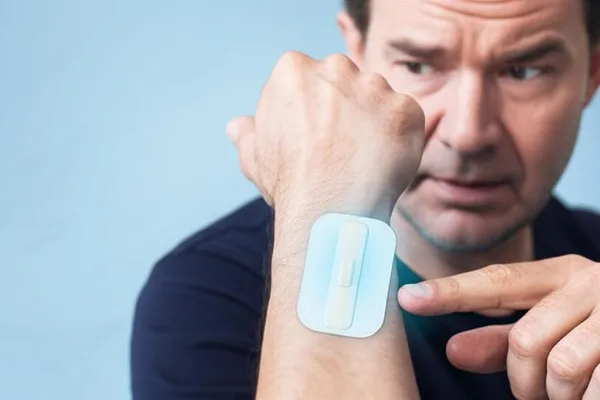
You may think that living with diabetes can be a challenge at times. You have to think about what you eat and drink. You have to prick your finger several times a day to check your blood sugar. Some people even have to inject insulin. So when you hear about this new technology, Diabetes Patches, you might think, "Oh... this would be a great convenience." But let's see if this story is true and how much of it can be trusted.
Are all patches the same?
Simply put, no . Not all "diabetic patches" on the market are the same. There are big differences between them. We should only trust the types of patches that are recommended by doctors and have been approved by proper tests. These approved patches can be divided into two main categories:
1. Insulin delivery patches: These deliver the same amount of insulin you would get from an injection, through the skin.
2. Blood sugar sensors: These can be worn on your body and can monitor your blood sugar levels throughout the day.
These are not just stickers. These are parts of complex medical device systems designed to manage diabetes. They have been thoroughly tested and approved by agencies like the FDA in the United States to ensure they are safe for human use.
However, the types of patches sold online and on Facebook as "Diabetic Patches" that can be purchased over the counter at pharmacies are completely different . They claim that these patches, made from various plant extracts, will cure diabetes. But the truth is, there is no scientific evidence to prove that these work. They haven't even been properly researched.
Types of diabetic patches and their differences
To make this point clearer, let's look at these different types of patches separately. I'll show you this in this table so that you can easily understand it.
| Patch type | Functionality | The most important thing |
|---|---|---|
| Insulin Patch-Pump | This is a small device. You fill it with the insulin you need and stick it on your body with a patch. The insulin goes into the body through a very small needle on the patch. | A doctor's prescription is mandatory. Research shows that people who use these require less insulin than those who take daily injections. |
| Continuous Glucose Monitoring (CGM) | A sensor that is attached to the skin. This can be scanned with a smartphone or other device to see how your sugar levels are and how they change throughout the day. | This does not provide medication, it only measures blood sugar levels. A doctor's prescription is mandatory. |
| Patches in research stage | Researchers are trying to create a patch that delivers insulin without any other device, similar to the nicotine patch used to quit smoking. | It's still in the research stage . Even if it's successful in animals, it will be a long time before it can be used on humans. |
| Herbal/OTC Patches sold online | These contain a mixture of Chinese herbs, which are said to enter the body through the skin and cure diabetes. | There is no scientific evidence. Doctors do not recommend it. Using these can lead to dangerous situations where diabetes cannot be controlled. |
The truth about Chinese herbal medicine and diabetes
Some may think, "If China uses herbal medicine like this for diabetes, why can't we?"
Doctors and research say that's not a good idea. There's very little research on whether plant extracts can be administered through the skin to control diabetes. One large study looked at how Chinese herbal medicine might help with neuropathy, a condition caused by diabetes.
Although 38 Chinese herbal remedies were analyzed, no clear evidence was found that any of them could help with diabetic neuropathy. They also found that the side effects of these products were poorly documented.
That means the risks are high. Stopping the medication your doctor prescribes and using something unproven like this will only make your condition get worse and worse out of control.
Patches for diabetes and other diseases
Currently, there is no single patch (with or without a doctor's prescription) that can control diabetes alone. Each of the successful patches we discussed earlier is just part of a complex medical system.
However, there are some types of patches that are used for other health problems that a person with diabetes may experience. Think about it this way.
- For high blood pressure: Many people with diabetes also have high blood pressure. There is a patch that contains a medicine called `(Clonidine)`.
- For bladder problems: Diabetes can cause nerve damage, causing some people to have bladder control problems. There is a patch that contains a medicine called Oxybutynin.
- For chest pain: Diabetes increases the risk of coronary artery disease and chest pain (angina). A patch called transdermal nitroglycerine is used for this.
You need to understand that these are not patches for diabetes, but for other conditions that can occur due to diabetes. These should only be used under the advice of your doctor.
Why are we attracted to such "natural" things?
You may be wondering how great it would be to be able to cure your illness with a "natural" herbal patch. That's normal. Sometimes, the medications your doctor prescribes may not have the desired results. Or, they may have unpleasant side effects.
Another major reason is the high cost of medicines . The price of insulin in particular has increased significantly in recent times. So, at a time like this, it is not surprising to think that it is possible to cure the disease at a lower cost.
However, the best thing you can do is not to pursue unproven treatments like this. If you need to reduce your medication, or if you have concerns about your current treatment, talk to your doctor about it openly.
Also, follow your doctor's advice to lose weight, eat a healthy diet, and exercise daily. It takes dedication and hard work, but these are the best "natural" ways to bring your blood sugar levels back to normal. Then you can delay or completely stop the serious complications of diabetes.
Take-Home Message
- Medically approved diabetes patches (e.g., insulin pumps, CGM sensors) are not just stickers, they are parts of complex medical device systems. They should be used only as directed by a doctor.
- "Natural" or "herbal" diabetes patches sold online, on social media, or in some stores have no scientific basis. Using them could harm your health.
- Currently, there is no single "magic" patch in the world that can control diabetes.
- If you are interested in the treatments you are taking or other alternative methods, do not trust information found on the internet, and always talk to your doctor.
- The best "natural" ways to control diabetes are a healthy diet, exercise, and maintaining a healthy weight.




💬 Comments (0)
No comments yet. Be the first to share your thoughts here.
Add Your Comment