

Imagine you've applied for a new job, or you've had an accident and ended up in the hospital. What if you were suddenly told that you need to take a "drug test"? You'd be a little nervous, wouldn't you? What exactly is a drug test? Why is it done? How do you interpret the results? You've probably never thought about it. But this is something we all need to know. So let's talk about it simply and clearly.
Simply put, what is a drug test?
A drug test is a test to determine whether you have a legal or illegal drug in your body. This uses a biological sample taken from your body, for example, urine or blood.
When we think of "drugs," we usually think of illegal substances, but these tests cover a much broader spectrum. That is, they include:
- Legal things - like alcohol and tobacco.
- Over-the-counter medications can be purchased from the pharmacy without a prescription.
- Prescription medications prescribed by a doctor.
- Illegal drugs.
The most important thing is that a single test cannot tell exactly how long or how much someone has been using drugs. This means that this test alone is not enough to distinguish between someone who uses drugs occasionally and someone who is addicted to drugs.
The different drugs we take are broken down (metabolized) by our bodies at different rates. Therefore, while some drugs can remain in the body for a few days, others can remain in the body for weeks. This means that the time period for which drugs can be detected varies. The most commonly used test for this is urine drug testing (UDT).
In what cases is it necessary to perform such a test?
There are several reasons why you might need to take a drug test. Let's take a look at what they are.
At work
This is the most common reason. Institutions may request this test for several reasons.
- Before hiring a new employee: This may be mandatory, especially if you are moving abroad or in a job with high responsibility.
- While on the job: Some organizations conduct these tests randomly or on a schedule.
- When drug use is suspected: If suspicion arises due to changes in an employee's behavior, such as absenteeism at work.
- After an accident at work: To find out if drug use was the cause of the accident.
For medical reasons
- Diagnosis and treatment: These tests are used to monitor and treat people with alcohol or drug addiction. They help determine whether they are responding well to treatment, staying sober, or relapse.
- Emergencies: If someone is hospitalized suddenly due to a drug overdose or poisoning, this test is performed in the Emergency Treatment Unit (ETU) to determine the exact cause of the symptoms.
- Medication Monitoring: If a doctor has prescribed you medications such as opioids, which have a high risk of addiction, your doctor may sometimes request this test to see if you are taking the medication at the correct dosage and whether you are abusing it.
For legal purposes
- Court Orders: These tests are required by court orders when referred to rehabilitation programs or during the probation period.
- Criminal Investigation: To collect evidence for a crime.
- Driving under the influence of alcohol or drugs: Investigations conducted by police officers.
In the field of sports
These tests are mandatory to find out if professional athletes are using performance-enhancing drugs.
What types of drug tests are there?
There are several types of drug tests. They are classified according to the sample taken for the test and the type of drug being tested. Let's look at this clearly in a table.
| Test Type | The sample used | Important information |
|---|---|---|
| Urine Test | Urine/Pee | This is the most commonly used method . It can detect substances such as alcohol, amphetamines , benzodiazepines , opioids , cocaine, and marijuana (THC) . |
| Blood Test | Blood | Often used in emergencies (in the ETU) , it can measure the amount of alcohol (ethanol) in the blood very accurately. |
| Hair Follicle Test | Hair | Information about a person's long-term drug use can be obtained. Information can be obtained for up to 3 months from a hair on the scalp, and up to 12 months from hair elsewhere on the body. |
| Breath Test | Exhalation (Breath) | It is mainly used to determine whether alcohol has been consumed recently . It is a method commonly used by the police. |
| Sweat Test | Sweat | Wearing a special absorbent pad that is attached to the skin collects sweat. During that time, it can be detected whether drugs have been used. |
What does a test find and how?
When a drug enters the body, our liver and other organs break it down. In this process, the drug is converted into other chemicals called 'metabolites'. After a while, these drugs and their 'metabolites' are excreted from the body, mainly through urine.
A drug test checks to see if your sample contains these drugs or their metabolites.
Often, multiple types of drugs are tested in a single sample. The five main types most commonly tested for in a test for illegal drugs are:
- Amphetamines
- Cocaine
- Marijuana
- PCP
- Opioids
In addition, there are many other things you can check. For example:
- Alcohol `(Ethanol)`
- Antidepressants
- Barbiturates
- Benzodiazepines
- Fentanyl
- Heroin
- Morphine
- Nicotine
Is there a drug test that can be done at home?
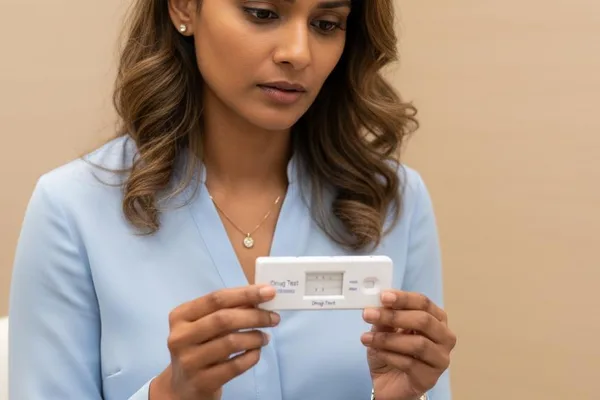
Yes, there are kits on the market that allow you to test a urine sample at home. There may also be kits on the market that test saliva, breath, or hair.
But remember, the accuracy of these can vary . They are generally less sensitive than a laboratory test. This means that even if a home test shows 'Negative' (no drugs), the same sample may still be 'Positive' (drugs present) if tested in a lab.
Additionally, the American Academy of Pediatrics advises parents not to subject their children to these types of tests at home. Studies have shown that these do not reduce drug use in children, and that misinterpretation of the results can damage the parent-child relationship.
How to understand the test results?
The results are usually reported as ``Positive`` or ``Negative``. However, there are a few things to keep in mind when interpreting this.
Understanding a Positive (+) result
- Positive simply means that the drug tested was present in the body at detectable levels within a certain period of time.
- This does not necessarily mean that the person is intoxicated at that moment, nor that they are addicted to drugs.
- False-Positives: Sometimes other medications or foods you take can cause a positive result. For example, eating poppy seeds can cause a positive opioid test. Some common cold medications can cause a positive PCP test.
- Therefore, if the first test is positive, another specific test (confirmatory test) is done to confirm it. That is what leads to the final conclusion.
Understanding a Negative (-) Result
- Negative means that the drug tested could not be identified.
- The reason for this may be that the level of the drug in the body is too low to be detected, or that the drug was used during a period that was not detected by the test.
- This does not necessarily mean that the person has not used drugs recently, nor that they do not have a drug-related problem.
- False-Negatives: Negative results can also occur due to improper sample collection, attempts to cheat the test (e.g., using someone else's urine), or the test not covering the specific drug.
Taking a drug test can be a bit nerve-wracking. But remember, doctors and officials carefully analyze the results. If you have any questions about the process or the results, ask the agency that ordered the test or your doctor .
Take-Home Message
- A drug test is a test that uses a sample of urine or blood to check for the presence of drugs in the body.
- These tests are conducted for various reasons, such as employment, medical, and legal matters.
- A positive result alone does not mean that someone is addicted to drugs. Further tests are needed to confirm this.
- A negative result cannot be 100% guaranteed that someone is not using drugs at all.
- Before undergoing a test, be sure to tell your doctor or the relevant official about all medications and supplements you are taking.
- If you have any concerns or doubts about this, talk openly with the doctor who prescribed it.




💬 Comments (0)
No comments yet. Be the first to share your thoughts here.
Add Your Comment