
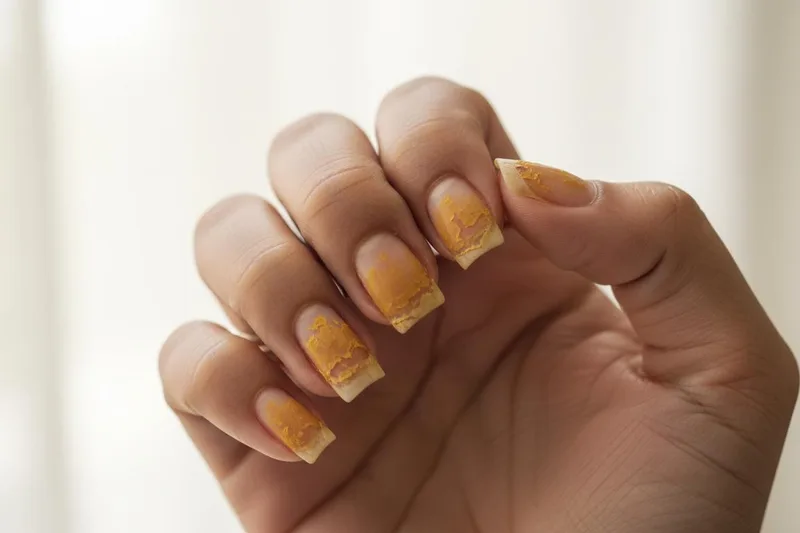
Our fingernails and toenails are really important for our beauty and health, aren't they? Sometimes you've noticed that one or two of your nails, or those of someone you know, have changed color, become thick, or are breaking or chipping. Some people don't pay attention to this, but it can be something that really needs attention.
Simply put, what are these dystrophic nails?
Okay, let's first look at what `(Dystrophic Nails)` is. `(Dystrophic Nails)` is a condition where one or more of your fingernails or toenails are deformed, thickened, and discolored . This is not just a cosmetic issue. There can be many reasons for this. It could be a toenail fungus, or it could be a skin condition. Therefore, it is very important to recognize and treat this properly.
Who is most affected by this condition (Dystrophic Nails)?
Now you may be wondering if this can happen to anyone. Yes, anyone can, but some people are at a higher risk.
- People over 65: They are more likely to develop nail fungal infections. This can happen because as we age, our body's immune system weakens and the blood supply to our nails decreases. Think about our grandparents, their nails have changed at times, right?
- People with skin diseases: For example, people with skin diseases like `(Psoriasis)` (scaly patches) can also have this condition on their nails. `(Psoriasis)` is a disease in which skin cells grow rapidly due to a change in the immune system, and they build up on top of each other, forming red, scaly patches. This can also affect the nails, causing them to develop small pits, change color, and become thick.
What effect can this have on your body?
Some people may feel pain when their nails change like this. Especially if the nail curves inward and penetrates the skin (`ingrown toenails`), the pain is even worse. Imagine how much trouble it is when walking and putting on shoes. Sometimes the wound can become infected and fester.
Also, you may feel a little uncomfortable mentally because your nails look ugly. Who wants to live with ugly nails, right? Some people are reluctant to put on sandals or put their hands outside because of this.
Even if it's not painful, if you notice any changes in your nails , you should definitely tell a doctor . Because the underlying cause may need to be treated. Just treating the nail won't fix it, you need to find the cause.
What are the symptoms of `(Dystrophic Nails)`?
Some people may only see these symptoms on one nail. Others may have them on several nails. See if these symptoms sound familiar to you:
- Nails becoming cracked in places .
- The feeling that the nails are crumbling or peeling . Like chalk powder.
- The nail may be abnormally shaped or curved. For example, the nail may appear to be protruding upwards or sideways, or it may be sinking inwards like a spoon.
- The nail may separate from the skin under the nail or may become detached completely.
- Nails that are thicker than normal. Sometimes the nails can become so thick that they cannot be cut.
- The color of the nails may turn yellow, white, greenish brown, or even black .
What are the main causes of `(Dystrophic Nails)`?
These nail deformities are caused by an infection or injury to the nail, the skin where the nail is located (we call this the `nailbed`). Here are some of the main causes:
- Infections from nail trauma or ingrown nails. For example, if your toe gets stuck in a door or something heavy falls on your foot, the nail can become bruised, broken, and bleed. This can lead to infection and deformity of the nail. Sometimes, when we wear tight shoes, the nail can become compressed and cause problems like this.
- Mycotic nails (nail fungus) or other nail fungus infections (toenail fungus). This is a very common cause. It is especially common in the toenails. This fungus can easily spread in damp environments, such as public bathrooms and swimming pools.
- Psoriasis (skin diseases such as psoriasis). As I mentioned before, people with psoriasis can also experience these problems with their nails. Also, other skin diseases such as eczema can affect their nails.
- Trauma to your nail. For example, getting your toe caught in a door or something heavy falling on your foot can damage your nails and cause dystrophic nails. Some people bite their nails or pick at the skin around their nails, which can also damage their nails.
Is this condition `(Dystrophic Nails)` contagious?
This is also a problem for many people. Yes, if the cause is toenail fungus, it can be transmitted to others. That means you have to be careful with your family and those who live with you. This can be transmitted when you use the same towels, socks, shoes, and even when you use the same bathroom.
However, if the cause is a trauma to the nail or a skin condition like psoriasis, it is not contagious to others. Therefore, it is important to know the exact cause.
How do doctors diagnose this condition (Dystrophic Nails)?
First of all, Dystrophic Nails is not a disease in itself. It is just a sign that some other problem is affecting your nails.
Your doctor will carefully examine your nails. They will look at things like the color, thickness, shape of the nails, and the condition of the skin under the nails. They will then ask about your health history, any other medical conditions you have (e.g., diabetes, psoriasis), any medications you take, and whether anyone in your family has had similar problems. All of this information will be put together to determine the cause.
What kind of tests are done to identify this exactly?
After your doctor looks at your nails and says you have ``Dystrophic Nails'', the next step is to find out exactly what is causing it. This may involve tests such as:
- Blood tests: Sometimes a sample of your blood may be taken to check for infections, other medical conditions, or nutritional deficiencies. This involves taking a small amount of blood with a needle and sending it to a lab for testing.
- Testing a nail sample: If a fungal infection is suspected, the doctor may scrape a small piece of the nail or something like powder from under the nail and send it to a lab to check for the presence of fungus.
- Nail biopsy: This is not done for everyone. However, if the cause is difficult to find, especially if a condition like psoriasis is suspected, this test may be done. This involves taking a small piece (sample) of your nail and looking at it under a microscope in a lab. Don't worry, this is usually done under a numbing agent and is not very painful.
- Physical exam: In this, the doctor examines your entire body and gets an idea of your overall health. You can tell us about any discomfort you are feeling and any other illnesses you may have.
What are the treatments for these `(Dystrophic Nails)`?
Treatment methods depend on the cause. That is, the treatment that is appropriate for the cause is given.
- If you have an ingrown toenail, nail trauma, or bacterial infection , your doctor may prescribe antibiotics (either oral or topical) .
- If you have toenail fungus , you may be given antifungal creams or pills . These may need to be used for a short period of time, sometimes for several months. Sometimes there are also special medicated nail polishes.
- If you have psoriasis, it can be treated with light therapy, steroid creams, other medications, or immune therapy .
- Sometimes, if the nail is very deformed and painful, the doctor may remove all or part of the nail. Don't worry, it's done painlessly. A new, healthy nail will grow back.
Is it okay to try to treat this at home?
No, never try to treat these `(Dystrophic Nails)` on your own without medical advice.
This is very important. Because, if nail problems are not treated properly, they can get worse. They can even lead to serious infections. This is especially important if you have other health conditions like diabetes mellitus . People with diabetes have less sensation in their feet, so even a small wound can easily become larger and infected.
If your nail has been damaged by trauma, it can take several months for the damaged nail to fully grow back (about 6 months for a fingernail, 12-18 months for a toenail). It is best to consult a doctor about how to properly care for your nail during that time.
How can we protect ourselves from this condition called `(Dystrophic Nails)`?
There is no way to prevent this from happening 100%, but there are a few things we can do to protect ourselves from toenail fungus , as fungal infections are a major cause of this.
- Change into a clean pair of socks at least once a day, and whenever your feet get wet (from sweating, getting wet in the rain). If your shoes get wet, change into a dry pair as soon as possible. A moist environment is a good breeding ground for fungi. Use cotton socks if possible.
- Avoid sharing shoes, nail clippers, or towels with other people. These can easily spread the fungus. Use your own personal items.
- When cutting your toenails, cut them straight across. When your nails grow long, they can become infected with fungus. Also, if you cut your nails crookedly or at an angle, you are more likely to develop ingrown toenails.
- Be sure to wear flip-flops or other footwear when using public bathrooms, gym locker rooms, and around swimming pools. Avoid walking barefoot in public areas. Fungi can be common in these areas.
- Always wash and dry your feet thoroughly, especially between the toes.
- Wear well-ventilated, loose-fitting shoes.
So, what should we think about these `(Dystrophic Nails)`? What will happen in the future?
Dystrophic nails are usually not serious. However, some conditions that cause them, such as toenail fungus and psoriasis , require medical attention. If left untreated, the condition can worsen, the infection can spread, and the nail can even be lost completely.
Another thing, if you have diabetes (`Diabetes Mellitus`), you should always check your feet for any minor cuts, scrapes, or nail problems. Because, in people with diabetes, even a small wound can easily become infected and cause major problems. Therefore, do not ignore nail problems, and see a doctor immediately.
When should we see a doctor about this?
Our nails are a good indicator of our overall health. So, if you notice any changes in your fingernails or toenails, it's best to see a doctor for advice. Check each of your nails regularly for the following:
- Changes in nail color. For example, spots or streaks on the nail, yellowing, whitening, or blackening.
- Changes in the shape of the nails. For example, the nail becomes crooked, or the nail separates from the skin under the nail.
- Changes in the appearance of the nails. For example, the nails may become thicker, thinner, break easily, or crumble.
- Feeling pain, redness, swelling, or tightness around or under the nail .
- A bad smell coming from the nail.
If you see something like this, don't just assume "it's okay" and see a doctor.
What are the important questions to ask the doctor?
When you go to see the doctor, it may be helpful to ask these questions:
- What is the cause of this problem with my nails?
- What treatment do you recommend? How long should it be done?
- What are the side effects of this treatment?
- Will my ``Dystrophic Nails'' condition be completely cured after completing this treatment? How long will it take for a new nail to grow?
- What should I do to prevent this from happening again?
The most important things to remember (Take-Home Message)
Okay, so, this condition called `(Dystrophic Nails)` or nail deformities need not be such a big deal. The most common causes of this are conditions like toenail fungus and `(Psoriasis)` , which can be treated and cured.
Especially if you have a condition like diabetes, treating even minor problems with your feet and nails quickly can prevent serious complications like infections.
The important thing is that your doctor can find the real cause and give you the right treatment. In most cases, with the right treatment, you can get healthy, beautiful nails again. So, if you notice a change in your nails, don't ignore it, and seek medical advice immediately. Your health is in your hands!
` Nails, Nail Deformities, Dystrophic Nails, Nail Fungus, Nail Infections, Ingrown Toenails, Psoriasis, Nail Treatment, Nail Care, Yellowing Nails, Thickening Nails




💬 Comments (0)
No comments yet. Be the first to share your thoughts here.
Add Your Comment