
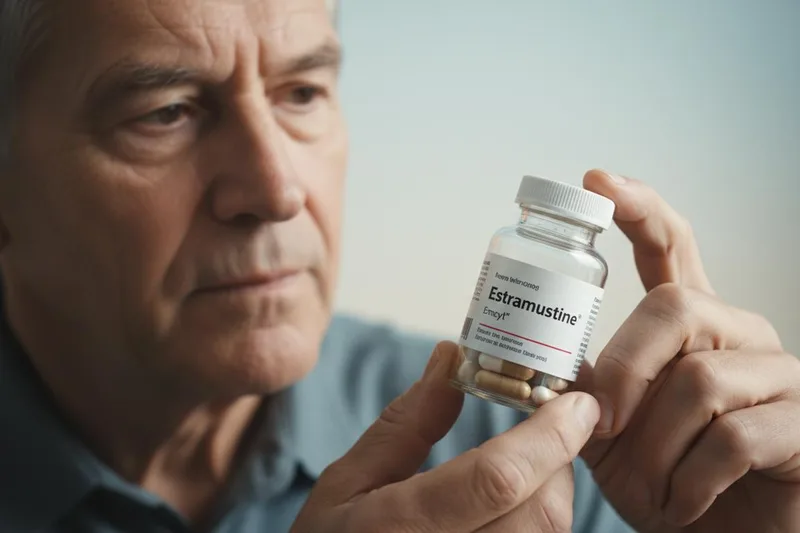
When you or someone close to you is told that you have prostate cancer, it is normal to have many questions about the medication that is given to you. Estramustine is a special medication that doctors use in such cases. Simply put, it is a medication that belongs to the chemotherapy group. It works by controlling the growth of cancer cells. This medication may also be available on the market under the name Emcyt. But the name that your doctor prescribes is important. In this article, we will talk in detail about this medication, that is, what it does, how to use it, and what you need to be careful about.
Before starting this medication, you should definitely tell your doctor about these things, right?
Yes, before you start using Estramustine, it is very important to give your doctor a complete description of your health condition. Because people with certain diseases need special care when giving this medicine. So if you have any of these things, you should definitely tell them:
- If you have any blood disorders.
- If you have diabetes (`(Diabetes Mellitus)`).
- If you have heart disease.
- If you have an infection, especially a virus infection such as chickenpox, cold sores, or herpes.
- If you have kidney disease.
- If you have a migraine.
- If you have seizures (convulsions) such as epilepsy.
- If you have previously had an allergic reaction to estramustine, estrogens, other chemotherapy drugs, other medications, foods, artificial colors, or preservatives.
- If you are pregnant or trying to get pregnant.
- If you are a breastfeeding mother.
If you tell these things accurately, your doctor can plan the treatment that best suits you.
How exactly do I use this medicine?
It is very important to take this medicine exactly as your doctor tells you to, because that is how you will get the most out of it and minimize side effects.
This comes in the form of capsules. You should take this with a glass of water. The most important thing is to take this medicine on an empty stomach. That is, you should take it at least one hour before or two hours after eating. Do not take this with food. Especially do not take this with foods that are high in calcium, such as milk, cheese, and yogurt. Because calcium can reduce the absorption of this medicine into the body.
Take the medicine exactly as your doctor tells you on the prescription label, at the right time, in the right amount. Do not take more than your doctor tells you to take, or take it more often. Continue taking this medicine until your doctor tells you to stop.
If you are giving this medicine to children, you should talk to your pediatrician about it. It may require special care.
If you accidentally take too much medicine: If this happens, and you think you have taken more medicine than you thought, do not panic and immediately call the nearest hospital emergency room or poison control center for advice.
Remember this: This medicine is for you only. Do not share your medicine with others, even if they have the same illness as you. Not all medicines work for everyone.
What do you do if you miss a medication appointment?
If you forget to take a dose, take it as soon as you remember. However, if it is almost time for your next dose, within a few hours, skip the missed dose and take your next dose at the scheduled time. Never take a double dose. Doing so may increase the amount of medicine you are taking and cause side effects. If you are unsure, ask your doctor or pharmacist.
What other medications may interact with this medicine?
Yes, there are some medications that can cause problems when taken with estramustine. Therefore, if you are taking any other medications, whether prescribed by a doctor or purchased from a pharmacy, it is essential to tell your doctor about all of them.
Do not take Estramustine with the following medications:
- Nalidixic acid (`(nalidixic acid)`)
Also, Estramustine may interact with the following medications. So talk to your doctor before taking them:
- Calcium supplements (as mentioned earlier, remember not to take milk with calcium-rich foods.)
- Medicines that increase the number of blood cells, for example, filgrastim, pegfilgrastim, sargramostim
- Types of vaccines (some vaccines are not compatible with this medicine, because immunity is low)
Another thing, if you are taking these types of painkillers, tell your doctor about that too:
- Acetaminophen (also commonly called paracetamol)
- Aspirin (`(aspirin)`)
- Ibuprofen (`(ibuprofen)`)
- Ketoprofen (`(ketoprofen)`)
- Naproxen (`(naproxen)`)
This list may not include all interactions. So tell your doctor about all the medications you take, including herbal products, vitamins, non-prescription drugs, and dietary supplements, as well as if you smoke, drink alcohol, or use other drugs. Some of these things can interact with your medication.
What should I be especially careful about when taking this medicine?
While taking this medicine, your doctor will need to see you regularly (`(check-ups)`) to check your progress. Chemotherapy medicines affect not only cancer cells, but sometimes healthy cells in our body as well. So it is normal for you to feel a little more uncomfortable, sick, or tired than usual. But if you have any side effects, tell your doctor. Continue taking the medicine as prescribed, even if you feel sick, until your doctor tells you to stop.
Sometimes, you may be given additional medications to help control side effects. Be sure to use these medications exactly as directed.
Important: If you have a fever, chills, sore throat, or symptoms of a cold or flu, call your doctor right away. Do not self-medicate. This medicine may reduce your body's ability to fight infections. Therefore, try to stay away from people who are sick as much as possible. Also, be careful when going to crowded places.
This medicine may increase your risk of bleeding or bruising. If you notice any unusual bleeding, such as nosebleeds, bleeding gums, pinpoint red spots under the skin, black, tarry stools, or blood in the urine, tell your doctor right away.
Be careful when brushing your teeth, flossing, or using toothpicks. Use a soft toothbrush. This is because you can easily get bacterial infections and your gums may bleed during this time. If you are having any dental work done, tell your dentist that you are taking this medicine.
Unless your doctor tells you to, do not take medications that contain aspirin, acetaminophen, ibuprofen, naproxen, or ketoprofen. These medications can suppress your fever, making it harder to tell if you have an infection.
It is very important that both men and women use effective birth control methods to prevent pregnancy while taking this medicine. Do not become pregnant while taking this medicine. This is because there is a potential for serious side effects to an unborn child. Ask your doctor or pharmacist for more information. Women should avoid breastfeeding while taking this medicine.
What side effects might I experience from this medication?
Like any medicine, estramustine can cause some side effects. Not everyone gets them, but it's good to be aware of the possible ones. Some of them should be reported to your doctor right away, while others should be reported only if they persist or become bothersome.
Side effects that require immediate medical attention:
If you experience any of these symptoms, tell your doctor or healthcare provider as soon as possible:
- Allergic reactions - skin rash, itching or hives, swelling of the face, lips, or tongue
- Signs of infection - fever or chills, cough, sore throat, pain or difficulty passing urine
- Signs of decreased platelets or bleeding - bruising, pinpoint red spots on the skin, black, tarry stools, blood in the urine
- Breathing problems
- Changes in vision (`(changes in vision)`) - sudden blurred vision
- Chest pain (`(chest pain)`) - This can be a symptom of a heart attack
- High blood pressure (`(high blood pressure)`)
- Pain, swelling, warmth in the leg - This could be a blood clot.
- Swelling of the ankles, feet, hands (`(swelling of the ankles, feet, hands)`)
- Problems with balance, talking, walking (`(trouble with balance, talking, walking)`) - suddenly speaking seems to be confused, walking seems to be like walking
- Frequent vomiting (`(vomiting)`)
- Sudden weight gain
- Yellowing of the eyes or skin - This could be a liver problem.
Side effects that should be sought medical advice if they persist or are bothersome:
These side effects usually do not require medical attention. However, if they persist or bother you, tell your doctor:
- Breast enlargement or pain in both males and females (`(breast enlargement in both males and females)`)
- Changes in sexual desire or performance (`(change in sex drive or performance)`)
- Diarrhea
- Dry skin
- Loss of appetite
- Nausea (feeling like vomiting)
- Stomach upset, stomach fullness (`(stomach upset)`)
- Trouble sleeping
This list may not include all side effects. Talk to your doctor for medical advice about side effects. You can also report side effects to the FDA (Food and Drug Administration) at 1-800-FDA-1088.
How should I store my medicine?
Keep this medicine in a safe place, high up, out of the reach of children.
This should be stored in the refrigerator at a temperature between 2 and 8 degrees Celsius (36 and 46 degrees Fahrenheit). Do not keep any unused medicine that has passed its expiration date, and dispose of it properly. You can ask your pharmacist about this.
Another thing to remember: This is just a summary of what we've talked about. It may not include every detail. If you have any more questions about this medicine, talk to your doctor, pharmacist, or other healthcare provider. They can explain anything to you.
So, what are the things we need to remember from what we've talked about?
Estramustine is a chemotherapy drug used to treat prostate cancer. It controls the growth of cancer cells.
- The medicine should be taken on an empty stomach, with water. Take it one hour before or two hours after a meal. Do not take it with milk or calcium-rich foods.
- Be sure to tell your doctor about any other medications you are already taking, any other illnesses you have, and any allergies you have.
- Be careful of infections and bleeding while taking the medicine. If you notice anything like fever, severe bruising, or unusual bleeding, tell your doctor immediately.
- Both men and women should use effective birth control to prevent pregnancy. Do not become pregnant or breastfeed while taking this medicine.
- Side effects may occur. If you experience any serious side effects such as difficulty breathing, chest pain, or swelling of the legs, seek medical advice immediately.
- Keep the medicine in the refrigerator, out of the reach of children. Throw away expired medicine.
If you have any questions about this medicine, don't be afraid to ask your doctor. They will help you. Your well-being is the most important thing to them.
` Estramustine, anticancer, prostate cancer, chemotherapy, Emcyt, cancer medicine, side effects


💬 Comments (0)
No comments yet. Be the first to share your thoughts here.
Add Your Comment