
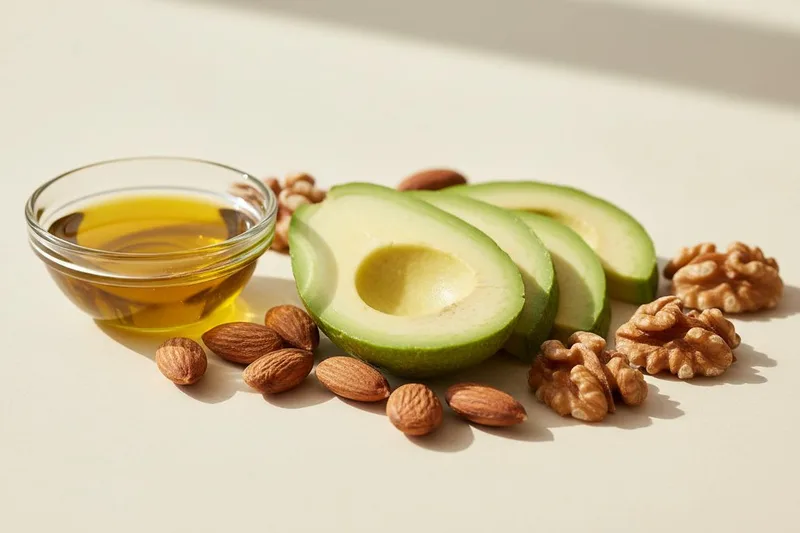
When we hear the word fat, we sometimes get a little scared, don't we? Some people think, 'Oh, fat is not good to eat.' But did you know, fat is actually an essential nutrient for our bodies. Not all fats are bad, and some types of fats are essential for our bodies to function. So, today we're going to dispel the misconceptions about this fat and talk about the real details.
What does fat do to our bodies?
Simply put, fat is one of the four main nutrients that provide energy to our bodies. The others are protein, carbohydrates, and water. We call these macronutrients .
One of the unique things about fat is that it is high in calories compared to other nutrients. Just think, one gram of fat has 9 calories. But one gram of protein or carbohydrate has only 4 calories. That's more than double! So fat is a highly concentrated source of calories.
Fat is a type of triglyceride in the chemical group `(Lipids)` . Our body needs these `(Lipids)` or fats to do several special jobs. Just think, the walls of billions of cells in our body are made up of fats. Also, fats help to store and transport certain things inside the body. For example, fat is essential for the body to properly absorb fat-soluble vitamins like vitamins A, D, E, and K. Fat helps our body to use these vitamins properly.
Another thing is that fat helps us feel 'enough, full' when we eat. This is called satiety . This means that it is also important to control our overeating. So when there is a little fat in a meal, we feel full quickly, so we eat less than we should.
But here's the thing, the fat we eat doesn't get stored directly as body fat, that is, as adipose tissue . That only happens if we consume more calories (whether they come from protein, carbohydrates, or fats) than we need per day. That is, if we consume more calories than we burn for energy, our body stores them as fat and grows.
So what types of fats are there?
We often categorize fats into 'saturated' and 'unsaturated'. But it's actually a bit more complicated than that. To be precise, there are four main types of fats that we get from food:
- Monounsaturated fats
- Polyunsaturated fats
- Saturated fats
- Trans fats
Now let's look at each of these types separately.
What are monounsaturated fats?
These are also called monounsaturated fatty acids (MUFAs) . We mainly get these from:
- From avocados and avocado oil
- Various nuts and their oils (e.g. peanuts, almonds, cashews)
- From olives and olive oil
Doctors recommend that 20% or less of our total daily calories should come from these monounsaturated fats. If the average adult is recommended to consume about 2,000 calories per day, then about 400 calories should come from this type at most.
Let's also learn about polyunsaturated fats!
These are also called polyunsaturated fatty acids (PUFAs) . Some of these are essential fatty acids . This means that our bodies cannot do without them, and our bodies cannot make them. Therefore, we need to get them from the foods we eat.
Essential polyunsaturated fatty acids are:
- Omega-3 : A man needs about 1.6 grams per day, and a woman needs about 1.1 grams.
- Omega-6 : A man needs about 17 grams per day, and a woman needs about 12 grams.
There are two main types of omega-3 fatty acids, and they come from different sources:
- Long-chain omega-3s : These are found mostly in oily fish, such as herring, mackerel, salmon, sardines, trout, and shellfish. They are also abundant in breast milk.
- Short-chain omega-3s : These are found mainly in vegetables and plants. They are found in green vegetables like spinach, canola oil, flaxseeds and flaxseed oil, soybeans, walnuts and walnut oil.
There are many sources of omega-6 fatty acids. Some examples are:
- Corn and corn oil
- Eggs
- Legumes like soybeans and soybean oil
- Sesame seeds and sesame oil
- Sunflower seeds and sunflower oil
- Soft margarine
- Wheat germ
Aren't saturated fats so good?
Saturated fat is a type of fat that is solid at room temperature. It is not harmful in very small amounts . Doctors recommend that less than 10% of our total daily calories come from saturated fat.
But research has shown that consuming too much saturated fat can be harmful to your health . This is because it can increase your risk of developing cardiovascular disease, or heart disease . In particular, it is thought that this is because it raises the level of bad cholesterol, or LDL cholesterol , in our bodies. That is why doctors strongly recommend that we limit the amount of saturated fat we eat and how often we eat it.
The main foods high in saturated fat are:
- Animal fats (e.g. Lard, Tallow)
- Cocoa butter and chocolate (especially milk chocolate)
- Coconut milk and coconut oil (although these contain saturated fats, there are varying opinions about using them in moderation)
- Dairy foods, especially butter, cream, skim milk, and some cheeses
- Palm oil
- Red meats (beef, lamb, pork)
Trans fats – this is the most dangerous!
Trans fats are very similar to saturated fats. The only difference is a slight difference in chemical structure. Both are solid at room temperature, and both raise bad cholesterol (LDL cholesterol). But trans fats do something even worse – they lower good cholesterol (HDL cholesterol)! This HDL cholesterol is the good kind of cholesterol that protects our heart.
There are two ways trans fats can come in:
- Natural sources : Red meat and dairy products may contain very small amounts. Small amounts are also produced when vegetable oils are heated to high temperatures (e.g., during deep frying).
- Artificial Sources : Trans fats are created artificially by subjecting liquid vegetable oils to certain chemical processes, such as hydrogenation. These are the most harmful . They used to be found in many baked goods, packaged snacks, and some types of margarine.
But the good news is that many countries around the world, like the United States, have now banned the addition of artificial trans fats to food. The reason for this is the long-term health risks of eating trans fats. There is also evidence that trans fats increase the risk of cancer and other diseases.
So can we classify fats as good and bad?
In fact, when talking about fats other than trans fats, it's hard to say 'this is good, this is bad.' Trans fats are always bad, there's no doubt about it!
But let's look at the others. Research shows that sources of saturated fat, sometimes labeled 'bad' (e.g., full-fat dairy, dark chocolate, unsalted meat), when consumed in moderation, do not necessarily increase the risk of heart disease.
Also, while the so-called 'good' unsaturated fats (i.e. monounsaturated and polyunsaturated fats) are good for the body, they are not good if consumed in excess. Too much of anything is not good, even the nectar is poisonous. That is why doctors say that we should be careful about the amount of unsaturated fats we add to our meals.
Is low-fat food always good?
No, it doesn't always happen that way. Think about it, when you reduce the fat in a food, it changes its taste, often making it taste worse. So what do food companies do? They add more sugar and carbohydrates to 'low-fat' foods to compensate for that taste. But over time, this extra sugar and carbohydrates can increase the risk of developing diseases like Type 2 diabetes .
So, to avoid one bad thing and end up with another, we need to read the nutrition label on food packages carefully. Be especially careful about the amount of carbohydrates and sugar in it. Don't assume that something is good just because it says "fat-free" or "low-fat."
If you have any questions about this, talk to your primary care provider. He or she can give you more information and guidance. They may also refer you to someone like a dietitian or nutritionist.
Is there such a thing as a high-fat diet?
Yes, there are some diets that prioritize fats and proteins over carbohydrates. An example is the ketogenic diet . This type of diet can be beneficial for some diseases, such as treatment-resistant epilepsy. However, it is not suitable for everyone. For some people, the keto diet can put extra strain on the liver or kidneys. Therefore, never start a keto diet without medical advice.
When you go to the supermarket and buy food, there are times when you get confused before you even look at the nutrition labels. It's normal to feel lost and confused about whether this fat is good or bad. You're not alone, many people are like that.
Your family doctor can help you find out more about this. Learning to read nutrition labels and identify the different types of fats can be an important first step. Once you know what to look for, making decisions about fats and other foods will not be so difficult.
So, what message should we remember from this story?
Very simple. Fat is not our enemy, it is our friend! But with conditions.
- Not all fats are bad: There are essential fats for our bodies. Without them, we cannot be healthy.
- Avoid trans fats at all costs: These are the real bad ones. Avoid foods containing artificial trans fats as much as possible.
- Limit saturated fat: Limit saturated fat, which is found in things like red meat, high-fat dairy products, palm oil, and coconut oil, to a minimum.
- Prioritize good fats: Add unsaturated fats (monounsaturated and polyunsaturated) found in avocados, olive oil, nuts (peanuts, cashews, almonds), flax seeds, and oily fish (like salmon, sardines) to your diet.
- Quantity matters: Even though it's the best type of fat, it's not good to have too much. Keep everything in balance.
- Read labels: Don't be fooled by the words 'low-fat'. Also check the sugar and carbohydrate content.
- Seek medical advice: If you have any questions about fats or nutrition, don't be afraid to ask your doctor.
Remember, a balanced diet is very important for a healthy life. In that balanced diet, it is important to have the right kind of fat, in the right amount! So let's make wise choices, make friends with fat, and stay healthy!
` Fat, nutrition, healthy eating, diet, cholesterol, heart disease, unsaturated fats, saturated fats


💬 Comments (0)
No comments yet. Be the first to share your thoughts here.
Add Your Comment