

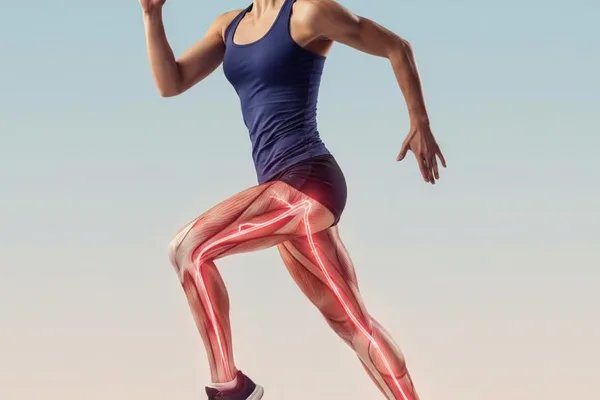
Have you ever wondered how your legs get the energy they need when you're climbing stairs, running after a bus, or just walking around the yard? The muscles in our legs that we use to run, jump, and walk need to be constantly supplied with oxygen and nutrients. So, today we're going to talk about a very important, major blood vessel that helps with all of this, and that gives life to our legs. That's the femoral artery, or as it's called in English, the femoral artery .
So what is the function of the femoral artery?
Simply put, the femoral artery is one of the main blood vessels in our body. It is like a main pipe that carries water from a water pump to a garden. Its main function is to carry clean, oxygenated blood from our heart to the lower abdomen and down the entire length of our legs. Like every tissue in our body, the muscles in our legs also need oxygen and nutrients to function. So that need is met by the blood flowing through this femoral artery.
You have heard of two types of blood vessels: Arteries and Veins. Arteries carry clean blood from the heart to the rest of the body. Veins carry deoxygenated blood back to the heart. Parallel to this femoral artery, or close to it, is the femoral vein . It carries the dirty blood from the legs back up to the heart.
Where is this blood vessel located?
The femoral artery is located at the top of your thigh, near your groin. To be precise, it starts near the groin, where your belly ends and your legs begin. From there, this blood vessel runs almost straight down your thigh and ends behind your knee. Behind your knee, it branches into another artery, called the ``Popliteal Artery''.
What are the main parts of the femoral artery?
This main blood vessel does not continue in one direction. It divides into several main parts and branches.
- Common Femoral Artery: This is the initial part. From this, small branches branch off to supply blood to the tissues of the abdominal wall, the groin, and the surrounding area.
- Deep Femoral Artery: This is a major branch that branches off the common femoral artery. It supplies blood to the thigh bone (femur), hip, buttocks, and the deep muscles of the inner thigh.
- Superficial Femoral Artery: This is an extension of the common femoral artery that runs downward. It supplies blood to the muscles in the front of the thigh and part of the knee.
How big is this? What use is this to doctors?
The common femoral artery is usually about 4 centimeters (about 1.5 inches) long. But its diameter, or thickness, varies from person to person depending on gender, weight, height, and ethnicity. It is usually about 7-8 millimeters.
Because it is relatively large in diameter, it is very useful for doctors in some medical procedures. For example, when treating the blood vessels of the heart, such as during tests such as an angiogram , the doctor can insert a thin tube (catheter) through this femoral artery into the body and bring it closer to the heart. This is called `(Endovascular procedures)`. So this is a good way to reach other blood vessels inside the body.
Common conditions affecting the femoral artery
Like other blood vessels, the femoral artery can be affected by various medical conditions. Let's take a look at the most common ones.
| Medical condition | A simple explanation |
|---|---|
| Peripheral Artery Disease (PAD) | This is the most common disease affecting the femoral artery. This is where things like cholesterol get deposited inside the blood vessels, obstructing blood flow. |
| Blood Clots | A blood clot can form inside a blood vessel and become stuck. This can even stop the flow of blood completely. |
| Aneurysms | The wall of the blood vessel becomes weak and swells up like a balloon. This can even burst. |
What could be the symptoms of these diseases?
If there is a problem with your femoral artery, the following symptoms may occur. You should definitely pay attention to these.
- Pain, stiffness, aching, or fatigue in the leg muscles when walking, especially at a brisk pace or when climbing stairs. This pain usually subsides after a short rest.
- Feeling of swelling or pressure in the leg.
- If you get a wound on your leg or foot, it will take a long time to heal.
- Skin discoloration (especially on the feet).
- Tingling in the leg or loss of sensation in the leg.
Emergency! If you have these symptoms, seek medical advice immediately!
A sudden, complete blockage of the femoral artery is a medical emergency that requires immediate treatment. This happens when something like a blood clot gets stuck.
If you suddenly experience one or more of the following symptoms, go to a hospital's Emergency Department (ETU) immediately . Delayed treatment can lead to serious damage to the leg, possibly even requiring amputation.
- Severe pain in the leg.
- Feeling of numbness in the leg (Paralysis).
- Tingling in the legs.
- Sudden coldness of the legs.
- The skin on the legs becomes very pale or bluish.
Also, if the femoral artery is cut in an accident, it will cause excessive bleeding. That is also a life-threatening emergency. In that case, it is also essential to go to the ETU immediately.
How do we keep this precious blood vessel healthy?
Fortunately, by changing our lifestyle, we can maintain the health of the femoral artery, as well as all other blood vessels in the body.
- Maintain a good diet: Eat a diet low in salt, cholesterol, and saturated fats, and rich in vegetables and fruits.
- Exercise regularly: Do simple exercise like walking for at least 30 minutes a day.
- Control your blood pressure: If you have high blood pressure, take the medication your doctor prescribes exactly.
- Avoid smoking completely: Smoking is the biggest damage to blood vessels.
- Limit alcohol consumption.
- Control diabetes: If you have diabetes, it is essential to control your blood sugar levels well.
- Maintain a healthy weight.
If you have pain in your legs, difficulty walking, or any other symptoms, don't just dismiss it as "something that happens with age." Be sure to see your doctor and talk about it. He or she will run the necessary tests, find out exactly what your problem is, and prescribe the necessary treatment.
Take-Home Message
- The femoral artery is the main blood vessel that supplies oxygen and nutrients to your legs.
- Pain in your legs when walking can be a symptom of peripheral artery disease (PAD). Don't ignore it.
- A healthy lifestyle (good diet, exercise, and avoiding smoking) can keep your arteries healthy.
- If you have symptoms such as sudden, severe leg pain, numbness, coldness, or paleness, it is an emergency. Go to a hospital's Emergency Department (ETU) immediately.
- If you have any concerns about the health of your feet, consult your family doctor for advice.




💬 Comments (0)
No comments yet. Be the first to share your thoughts here.
Add Your Comment