
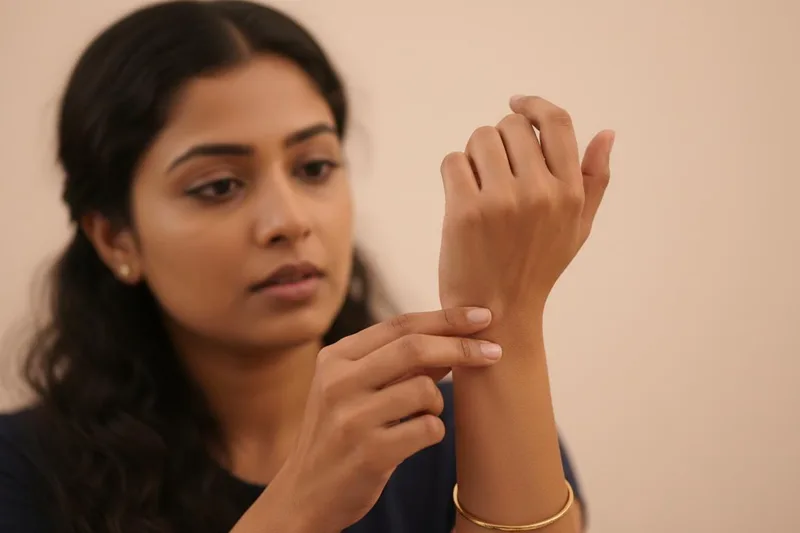
Have you ever noticed a small lump under the skin on your wrist, finger, or ankle? It may be a little painful when pressed, or it may not be painful at all. It is normal to feel a little scared when you see such lumps. So, today we will talk about what exactly is a ganglion cyst.
What exactly is a ganglion cyst?
Simply put, a gallstone is a small sac filled with fluid that forms under your skin, often near a joint or tendon. Think of it like a small water balloon. This fluid is usually jelly-like and slightly thick.
To be precise, how these are formed is that when there is a small tear or weakness in the tissue covering around the joint, the synovial fluid inside the joint gradually leaks out and accumulates, forming this cyst. Some people also call this a 'Bible Cyst'. The reason for this is that in the past, some people tried to flatten such a cyst by placing a heavy book (like a Bible) on it. However , this is not something we recommend these days, because it can also cause injury.
The important thing is that these gallstones are not cancerous. This means that they are not caused by a dangerous disease, and in most cases, they are harmless.
Where are these ganglion cysts most commonly seen?
The places you can most often see these nuts are:
- Wrist: It is most commonly seen on the upper side (back) of the wrist. Sometimes it can also occur on the palm side (front).
- Fingers: Near a joint in any finger or toe. Most often, they can form at the base of the finger, near the palm, or near the last joint closest to the nail (also called a `mucous cyst`).
- On the leg: It can be seen near the ankle, on the top of the leg, or near the toes.
Sometimes, when the joint with this cyst is moved or used too much, the cyst may feel like it is getting bigger, and the pain may also increase.
What could be the symptoms of this tumor?
The main symptom is a lump-like lump under the skin. It can range in size from the tip of a pen to the size of a golf ball. It can be round or oval in shape. It can get bigger over time, sometimes get smaller, and then get bigger again.
Some people may not experience any discomfort or pain from this tumor. However, if symptoms are present, they may experience things like:
- Pain: As the tumor grows, it can cause pain if it presses on a nearby nerve. This pain can be present even when the tumor is still, or it can be aggravated by moving the affected joint.
- Tingling sensation or weakness: A pinched nerve may cause a tingling sensation or a slight weakness in an arm or leg.
- Difficulty moving the joint: If the tumor is large, it may be difficult to fully bend or extend the affected joint.
- Uncomfortable appearance: Some people may feel uncomfortable about the appearance of the tumor.
This is called a 'mass effect'. That is, because the tumor is there, the surrounding nerves or tissues are compressed, and inflammation may occur.
Most of the time, these gallstones feel a little firm to the touch. However, some can be a little soft. They can move around a bit under the skin. Sometimes, when viewed from a certain angle, the cyst may appear translucent.
Consider, some tumors are so small that they may not be a big lump to be seen, but they may just be painful. These are called 'occult ganglions' . In such cases, the doctor may do an 'MRI' scan or an 'Ultrasound' scan to see if there is a hidden tumor.
Why do these ganglion cysts form?
In fact, no one knows exactly what causes these tumors to form. However, there are some things that doctors think are possible:
- Injury to a joint or tendon: Sometimes, when a joint or tendon suffers a minor accident, injury, or overuse, the tissue there may become weak and this tumor may begin to form.
- Weakening of tissues: Sometimes, for no apparent reason, the tissues lining the joint can weaken and leak fluid.
Who is more likely to develop Ganglion Cysts?
Anyone can develop this. However, some people have been found to be more likely to develop these:
- Sex: Women are about three times more likely to develop these than men.
- Age: It is most common in people between the ages of 20 and 50. That is, from young to middle-aged. It is less common in children, but it is not impossible.
- Previous joint injuries or conditions: If you have previously injured a joint, or if you have developed a condition such as tendonitis due to frequent use of a joint such as the wrist, you are more likely to develop a gallstone in the future.
- Arthritis: People with arthritis (especially osteoarthritis) in the fingers are more likely to develop mucous cysts near the tips of the fingers (the joints closest to the nails). However, it is important to note that having a mucous cyst on a finger does not mean that you have arthritis or will develop it.
How does a doctor accurately diagnose a ganglion cyst?
Most of the time, doctors diagnose these gallstones by examining you (physical exam) .
- Appearance and location of the lump: A doctor may be suspicious when they see a lump that looks like a typical lump in areas where gallstones commonly form, such as the wrist, fingers, or legs.
- Examination: The doctor will examine the lump to see if it hurts, is it hard, swollen, or moving around.
- Transillumination: In this, the doctor shines a small light (like a torch) on the lump. If it is a gallstone, the light will pass through it and make the lump appear partially see-through because it has fluid inside. This will not happen with a solid lump.
- X-ray: You may be asked to take an X-ray to see if there is another problem, such as arthritis, in the joint near the tumor, or if there is a problem with a bone. A gallstone may not be visible on an X-ray, but it can help identify other problems.
- Ultrasound or MRI scan: Sometimes, an ultrasound scan or MRI scan may be recommended to confirm the exact location of the lump, or to look for very small, invisible 'occult' ganglions. These can clearly see whether the lump is fluid or solid, and whether it is affecting surrounding tissue.
- Biopsy: Very rarely, and only if there is any doubt about the tumor, the doctor may take a small sample (called a biopsy) from inside the lump and send it to a lab for testing. Gallstones usually contain a jelly-like fluid, not solid cells.
What can I do to get rid of my ganglion cyst?
Most of the time, if a gallstone doesn't cause you any pain or discomfort, it doesn't need treatment. Your doctor may say to wait a while and see if it goes away on its own. However, if the lump is causing you pain, making it difficult to do work, or making you look unwell, there are treatments available:
1. Observation: As mentioned earlier, if there is no problem, the doctor will just tell you to wait. Some tumors will go away on their own.
2. Splints or braces: Reducing movement of the painful joint can reduce pressure on the tumor, which can help reduce pain and swelling. Your doctor may recommend that you wear a splint or brace on the affected joint.
3. Painkillers and anti-inflammatory medication: Common painkillers like paracetamol, or NSAID medications like ibuprofen prescribed by a doctor, can help reduce pain and swelling.
4. Aspiration : In this procedure, the doctor uses a small amount of numbing medicine and a needle to remove the fluid from the cyst. This is usually done in the doctor's office. You may feel some relief immediately, and the cyst will shrink. But remember, this only removes the fluid, not the root of the cyst. Therefore, many people are more likely to have the cyst recur after this type of aspiration. Sometimes, the doctor may also inject a steroid into the cyst after the fluid has been removed to reduce the risk of it coming back.
When is surgery needed for a gallstone?
If other treatments (medication, splints, aspiration ) do not provide relief, if there is severe pain due to the tumor, if there are symptoms such as numbness and weakness due to nerve compression, or if the tumor keeps coming back, your doctor may consider surgery.
During surgery , the entire tumor is removed, along with its stalk or root. This root is what connects the joint or bone to the tendon. If this is not removed properly, the tumor will try to grow back.
The surgeon may perform this surgery either through a small incision (open surgery) or through an arthroscopy , which involves inserting a camera and delicate instruments through very small incisions. Arthroscopy leaves smaller scars and takes less time to heal.
The surgery to remove these ganglion cysts is called a ganglionectomy . This is often an outpatient procedure. This means that you should be able to go home the same day as the operation. It can take two to six weeks to fully recover. During this time, you may need to rest your arm or leg, and you may need to wear a splint. Orthopedic surgeons are trained to perform this type of surgery.
Surgery can greatly reduce your symptoms. Also, the risk of a tumor coming back after surgery is much lower than after aspiration . However, it is reported that between 5% and 15% of tumors can come back after surgery.
What happens if a ganglion cyst is left untreated?
As mentioned earlier, if you are not having any problems with your gallstones, you may not need any treatment. Sometimes, these gallstones will go away on their own within a few months or a year or two.
However, a doctor may recommend treatment in the following cases:
- If there is pain due to the tumor: Pain may occur when the tumor presses on a nerve or joint tissue.
- If you have difficulty performing some daily tasks, such as walking, writing, or lifting weights.
- If there is numbness, tingling, or muscle weakness due to nerve compression caused by the tumor.
- If you feel self-conscious about your appearance because of the tumor.
Are Ganglion Cysts Dangerous?
No. Gallstones are not dangerous. They are non-cancerous (benign) tumors. This means that they do not spread to other parts of the body. They are not cancerous. So there is nothing to worry about.
What is the outlook for someone with Ganglion Cysts? (Prognosis)
Although some gallstones can be painful, they are not a major, long-term threat to your health. With or without treatment, most people live normal lives.
Can ganglion cysts be prevented from forming?
Unfortunately, there is no surefire way to prevent gallstones from forming, as medical experts still don't know exactly what causes them to form. While taking care of your joints and reducing overuse of a joint can help, there is no guarantee.
What should I ask my doctor?
If you have a gallstone, it's a good idea to ask your doctor about the following:
- Do I need treatment for this right away? Or can I wait a little longer?
- What treatment options would you recommend to try first? Why?
- How successful are these treatments? Are there any side effects?
- What is the chance of the tumor coming back after treatment?
- Under what circumstances would you consider surgery for these tumors?
- What are the risks and benefits of ganglionectomy surgery? How long does it take to recover?
Finally, things to remember
So, if you have a fluid-filled lump under your skin, called a ganglion cyst, don't worry. You probably don't need treatment for it right away. If the lump isn't bothering you, your doctor will probably just watch it for a while to see if it changes.
Gallstones are non-cancerous (benign) growths. This means they are not cancerous. They do not pose a long-term threat to your health.
Most gallstones go away on their own. However, if they are affecting your life in any way, such as causing pain, difficulty performing daily activities, or numbness, you should definitely talk to your doctor about treatment. You may be able to get relief with braces, painkillers, aspiration, or surgery. Your doctor will tell you what is best for you.
` Ganglion Cyst, Hand Cyst, Joint Cyst, Bible Cyst, Wrist Cyst, Finger Cyst




💬 Comments (0)
No comments yet. Be the first to share your thoughts here.
Add Your Comment