
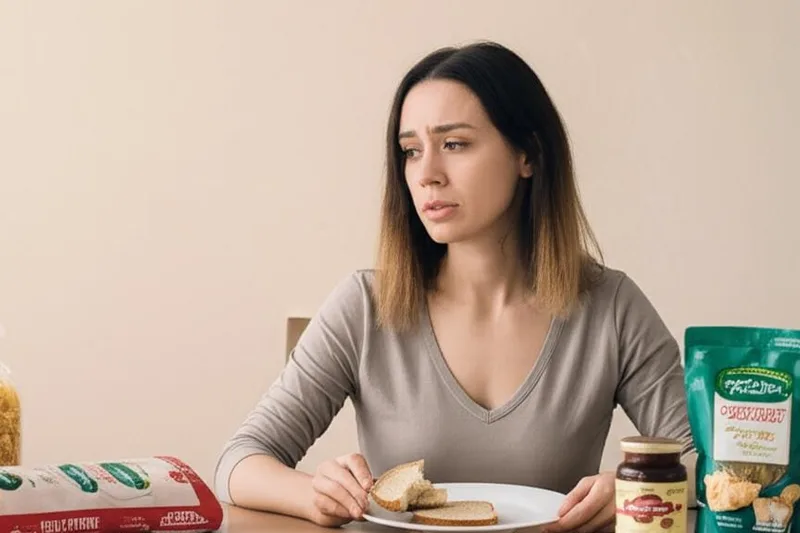
Have you ever had a stomach ache, bloating, or stomach pain after eating something like bread, toast, buns, or noodles? Many people think that these symptoms are normal and forget about them. But if your body is sensitive to the ubiquitous “gluten” these days, these symptoms may occur. So, who really wants to go on a gluten-free diet? Let’s talk about this simply and clearly.
What to do before going on a gluten-free diet
If you experience symptoms like stomach upset, diarrhea, and bloating when you eat foods containing gluten, the first thing you should do is see a doctor and get tested for celiac disease . This is very important. Never stop eating gluten on your own.
Think about it this way. You want to catch a thief, but before you can tell the police, the thief has wiped out all the evidence he left behind. Can the police then come and catch the thief? No, right? That's what happens if you stop eating gluten before you get a medical checkup.
Why is the test so important?
Celiac disease is a condition in which your body's immune system attacks the walls of your small intestine when you eat gluten. This damages the walls of the intestine and reduces the absorption of nutrients from the food we eat. Over time, this can lead to serious conditions such as malnutrition and weight loss .
The only way to know for sure if you have this disease is to have a blood test. This looks for a special type of antibodies that are produced in the body. If you stop eating gluten, the production of these antibodies in your body will gradually decrease and disappear after 3 to 6 months. Then, even if you do a blood test, it will not detect the disease. Therefore , to get an accurate diagnosis, you should definitely see a doctor and get this test done before you stop eating gluten.
If necessary, depending on the results of the blood test, your doctor may also refer you for a biopsy, which involves taking a small piece of the intestine and examining it.
What if you don't have Celiac Disease, but are allergic to gluten?
Okay, so now you've done all the testing. But the results show that you don't have Celiac Disease. But you're 100% sure that you have a problem with gluten. So what happens?
We call this condition Gluten Sensitivity. This is a real condition. Some doctors didn't accept it in the past, but now they accept it as a real medical condition.
A person with gluten sensitivity does not experience the same intestinal damage as someone with celiac disease, but the symptoms can be similar to those of someone with celiac disease, and sometimes even more severe.
There is no specific medical test to diagnose this condition yet. So you should clearly tell your doctor about your symptoms. In addition to stomach upset, many people also experience symptoms like extreme fatigue and headaches .
Let's understand the difference between these two situations a little more clearly.
| Characteristic | Celiac Disease | Gluten Sensitivity |
|---|---|---|
| The root cause | An immune system response (Autoimmune reaction) | The cause is not yet fully understood, but it is thought to be related to the immune system. |
| Damage to the intestine | Yes, the walls of the small intestine are damaged. | No, Bluetooth does not harm the intestines. |
| Diagnosis | It can be confirmed through blood tests and biopsy. | There is no specific test. The diagnosis is made based on symptoms, after confirming that there is no celiac disease or other conditions. |
| Common symptoms | Diarrhea, stomach pain, weight loss, skin problems, malnutrition. | Bloating, stomach pain, diarrhea or constipation, fatigue, headache, joint pain. |
Are there really any benefits to gluten-free diets?
Yes. If a doctor has confirmed that you have celiac disease or gluten sensitivity, a gluten-free diet is the only treatment you have. If you follow this properly, your symptoms will go away completely and you can live a healthy life.
But there is something important we all need to understand here.
A gluten-free diet is not a magic weight loss solution that works for everyone. It is a treatment for those with a medical need.
These days, there is a wave of people eating gluten-free foods without any medical advice, just thinking that it is “good.” That is not a good thing. Because, grains that contain gluten provide our bodies with a lot of fiber, vitamins, and minerals. If we stop eating these foods for no reason, we may miss out on those nutrients.
Also, store-bought biscuits and cakes labeled "gluten-free" may sometimes have added extra sugar, oil, and salt to improve their taste and texture. So if you're trying to lose weight by eating these, you might end up with the opposite effect.
So how do you do this properly?
If your doctor advises you to go gluten-free, all you have to do is eliminate gluten-containing foods from your diet.
- The main things that contain gluten: Wheat, barley, rye. Simply put, this includes almost everything made from bread flour (wheat flour) in our country. Examples: bread, buns, cakes, biscuits, noodles, pasta, roti, some sauces, cereals.
- Gluten-free foods we can eat: Rice, our staple food, does not contain gluten. Also, things like chickpeas, green beans, peas, cassava, sweet potatoes, potatoes, all vegetables, all fruits, meat, fish, eggs, and milk do not naturally contain gluten.
The best thing to do is to reduce packaged and processed foods as much as possible and prioritize natural foods.
Take-Home Message
- If you have trouble eating gluten-containing foods, don't make decisions alone. See your doctor first.
- Do not stop eating gluten-containing foods before undergoing a medical examination for any reason. Doing so will make it difficult to make an accurate diagnosis.
- Celiac disease is a condition that damages the intestines. In gluten sensitivity, the intestines are not damaged, but the symptoms can be severe.
- A gluten-free diet is a medical necessity, not a one-size-fits-all weight loss method or fad.
- If you want a gluten-free diet, prioritize natural foods like rice, vegetables, and fruits.
Gluten, Gluten-Free, Celiac Disease, Celiac Disease, Gluten Sensitivity, Stomach Ache, Diarrhea, Nutrition




💬 Comments (0)
No comments yet. Be the first to share your thoughts here.
Add Your Comment