
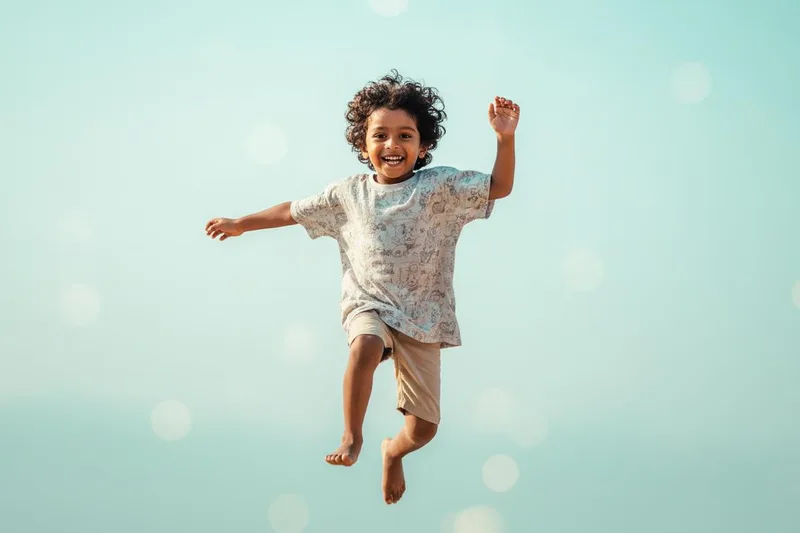
Have you ever thought about how easy it is for us to do things like walking, running, and waving our arms? But all these big movements are complex tasks that involve many parts of our body working together. Especially in the development of a young child, it is very important that these big movement skills, or in medical terms, gross motor skills , develop properly. So, today we will talk about this in detail.
What are these so-called gross motor skills?
Simply put, gross motor skills are movements that involve the large muscles in our bodies. Think of the large muscles in your legs, arms, and hips. The word "gross" means "big." "Motor" means "movement." So, things like walking and waving are called gross motor skills.
For these gross motor skills to be effective, several parts of our body need to work in perfect coordination. Do you know what those are?
- Skeletal Muscles: These are the muscles that provide the strength needed to perform movements.
- Bones: Our muscles are attached to these bones. These are what give our body a skeleton.
- Nerves: Strictly speaking, these are the ones that carry messages from the brain to the muscles, saying, "This is how it should move, this is how it should happen."
In addition to these things, several other things are associated with these gross motor skills:
- Balance: Maintaining the balance of the body.
- Coordination: The ability to link and perform movements smoothly.
- Body awareness and spatial awareness: Being aware of one's own body as well as the environment in which one is located.
- Reaction time: The ability to respond quickly when something happens.
These gross motor control problems can occur at any age. However, doctors focus especially on these skills during child development . Child development is the way your child grows and changes over time.
Experts divide child development into four main areas:
- Physical development: This is where gross motor skills belong.
- Cognitive development: The development of thinking and understanding.
- Language development: The development of speaking and understanding language.
- Social-emotional development: Developing how to interact with others and how to manage one's emotions.
Doctors pay special attention to these gross motor skills because delays in these skills can be a sign of certain neurological conditions. So, the sooner something like this is recognized, the sooner the child can get the help they need.
What are examples of gross motor skills in everyday life?
These things we do every day are examples of gross motor skills:
- Standing still
- Walking
- Running
- Sitting upright without back support
- Chewing food (this also uses the jaw muscles)
- Jumping
- Spinning the waist
- Bending forward
- Shaking, twisting the neck
- Raising hands
- Waving
Hand-eye and foot-eye coordination skills, that is, things that involve the hands and eyes, or feet and eyes, working together, are gross motor skills:
- Throwing and catching a ball
- Kicking a ball
- Cartwheeling with both hands like circus performers
- Skipping
- Swimming
- Riding a bike, a skateboard
- Rollerblades or ice skating
What is the difference between Gross Motor Skills and Fine Motor Skills?
We say that gross motor skills are the big movements that we make using large muscles. So what are fine motor skills ? They are the small, subtle, precise movements that we make with these parts of ourselves:
- Wrist, hands and fingers
- Ankles, feet, and toes
The main difference between the two is where the movement occurs, and the amount of movement. Think about it, writing. That's a fine motor skill. It requires the small muscles in your fingers and wrist to move very finely and precisely. But waving is a gross motor skill. It requires the large muscles in your shoulders and upper arms to move very large. Your trunk muscles also help with this.
However, both of these types of motor skills require complex coordination of our muscles, bones, and nervous system. Young children develop gross motor skills first. Fine motor skills develop later.
Why are these gross motor skills so important?
Movement is a part of our daily lives. As our gross motor skills develop, our bodies change, and as our bodies change, these skills develop. New, improved gross motor skills allow us to explore our surroundings more, learn new things, and do new things.
Simply put, gross motor skills are essential for our mobility, independence, and overall health.
If there is a weakness in any of these skills, it can affect many aspects of life. It can make it difficult to perform important daily tasks, and it can also affect self-confidence and self-esteem.
How important are these gross motor skills in the development of young children?
Gross motor skills usually begin in infancy. They then develop throughout childhood. Doctors and parents track this development by looking at developmental milestones . These are behaviors that mark different stages of normal development. Each child develops at their own pace. However, most children go through certain changes at roughly the same time as they grow older.
Here are some important milestones for gross motor skills in babies and toddlers (and there are more, right?):
From 0 to 6 months:
- It rolls forward and backward, and the other way around.
- They sit with support, and after a while they can sit without support.
From 6 to 12 months:
- Crawling forward.
- Moving from one position to another. For example, from a sitting position to a kneeling position.
- They walk with support, hanging on to something.
12 to 18 months:
- Sits, kneels, walks (maybe alone).
From 18 months to 2 years:
- Walks smoothly.
- Trying to run.
- Walks while pulling or lifting a toy.
- Climbs and descends stairs with support.
At 3 years old:
- They jump in place with their feet together.
- Walks on tiptoe.
- Riding a tricycle.
- Catches a ball (using arms, body, and chest).
At 4 years old:
- Standing on one leg for about five seconds.
- Kicking a ball forward.
- Walking straight along a line.
- Running around obstacles.
At 5 years old:
- Walking backwards from heels to toes.
- Catching a small ball using only two hands.
- When someone tells you to, you jump forward with one leg (skipping).
At 6 years old:
- Walking on a balance beam.
- Jumping rope.
- Throwing and catching a ball as expected.
Gross motor skills continue to develop and strengthen beyond these age ranges. The most important thing to remember is that every child develops at their own pace. If you have any concerns about your child's gross motor milestones, talk to their pediatrician.
How do these gross motor skills develop?
The first major movements occur during fetal development . That is, while the baby is still in the mother's womb. While a fetus is inside the uterus, it kicks its legs and shakes its arms. Most mothers begin to feel these kicks and kicks at around 19 weeks.
After birth, these gross motor skills develop rapidly. They are both involuntary reflexes (things that happen automatically, not of our own volition) and purposeful movements . For example, if a newborn baby is held upright and placed on a hard surface with its legs extended, it will usually move its legs as if it were walking. This is called the "newborn stepping reflex."
Purposeful movements usually develop from the head down . Babies first learn to lift their heads while crawling. Then they learn to push themselves up with their hands. Next, they usually learn to kneel using their hands and feet, and finally learn to walk.
As a child’s muscles get stronger and their brain continues to develop, the finer and more complex these gross motor skills become. Gross motor skills continue to develop and become more complex throughout childhood and adolescence. For example, by age 6, most children can skip on one leg if someone teaches them. This movement requires a complex combination of muscle strength, balance, coordination, and timing.
Babies and toddlers learn a lot of gross motor skills by interacting with their surroundings. However, there are ways to help your child practice these skills.
How to help your child develop gross motor skills?
Play is the main way babies and young children develop gross motor skills. Especially goal-directed play . That is, play is done with a goal in mind (like learning something new) or completing a task.
Here are some ways you can help your baby or toddler develop their gross motor skills:
- Encourage crawling: While your baby is crawling, place a toy within arm's reach, but not too close for him to touch. You should be right next to him.
- Create age-appropriate obstacle courses: This helps young children learn balance and how to navigate obstacles. Think crawling under a chair or jumping over a pillow.
- Take your toddler to a park: There are usually toys and activities that can help them practice various gross motor skills.
- Encourage your child to play: Practice relevant skills with them at home. For example, kicking a ball or hitting a ball with a bat.
- Involve your child in age-appropriate household chores: things like clearing the table or putting something in the trash. Even if they don't do these tasks perfectly, they'll learn from them.
What are the causes of gross motor skills deficiencies?
If there is a problem with any of these parts of our body, it can affect gross motor skills:
- Brain
- Spinal cord
- Peripheral nerves (nerves outside the brain and spinal cord)
- Muscles
- Joints
- Bones
Therefore, there are countless medical conditions that can interfere with gross motor skills. The impairment can be mild or severe. Gross motor skills can also develop late (late) or there can be permanent problems with these skills.
Conditions affecting babies and young children:
Here are some of them (not the only ones):
- Autism Spectrum Disorder
- Cerebral Palsy
- Developmental Delay
- Down Syndrome and other genetic conditions
- Dyspraxia (Developmental Coordination Disorder) - This involves problems with movement coordination.
- Premature birth: Some babies born prematurely may have health problems that affect their gross motor development.
Conditions affecting young children and adults:
Some of these are:
- Brain tumor
- Movement disorders, such as ataxia (loss of balance) and spasticity (muscle stiffness).
- Muscular Dystrophy
- Multiple Sclerosis (MS) (most common in adults)
- Injuries to muscles, nerves, joints, and bones
- Spinal cord injury
- Stroke (common among adults)
Conditions that only affect adults (mostly):
Some of these are:
- Dementia ( memory and intelligence decline)
- Huntington's Disease
- Parkinson's Disease
- Peripheral Neuropathy
When should you see a doctor about gross motor skills?
If you think your child is not meeting gross motor skill milestones, be sure to talk to their pediatrician. The doctor will ask questions about your concerns and may also conduct tests if necessary.
If you or your child has a decline in gross motor skills, meaning they seem to be losing their previous abilities, see a doctor as soon as possible. Especially if the decline occurs suddenly, as it could be a sign of a serious underlying condition.
Finally, the most important thing
Gross motor skills are something that develop throughout life, from the embryonic stage to adolescence. Babies and toddlers develop these skills as they explore their surroundings. But there are many activities you can do to help them with this development.
Remember, if you have any concerns or questions about your child's gross motor skills, it's never too late to talk to a doctor about it. There are a number of conditions that can affect these movements. Early detection and treatment can make a big difference for your child.
` Gross Motor Skills, Child Development, Muscles, Movement, Play, Developmental Milestones, Child Health


💬 Comments (0)
No comments yet. Be the first to share your thoughts here.
Add Your Comment