
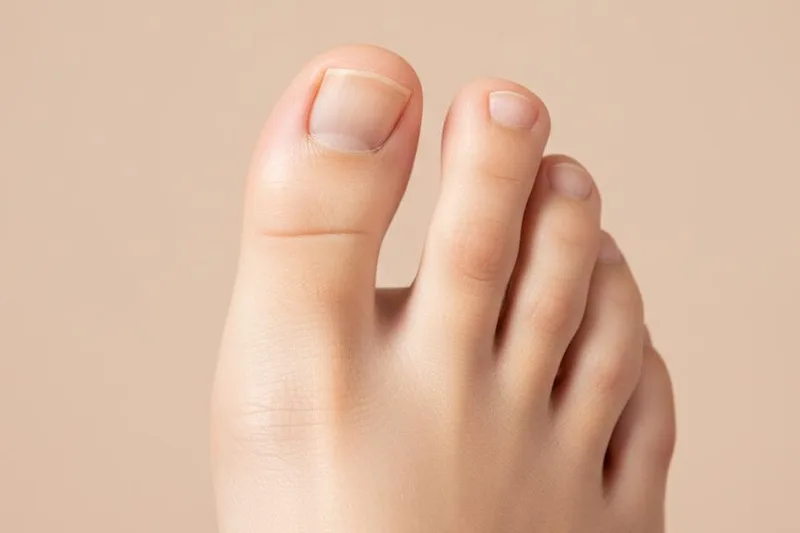
Have you ever looked at one of your toes and thought, "Why is this bent up like this?" If a toe that should normally be straight is bent up in the middle, looking like a hammer, you may have a condition called Hammertoe. It's very common, but many people don't know about it. So let's talk about it in simple terms today.
Simply put, what is this Hammertoe?
Hammertoe is a deformity that occurs in one of the joints of your toes. Instead of being straight, the toe bends upward at the middle joint. To be precise, the tip of the toe turns downward and the middle joint protrudes upward. This gives the toe a hammer-like shape. That's why it's called a hammertoe.
This condition usually affects one or more of your other four toes, not your big toe. It is especially common in the second toe (the finger on the side opposite the thumb).
At first, this may not seem like a big problem. It may not interfere with walking or using a cane. But if left untreated, over time, the bent toe can become stuck in that position and unable to straighten again. In severe cases, the toes can become stuck in an upside-down 'V' shape.
If you notice any changes in your feet or toes, especially pain, stiffness , or difficulty walking, see your doctor immediately.
What are the main types of hammertoe?
Doctors divide this Hammertoe condition into three main types, depending on its severity. It's important for you to know this too.
| Hammertoe type | What does that mean? |
|---|---|
| Flexible Hammertoe | This is the initial stage. Even though the finger looks bent, you can still hold it and straighten it out or bend it. Treatment is very easy at this stage. |
| Semi-rigid Hammertoe | Right now, the finger is a little stiff . It's a little difficult to straighten it. The joint is a little stiff. |
| Completely Rigid Hammertoe | This is the worst case scenario. The finger is frozen in place. You can't straighten it at all. In most cases, surgery is required. |
How do you know if you have Hammertoe? (Symptoms)
A hammertoe is often visible. You can easily recognize it if you see one toe bent more than usual when you look at it with your other toes. In addition, there may be several other symptoms.
| Symptom | A little bit about it |
|---|---|
| Pain | The top of the bent toe can hurt because it hits the shoe. You may also experience pain at the ball of your foot. |
| Difficulty moving fingers | You may find it difficult to straighten or bend your finger. |
| Corns and calluses | Because the top of the toe is constantly rubbing against the shoe, the skin in that area can thicken and form a corn. This can also cause pain. |
| Swelling and redness | The finger joint may become swollen and red. |
| Skin discoloration | Sometimes the skin color in that area may change. |
Why does this Hammertoe develop? Some of the main reasons
Simply put, hammertoe occurs when your toes are bent in an unnatural position for a long time. When this happens, the muscles and tendons in your toes become accustomed to that bent position and become tight. If this pressure continues, the muscles and tendons become so tight that you can't straighten your toes anymore.
There are several main reasons for this:
- Wearing shoes that are not the right size and are uncomfortable for the feet: This is the main reason. This risk is especially high for those who wear narrow toe boxes and high heels. Imagine that you wear beautiful, narrow shoes to go to a wedding. After a while, your toes start to hurt, right? That's because your toes get cramped. If you wear shoes like this continuously, you can develop Hammertoe. Also, this is because young children continue to wear the same old school shoes even after their feet grow out .
- The natural position of the foot: Some people have high arched feet. Others have flat feet. These people are also more likely to develop hammertoe.
- Long toes: If your toes are longer than normal, they may not fit properly in regular shoes. As a result, your toes may be bent and splayed.
- Certain medical conditions: People with diseases such as diabetes mellitus or rheumatoid arthritis are at higher risk.
- Bunions: Bunions are a condition where the joint of the big toe becomes swollen and protrudes, causing the big toe to push against the other toes. This pressure can also cause hammertoe in the other toes.
How do you find this, Doctor?
When you go to see a doctor, the first thing he does is carefully examine your feet and toes.
- They look at your fingers and check your joints.
- They hold their fingers in their hands, bend them, and straighten them, to see how far they move and how stiff they are.
- You will be asked what kind of shoes you use the most, and whether wearing certain shoes increases or decreases the pain.
- You may be asked to stand and walk with and without shoes.
- If necessary, you may also be asked to take an X-ray to check the condition of the bones in your fingers.
What are the treatments for this?
The best thing is, there are many good treatments for this. Your doctor will suggest treatments that will reduce the pressure on your toes and allow them to return to their natural position.
- Changing shoes: This is the first thing to do. Start using shoes with wide, deep toe boxes.
- Pads and taping: There are special toe pads available at pharmacies to help reduce pressure on your toes. Your doctor may also recommend that you apply medical tape to your toes to help keep them in the correct position.
- Orthotic devices: These are special shoe inserts that are placed inside your shoes to provide support to your feet and help keep your toes in the correct position.
- Painkillers: You can take painkillers like paracetamol or NSAIDs (Nonsteroidal anti-inflammatory drugs) to reduce pain and swelling. However, do not take these painkillers continuously for more than 10 days without consulting your doctor.
- Exercises for your fingers: There are simple exercises that can strengthen the muscles in your fingers and increase their flexibility. For example, you can grab a small towel on the floor with your toes and pull it. Your doctor will teach you exercises that are right for you.
- Surgery: Surgery is usually only recommended if other treatments have failed and the pain is so severe that you can't even walk.
Can hammertoe be prevented?
Yes, you can! The best and easiest way to prevent hammertoe is to choose comfortable shoes that fit your feet perfectly. Keep these things in mind when buying shoes:
- Avoid shoes with narrow, pointed toes as much as possible.
- Even if you know your shoe size, sizes can vary from brand to brand and style to style. So, try both shoes on and walk around a bit.
- When buying shoes, go in the evening after work for the day. Because our feet naturally swell a little from walking all day. So, shoes bought in the evening are more comfortable for you at any time of the day.
- When putting on shoes, make sure there is about half an inch of space between your longest toe and the front of the shoe. Don't wear shoes that are too tight.
Take-Home Message
- Hammertoe is a common condition in which the middle joint of the toe bends upward. The main cause of this is wearing uncomfortable, tight shoes.
- If detected early, it can be completely cured with things like changing shoes and simple exercises.
- If you have pain, swelling, or any other unusual changes in your toes, don't ignore it. See your doctor right away.
- The health of your feet is very important for the health of your entire body, so take good care of your feet.


💬 Comments (0)
No comments yet. Be the first to share your thoughts here.
Add Your Comment