

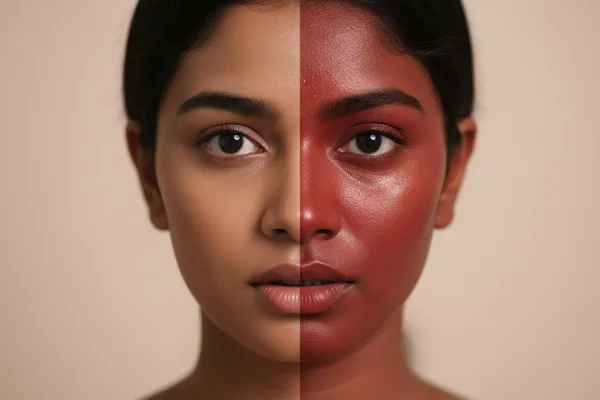
Imagine looking in the mirror and seeing a straight line down the middle of your face, one side very red and sweaty, and the other side normal, maybe a little pale... Isn't that a bit scary and surprising? Or what if you saw one side of your newborn baby's body suddenly turn red and the other side is normal? This is what we call the Harlequin Sign in medicine. Since the name is a bit strange, let's find out more about it and whether this is really something to be afraid of.
What exactly is this Harlequin Sign?
Simply put, Harlequin Sign is when one side of your body or face experiences a change in skin color (redness or darkening), while the other side remains the same, sometimes even pale. These two sides appear to be separated by a straight line, right down the middle of the body.
Along with this difference in skin color, other features can be seen on both sides.
- Redness: This area may be hyperhidrosis (excessive sweating). The skin on that area may also feel slightly warm to the touch.
- Pale/Normal Side: This side does not sweat. The skin will also feel cold to the touch.
Although this Harlequin Sign can sometimes be a symptom of a medical condition such as `Harlequin syndrome`, most of the time it is benign and simply goes away.
What are the main reasons for this?
It's not always possible to find a specific cause for this. The main reason for this is a communication problem in our body's autonomic nervous system. Think of this as our body's "auto-pilot" system. This system controls things we don't realize we have, like our breathing, heart rate, and sweating.
So, if there is a blockage or defect in the nerve pathway that sends messages from the brain (hypothalamus) through the spinal cord to the face and upper body, the message may not be sent properly to only one side of the body. This is why the blood vessels on one side dilate and turn red, while the other side does not receive the message and remains normal.
Does this happen to newborn babies too?
Yes, this is something that is seen in newborn babies. According to surveys, about 10% of healthy babies may develop this Harlequin Sign. So, don't worry if your baby has this.
This usually occurs between two and five days after the baby is born, but sometimes it can appear as late as three weeks.
The important thing is that this Harlequin Sign in newborns is completely harmless . This color change disappears in as little as 30 seconds. Sometimes it can last up to 20 minutes. It may reappear when the baby is placed on its side.
Very important: This condition called Harlequin Sign is not to be confused with `Harlequin ichthyosis`, a very dangerous, life-threatening and very rare genetic condition. `Harlequin ichthyosis` is a condition in which the baby's entire body is covered in thick, plate-like scales, with deep cracks in between. It is something completely different.
Other related diseases
The Harlequin Sign can sometimes appear as a symptom of other medical conditions.
Harlequin Syndrome
This is a condition that affects our sympathetic nervous system. This nervous system controls our "fight-or-flight" response, which is the changes that occur in the body when we are excited, scared, or exercising. Whenever this system is activated in a person with Harlequin Syndrome (for example, during exercise), one side of the face and body will become red and sweaty, while the other side will not.
Horner Syndrome
This is also a rare neurological condition. It affects the eye and surrounding tissues on one side of the face. It is also called `oculosympathetic palsy`. It is caused by a blockage in the nerve pathway from the brain to the eye and face. Here too, the affected side of the face may become red.
| Status | Who is affected? | Main features | Seriously? |
|---|---|---|---|
| Harlequin Sign (in newborns) | Healthy newborn babies (about 10%) | Temporary redness on one side of the body. | No. It is completely harmless and will go away on its own. |
| Harlequin Syndrome | For anyone of any age | Redness and sweating on one side when exercising or being excited. | Depends on the underlying cause. Most often harmless. |
| Horner Syndrome | For anyone of any age | Lower eyelid on one side of the face, small black eye, decreased sweating, and redness of the face. | The underlying cause (e.g., a tumor) may be serious. A medical examination is essential. |
How is it treated?
Treatment depends on the cause of the Harlequin Sign.
- For newborns: No treatment is needed. It will go away on its own in a few seconds or minutes.
- For Harlequin Syndrome: Treatment is not always necessary. Sometimes this condition can get better on its own. However, if your doctor thinks treatment is necessary, they will prescribe treatments based on the cause. These include:
- A vaccine called `Stellate ganglion block` is used to control skin discoloration.
- Botulinum toxin injections to control sweating.
- If there is an underlying tumor, it can be removed surgically or through radiation therapy.
- Counseling for mental anxiety caused by this appearance.
- For Horner Syndrome: If there is no pain, treatment may not be necessary. In this case, the doctor will treat the underlying cause.
When should you see a doctor?
If you or someone in your family notices the Harlequin Sign, which is red, sweaty, and hot on one side of the body, the best thing to do is see a doctor and get checked out.
Your doctor will examine you, ask about your symptoms, and if necessary, perform some tests to rule out other conditions. Although very rare, it is important to rule out a tumor or other condition, as this could be the cause.
If these symptoms are suddenly accompanied by other serious symptoms (e.g. severe headache, vision changes, loss of consciousness), it is very important to immediately go to the Emergency Department (ETU) of the nearest hospital .
Take-Home Message
- Harlequin Sign is a condition where one side of the body or face is red and the other side is pale. This is usually not harmful.
- This is common in newborn babies. It goes away on its own, within a few minutes, without treatment, and is nothing to worry about. Remember that this is not the dangerous `Harlequin ichthyosis` disease.
- If this occurs in adults, it may be a symptom of a nervous system condition such as `Harlequin syndrome` or `Horner syndrome`.
- If you or your baby experience this symptom, it is wise not to panic, but to see your doctor to determine the exact cause and to ensure that there are no other serious conditions.




💬 Comments (0)
No comments yet. Be the first to share your thoughts here.
Add Your Comment