
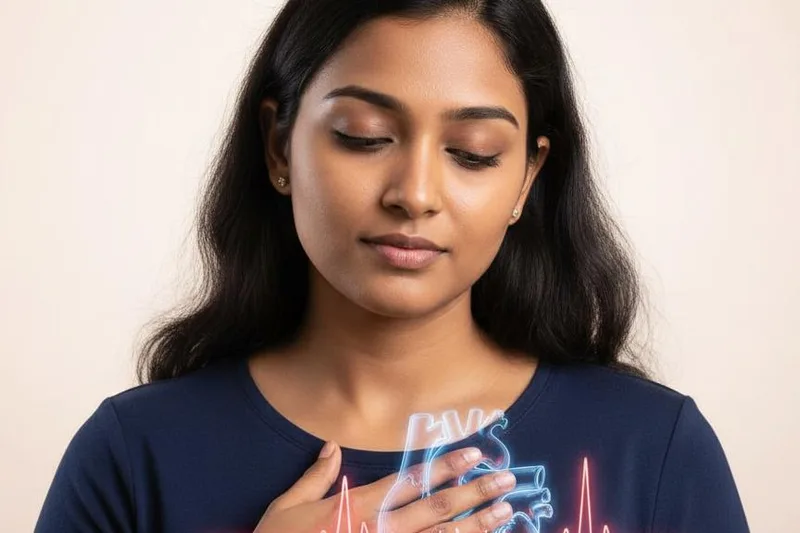
Have you ever put your hand on your chest in a quiet moment and closed your eyes and listened? That "lub-dub... lub-dub..." sound you feel and hear is the biggest proof that you are alive. That sound comes from the most amazing, never-stopping engine in our body. That is our heart. Do we really know about this little organ that works without a single second of rest from the day we are born until the day we die? Today, let's talk about this beloved heart on which our very life depends.
What is the heart? What service does it provide to the body?
Simply put, the heart is a very strong, muscular organ about the size of your fist. It is the central hub of blood circulation throughout our body, like the main bus station in a city. We also call it the circulatory system.
The main function of the heart is to pump blood throughout the body. Now you might be thinking, "So what happens when blood is pumped?" Think about it, the millions of tiny cells in our body need energy and oxygen to function. Just like we need food and breath to live. So the blood that the heart pumps is what takes this oxygen and nutrients and distributes them to every cell in the body. It is also what collects waste products like carbon dioxide that accumulates in the cells as they work and delivers them to the relevant organs (like the lungs and kidneys) for disposal.
Not only that, the heart performs several other important functions:
- It controls the rhythm and speed of the heartbeat. Our brain and nervous system tell our heart to beat faster when we are sleeping and slower when we are running.
- Blood Pressure is controlled. It is also the heart's responsibility to maintain the pressure inside the blood vessels at the proper level.
The heart does not work alone to do this job properly. Our nervous system and endocrine system work together with the heart. The nervous system is the one that gives signals to the heart to speed up when we feel scared or happy, and to slow down when we are relaxed. Hormones secreted by the endocrine system help control blood pressure by causing blood vessels to constrict or dilate.
Shall we take some pieces of the heart apart?
The heart is like a well-designed building. It has walls, rooms, doors, water pipes, and a system of electrical wires. Let's look at each of them one by one.
The walls and protective covering of the heart
The walls of the heart are the muscles that contract and expand to pump blood. In the middle of these walls is a thick layer of tissue, which we call the septum. This is what divides the heart into right and left sides.
The heart wall is made up of three main layers:
- Endocardium: This is the innermost layer.
- Myocardium: This is the middle, most active layer of muscle.
- Epicardium: This is the outermost protective layer.
The entire heart is again covered in a protective sac called the pericardium . A special fluid inside this sac helps the heart to glide without hitting other organs when it beats.
The Four Chambers of the Heart
There are four main chambers inside the heart. Two chambers on the top floor and two chambers on the bottom floor. Just like a two-story house. We call the chambers on the top floor the Atria , and the chambers on the bottom floor the Ventricles .
| Room of the heart | The work that it does |
|---|---|
| Right Atrium | Deoxygenated blood (shown in blue) from all over the body is collected in this chamber by two large veins (Superior & Inferior Vena Cava). It is then pumped to the right ventricle below. |
| Right Ventricle | From this chamber, the oxygen-poor blood is sent to the lungs, through the pulmonary artery. In the lungs, this blood is re-oxygenated. |
| Left Atrium | Fresh, oxygenated blood (shown in red) from the lungs enters this chamber through the pulmonary veins. The blood is then pumped to the left ventricle below. |
| Left Ventricle | This is the strongest and largest chamber in the heart. It is here that the heart pumps the fresh, oxygenated blood throughout the body. |
Simply put, the right side of the heart collects the blood that has been used in the body and sends it to the lungs to be cleaned. The left side distributes the blood that has been cleaned by the lungs back to the rest of the body. This is a continuous cycle.
Heart Valves
As blood flows back and forth between the chambers of the heart, there is a system of gates to stop it from flowing back in the wrong direction. We call these gates ``Valves`` . These gates open when blood flows in one direction, and close tightly again when some of the blood has gone.
There are four main types of valves:
- Tricuspid valve: The door between the right atrium and the right ventricle.
- Pulmonary valve: The opening where the vein that carries blood from the right ventricle to the lungs begins.
- Mitral valve: The door between the left atrium and the left ventricle.
- Aortic valve: The gate at the beginning of the main artery (Aorta) that carries blood from the left ventricle to the entire body.
Blood Vessels
We call the system of tubes that carry blood pumped by the heart throughout the body and back to the heart ``Blood Vessels.`` These are of three types.
- Arteries: These are the thick tubes that carry oxygenated blood from the heart to the rest of the body.
- Veins: These are the tubes that carry oxygen-poor blood used in parts of the body back to the heart.
- Capillaries: Very fine, hair-thin blood vessels that connect arteries and veins. It is within these capillaries that the cells receive oxygen and remove carbon dioxide.
The 'current' of the heart - how is this beating controlled?
The heart is not just a lump of flesh. It has a special electrical system called the ``Electrical Conduction System'' that keeps it beating in a regular rhythm. It's like the wiring system in a house.
There are several main parts to this system:
- Sinoatrial (SA) node: This is the heart's natural pacemaker. The electrical signal that tells the heart how fast to beat begins here.
- Atrioventricular (AV) node: This takes the signal from the SA node, delays it a bit, and sends it to the two lower chambers (atria) of the heart.
- Other parts (Bundle of His, Purkinje fibers): These carry the signal from the AV node throughout the lower chambers of the heart, causing them to contract suddenly.
In this way, after the two upper chambers contract and pump blood, within a tenth of a second, the two lower chambers contract and pump blood to the body and lungs. If there is a slight error in this electrical system, then irregular heartbeats (arrhythmia) occur.
What are the common diseases that affect the heart?
Since the heart is a very important organ in our body, it is very important for us to be aware of the diseases that can affect it.
Here are some common heart conditions:
- Heartbeat irregularities (Arrhythmia): The heart beats too fast, too slow, or in an irregular rhythm.
- Cardiomyopathy: Abnormal thickening, enlargement, or stiffness of the heart muscle.
- Heart attack / Myocardial infarction: A sudden blockage of a coronary artery that supplies blood to the heart, resulting in a lack of blood and oxygen to a part of the heart.
- Coronary artery disease: The arteries that supply blood to the heart become narrowed by deposits of cholesterol-like material (we call this 'plaque').
- Heart valve disease: The heart's gates, or valves, that we talked about earlier, do not function properly.
- High blood pressure: The pressure exerted on the walls of blood vessels is higher than normal.
- High cholesterol: Having too many fats in the blood.
Symptoms and tests that suggest a heart problem
If there is a problem with the heart, your body will give you clues. If you have symptoms like these, it is very important to see a doctor as soon as possible.
Symptoms to watch out for
- Chest pain or discomfort: A feeling of tightness or tightness in the chest.
- Shortness of breath: Feeling tired even after walking a short distance.
- Palpitations: A feeling of the heart beating rapidly .
- Dizziness or fainting.
- Swelling of the lower parts of the body, especially the legs.
- Unusually tired.
Methods of checking heart health
When you see a doctor, he or she may recommend one or more of these tests depending on your symptoms.
- Blood pressure measurement.
- ECG (Electrocardiogram - EKG): Recording the electrical activity of the heart.
- Echocardiogram: An echocardiogram is a test that uses sound waves to create an image of the heart.
- Blood tests: Check things like cholesterol levels and sugar levels.
- Exercise ECG `(Stress test)`: Monitoring how the heart works during exercise.
- Angiogram: A special X-ray test to check for blockages in the blood vessels of the heart.
How do you keep your heart healthy and strong?
The best thing is that by making small changes to our lifestyle, we can go a long way in protecting our heart health.
- Eat a heart-healthy diet. Eat more vegetables, fruits, legumes, and whole grains (like brown rice and oatmeal). Reduce oil, salt, sugar, and fast food as much as possible.
- Stay active. Get at least 150 minutes of moderate-intensity exercise per week (30 minutes a day, 5 days a week). Brisk walking, running, and swimming are good forms of exercise.
- Maintain a healthy weight. Maintaining a weight that is appropriate for your height is a great help for your heart.
- Avoid smoking completely. Smoking is one of the biggest enemies of the heart. If you smoke, talk to your doctor for help quitting.
- Manage stress. Stress is a silent enemy. Relax your mind through things like meditation, yoga, and engaging in a good hobby.
- Get regular medical checkups. It is very important to have your blood pressure, cholesterol, and sugar levels checked regularly, especially after the age of 40.
Take-Home Message
- The heart is an amazing pump that provides life to our entire body, working non-stop.
- To keep your heart healthy, a balanced diet, adequate exercise, a healthy weight, and mental well-being are essential.
- Smoking and excessive alcohol consumption are very harmful to the heart.
- Always be aware of symptoms such as chest pain, shortness of breath, and fainting. If you experience any of these, seek medical advice immediately.
- If you have a family history of heart disease, you should be extra careful. Talk to your doctor about this.


💬 Comments (0)
No comments yet. Be the first to share your thoughts here.
Add Your Comment