
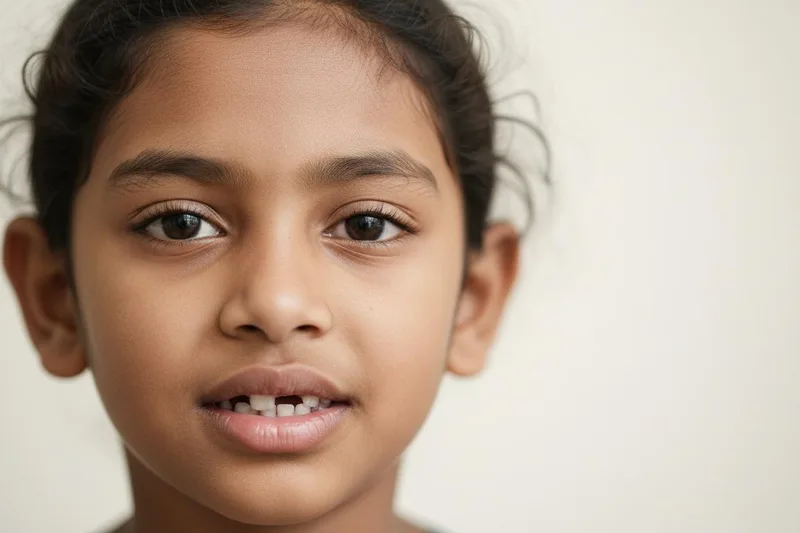
Have you ever noticed that some children do not have the right number of teeth for their age? Or some adults also have large gaps between their permanent teeth, and some teeth seem to be missing altogether. This can sometimes be a problem for the mind. Similarly, the condition of being born without some teeth is called hypodontia in medicine. Today, we will talk about this in detail, very simply.
What is hypodontia?
Simply put, hypodontia is a condition where a person is born without some of their teeth. This condition falls under the broader category of dental agenesis . Dental agenesis is the term doctors use to describe the absence of teeth from birth. "Congenital" means that you are born with this condition.
A person with hypodontia is usually missing one to six teeth, excluding wisdom teeth . This condition affects between 2% and 8% of the population. It can affect anyone.
Hypodontia can affect teeth anywhere in your mouth, but the teeth most likely to be lost are:
- Upper lateral incisors: These are the two small teeth on either side of the two large front teeth in your upper jaw.
- Upper second premolars: These are the teeth in your upper jaw that are slightly in front of your molars.
- Lower second premolars: These are the teeth that are slightly in front of your lower canines.
How does hypodontia affect oral health?
Missing teeth can interfere with your ability to eat and speak . Also, hypodontia can damage your gums and cause your jawbone to not grow properly. When your jawbone grows less, your jaw may appear smaller . It can also affect your facial appearance.
Think about how important teeth are for us to chew food properly. Missing teeth not only hinders that function, but can also make it difficult to pronounce certain letters.
Is Hypodontia a birth defect?
Yes, hypodontia is a birth defect . Children can inherit this condition from their parents through genes .
In some cases, infants and young children can develop hypodontia if they are exposed to certain illnesses, infections, or treatments (such as chemotherapy or radiation therapy for cancer) during their tooth development phase.
What are the symptoms of Hypodontia?
The most common symptom is the loss of one to six teeth at birth . This loss of teeth can occur anywhere in the mouth except for the wisdom teeth. Hypodontia can affect both primary teeth and permanent teeth.
Additionally, people with hypodontia may have peg-shaped or smaller than normal teeth. They may also have gaps and spaces between their existing teeth.
Hypodontia can also be a symptom of other genetic disorders . For example, some people with hypodontia may also have symptoms of a condition called ectodermal dysplasias . People with these ectodermal dysplasias may experience the following symptoms:
- Nail abnormalities.
- Thinning hair.
- Hearing impairment.
- Visual impairment.
- Decreased or absent sweat glands.
What are the causes of hypodontia?
People with hypodontia usually have an abnormality in an area called the dental lamina . The dental lamina is the layer of tissue under your gums where teeth form. This is often due to family history, which means genetics . However, other factors can also play a role.
Other conditions that may be associated with hypodontia
Hypodontia can occur in conjunction with other conditions or treatments, such as:
- Cleft lip or cleft palate .
- Low birth weight .
- Genetic conditions: For example , Down syndrome or Ectodermal Dysplasia .
- Infectious diseases: For example , `Candida` or `Rubella` .
- Anti-cancer treatment `(Chemotherapy)` .
- Radiation therapy .
How is hypodontia inherited through genes?
There are several genes that can cause hypodontia. Some of them are:
- `WNT1OB`
- `EDA`
- `EDAR`
- `EDARADD`
Depending on the specific gene, the inheritance pattern can vary. As with many genetic diseases, doctors determine this by looking at the status of both copies of a gene. That is, one copy from the mother and one copy from the father.
A person with hypodontia can inherit this condition in four main ways:
1. Autosomal recessive
In this case, hypodontia requires two copies of an abnormal gene – one from the mother and one from the father. This means that both parents must be carriers or have the disease.
2. Autosomal dominant
In this case, hypodontia only requires one copy of an abnormal gene – it can be inherited from either the mother or the father. This means that if one parent has the condition, the child is likely to have it too.
3. X-linked dominant
In this, there is one dominant abnormal gene on the X chromosome . This means that a male with X-linked hypodontia will pass this abnormal gene on to all of his daughters .
4. X-linked recessive
In this, there are one or two known abnormal genes on the X chromosome . This means that a woman with X-linked hypodontia will:
- There is a 25% chance of having a daughter who carries the abnormal gene.
- There is a 25% chance of having a daughter who does not carry the abnormal gene.
- There is a 25% chance of having a son with hypodontia.
- There is a 25% chance of having a son who is unaffected by the condition hypodontia.
Talking about these genetic aspects can seem a bit complicated, but if you have any doubts about this, it's best to see a doctor and discuss it further.
How is Hypodontia diagnosed?
If your doctor suspects hypodontia, they can confirm the diagnosis by taking dental X-rays . During an examination, a dentist will also look for other signs of hypodontia, such as small teeth, wedge-shaped teeth, and gaps between teeth .
What are the treatments for hypodontia?
There are several treatments for hypodontia. Some of them are:
- Braces or other types of orthodontics : These help reduce gaps between teeth and align teeth.
- Partial dentures : A temporary or permanent replacement for missing teeth.
- Dental bridges : An artificial tooth is attached to a missing tooth using the teeth on either side.
- Dental implants : A titanium root is placed in the jawbone and an artificial tooth is attached to it. This is very similar to a permanent tooth.
Children with hypodontia are usually allowed to wear partial dentures until they are old enough for other treatments. Because children's jaws are still growing, it may take a while before permanent treatments like dental implants can be considered.
Can I prevent hypodontia?
Since hypodontia is often inherited through genes , there is nothing you can do to prevent it from occurring. But remember, even if you have hypodontia, it does not mean that your children will inherit it. It depends on the way the genes are inherited, as mentioned earlier.
What should I expect if I have hypodontia?
The good news is that hypodontia is not a dangerous or life-threatening condition . However, if left untreated, it can have a significant impact on your quality of life, including difficulty eating, speaking, and self-consciousness about your appearance.
Fortunately, dentists, orthodontists, and other dental health care providers can manage and treat this condition with personalized treatment tailored to you.
If my child is missing teeth, when should I see a doctor?
If your child's baby teeth haven't erupted (have not erupted through the gums) by age 4 , or if their permanent teeth haven't erupted by age 14 , it's important to have them checked by a dentist. If you have any concerns about your child's missing teeth, ask your dentist about them during a routine office visit. Never ignore something that's minor.
What questions should I ask my doctor?
If you or your child has hypodontia, here are some questions to keep in mind to ask your doctor:
- How many teeth are missing?
- Will this condition affect my nutrition or digestion?
- What treatment options do I have?
- How long does the treatment take?
- Do I need to have further tests to find out if I or my child have other genetic conditions?
It is very important to ask questions like these and gain a clear understanding of your situation.
Finally, things to remember (Take-Home Message)
Hypodontia is a condition in which one to six teeth are missing from birth. This can cause eating and speaking challenges. But the good news is that it can be treated . If you or your child has hypodontia, talk to your dentist to discuss options that can help restore your smile, self-confidence, and quality of life. Don't worry, there are solutions for everything.
` Hypodontia, lack of teeth, congenital tooth loss, tooth regeneration, dental treatment, genetic diseases, oral health


💬 Comments (0)
No comments yet. Be the first to share your thoughts here.
Add Your Comment