

Everyone wants to be beautiful and clean. So sometimes we remove unwanted hair. When we shave or wax, sometimes small bumps appear, itchy, and painful, right? That is the condition we are going to talk about today, 'Ingrown Hair'. Although this is a bit annoying, it is something that can be controlled if you understand it and treat it properly.
What are these ingrown hairs?
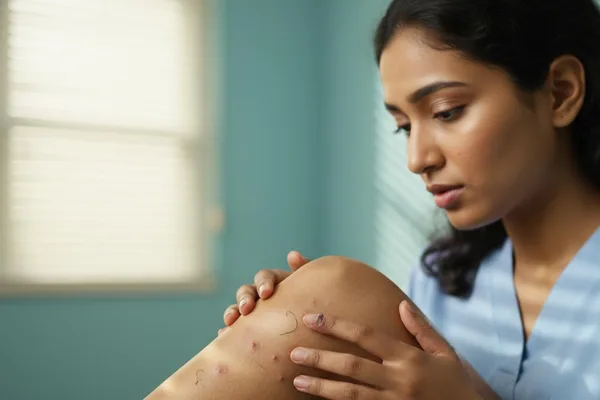
Simply put, ingrown hairs are when, after shaving, waxing, or tweezing, the new hair shaft doesn't come straight to the surface of the skin, but instead curls back into the skin and grows back there. It's like the hair shaft is on the wrong path. These can sometimes hurt, itch, and sometimes look like a small blister. You may have heard of 'razor bumps', 'shave bumps', or 'barber bumps'.
Who is most affected by this condition of ingrown hairs?
This is actually quite common . Anyone who shaves, waxes, or plucks their hair can develop this condition. People who shave frequently are more likely to develop it.
Also, if your hair is thick, curly, or coarse , you are more likely to have this `(Ingrown Hair)` problem. It is also said that people with certain skin tones are more prone to developing these. So, although this is common to everyone, it can affect some people a little more.
Where on our body do these occur most often?
This ``Ingrown Hair'' problem is usually seen in areas where we frequently remove hair.
- For men, the area of the face where the beard is shaved (neck, cheeks, chin) .
- In both women and men, in places like the legs, armpits, and private areas (bikini line, inner thighs) .
However, these are not limited to the areas mentioned above, they can develop anywhere else on the body where there is hair. For example, they can be seen on some parts of the head, chest, back, stomach, inside the nostrils, eyebrows, and even the buttocks.
What are the symptoms of an ``Ingrown Hair''?
There are several signs that can help you identify if you have something like this:
- Slight swelling and redness of the skin (skin irritation).
- The appearance of small bumps or papules. These may sometimes look like a black dot at the end of an ingrown hair.
- Pain. It can hurt when touched or when clothing touches it.
- Skin discoloration. It can be red, brown, or purple.
- Itching. Sometimes it itches a lot.
Be careful! Sometimes an infection can develop around this ingrown hair. If that happens, the bumps can get bigger, more painful, and even filled with pus. We call these ``Pustules''. If this infection occurs , it can also cause scarring , so you need to be careful.
So, do you know why hair goes into this skin?
The main reason for this is the methods we use to remove hair. That is, shaving, waxing, or plucking. With these methods, we only remove the hair shaft on the surface of the skin. The hair follicle underneath the skin remains.
So, when a new hair grows out of the follicle, sometimes it doesn't come straight up, but bends back towards the skin and grows inward, piercing the skin. This is especially likely to happen if your hair is thick, curly, or coarse . Because such hairs can bend easily and enter the skin with a sharp point.
Is this `(Ingrown Hair)` contagious?
No, not at all. `(Ingrown Hair)` is not a contagious disease. It cannot be transmitted from you to someone else.
How do you know for sure that this is an ``Ingrown Hair''?
In most cases, ingrown hairs are easy to identify. So you don't necessarily need to see a doctor to diagnose them. However, if you have any doubts, a doctor can examine you and confirm the diagnosis. The doctor will look at your skin, your symptoms, and ask you questions about your skin and your skin care routine. For example:
- When did you start seeing these symptoms?
- Are these bumps always there, or do they come and go and then come back?
- Do you shave, wax, or pluck hair with a tweezers?
- How often do you shave?
- What kind of razor do you use to shave?
- How often do you wax or pluck it with tweezers?
- How do you prepare your skin before hair removal?
By asking questions like these, the doctor can accurately understand your condition.
What can be done to treat ingrown hairs?
There are several simple home remedies for this `(Ingrown Hair)` problem:
- Stop shaving and waxing for a while. Sometimes, the ingrown hair can come out on its own once the hairs start growing a little longer.
- Use an electric shaver. Don't hold it too close to the skin, but rather just above the surface of the skin.
- Use depilatory products. These work by dissolving the proteins in the hair shaft, removing hair without shaving. However, test a small area before using them to see if your skin is allergic.
- Apply a warm compress. Soak a clean cloth in warm water and place it on the affected skin for 10-15 minutes. This will open the pores of the skin and help the ingrown hairs to come out more easily.
If these things don't help your symptoms, a doctor may need to prescribe medications that reduce inflammation and control infection .
In rare cases, a doctor may need to make a small incision with a sterile scalpel , drain the pus, and remove the trapped hair with sterile forceps.
The most important thing is, don't pick, squeeze, or dig into these growths with your fingernails. Doing so can cause injuries, scarring, and even infection. So be very careful.
How do you properly remove an ingrown hair?
If you want to remove an ingrown hair, first gently exfoliate your skin. Exfoliating means removing the top layer of dead skin cells. This helps loosen the ingrown hair. Use lukewarm water, not hot , and gently scrub in circular motions with a washcloth, scrub brush, or scrub gel.
Sometimes, if the tip of the hair is visible above the skin surface, and it has curled back into the skin, you can use a sterile needle, pin, or tweezers to gently pull it out. However, before doing this, you should first clean the area with something like rubbing alcohol to kill the germs and prevent infection. Then, very carefully insert the needle or tweezers through the hair loop and slowly lift it until one corner of the hair is free from the skin. Be careful not to damage the skin while doing this. If in doubt, it is best not to do this.
What happens if left untreated?
In most cases, an ingrown hair will heal on its own within a week or two, with little discomfort. This is because the hair follicle grows out of the skin on its own. However, sometimes an infection can develop around the ingrown hair follicle, causing pus to fill the area, discoloring the skin, and increasing pain. If you see signs of infection (pus, excessive redness, warmth, or severe pain), be sure to see a doctor.
What is the medicine for `(Ingrown Hair)`?
Your doctor may prescribe medications such as these to reduce inflammation and control infection caused by this condition:
- Antibiotic ointment or pills if there is an infection.
- Acne medications , such as retinoids, help remove dead skin cells and reduce the blockage of hair follicles.
- Steroid pills or creams. These reduce inflammation and swelling.
If the condition is more severe, the doctor may recommend other hair removal methods:
- Electrolysis: This method uses a very fine needle and a small electric current to destroy individual hair follicles. Since each hair follicle must be treated separately, it may not be practical to do this on large areas of the body.
- (Laser hair removal): In this method, heat from laser beams is used to destroy pigment-rich cells (i.e. hair follicles). This is most effective for dark, thick hair.
How soon will I feel better after treatment?
In most cases, ingrown hairs will resolve without treatment within a few days. However, more severe cases can take several weeks.
It can take a few days to see results from medications. Treatments like `(Electrolysis)` and `(Laser hair removal)` can show results quickly.
How to prevent ingrown hairs?
The best way to avoid this annoying `(Ingrown Hair)` problem is to follow the right methods when removing hair. Here are some tips to help you with that:
- Before shaving: Wet the skin and hairs in any area you plan to shave with lukewarm water. Letting it soak for a few minutes will soften the hairs.
- Apply a shaving gel or cream: To protect your skin, apply a good shaving gel or cream before shaving.
- Use a single-blade razor: Razors with multiple blades cut hairs very close to the skin, making them more likely to turn inward.
- Shave in the direction of hair growth: When you shave against the direction of hair growth, the tips of the hair shaft become sharper and easier to penetrate the skin.
- Wash your razor blade after every shave: This removes hair fragments and dead skin cells that get stuck in the razor.
- Change your razor blades frequently (or replace disposable razors): Dull blades can cause skin irritation and tearing. They can also cause ingrown hairs.
If you follow these steps, you will be able to greatly reduce the occurrence of ingrown hairs.
When should I see a doctor?
If your ingrown hair problem doesn't improve with home treatments and good skin care, or if your ingrown hair appears to be infected (pus, excessive redness, pain) , definitely see a doctor. Don't delay.
What questions should I ask the doctor?
When you go to see the doctor, you can ask questions like these:
- How do you tell if I have an ``Ingrown Hair''?
- What home treatments do you recommend?
- What kind of medicine do you recommend that can be purchased at the pharmacy?
- Can you prescribe a cream or ointment that I can apply?
- What specifically should I do to prevent this from happening again?
You can learn more by asking questions like these.
The most important things to remember (Take-Home Message)
Okay, so the ``Ingrown Hair'' we've been talking about is a very common skin condition. Although they can develop anywhere on the body where there is hair, they are most commonly seen in areas where we shave or wax. Especially on the face, legs, armpits, and private areas.
The best way to prevent this is to follow a good skin care routine and use the right methods when removing hair.
Simple home remedies can sometimes help relieve ingrown hairs. However, if there are signs of infection or the problem persists, be sure to see a doctor. Never squeeze or pick at these. This will only make the condition worse. Take care of your skin!
` Ingrown hairs, skin hairs, shaving, waxing, hair removal, skin problems, skin infections, razor bumps, shave bumps




💬 Comments (0)
No comments yet. Be the first to share your thoughts here.
Add Your Comment