
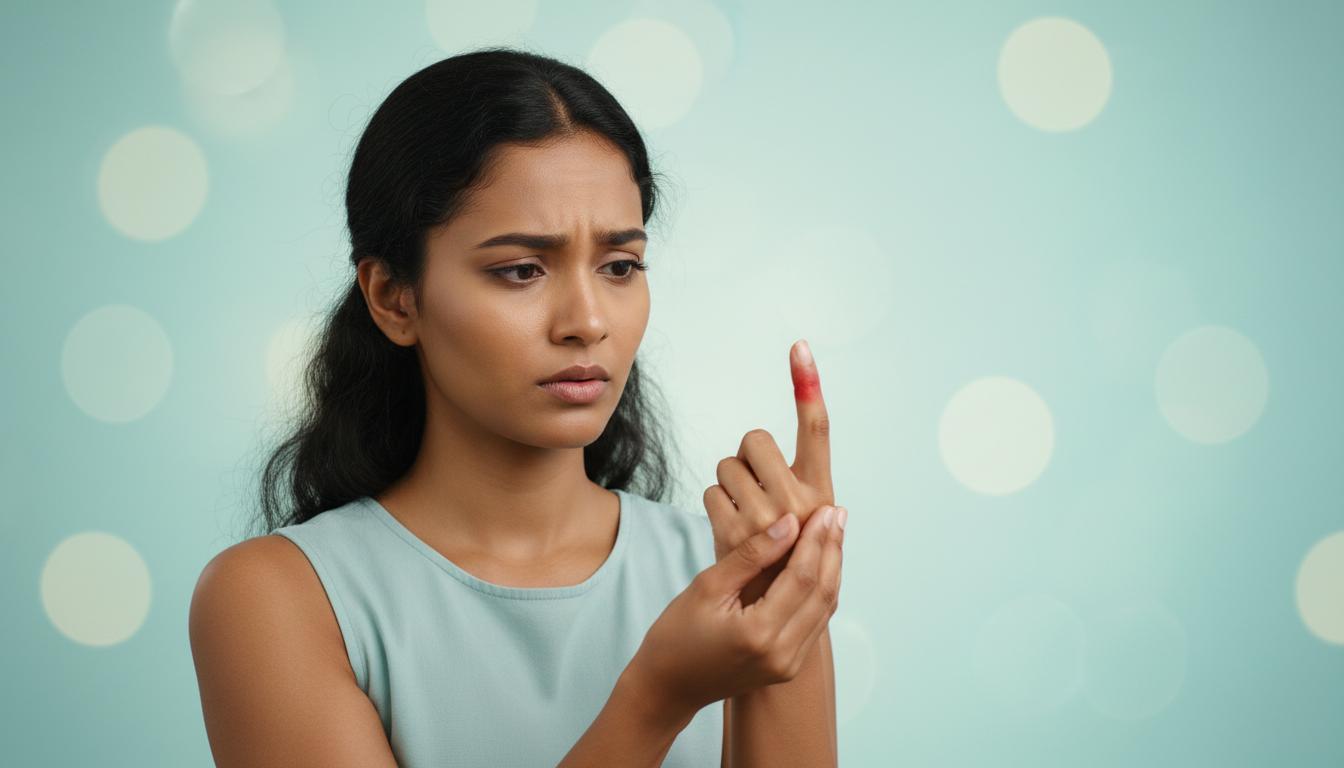
Did you suddenly get hit by a ball while playing sports? Or did you slip and land on your hand against the floor? Maybe you accidentally caught your finger in a door while rushing around your house. It is completely normal for your finger to become stiff, swollen, and throbbing after an accident like that, isn't it? We usually call this a 'jammed finger' or a 'sprained finger'. While many people brush it off as a simple minor tweak, sometimes it can be much more serious than you first think. So, let’s sit down and talk about what is really going on inside your hand today, shall we?
📌 Key Takeaways
- A jammed finger happens when the ligaments supporting your finger joints are suddenly stretched or torn by impact.
- Mild injuries often respond very well to the home-based RICE method (Rest, Ice, Compression, Elevation).
- It can be tricky to tell a sprain apart from a hairline fracture, so keep an eye out for severe pain, bruising, or deformity.
- If your finger remains numb, crooked, or fails to improve after 48 hours, you should visit your primary care physician, urgent care clinic, or emergency department.
BMI Calculator
Know your body mass index (BMI) and weight classification
What exactly is a jammed finger?
Simply put, a sprained or jammed finger is an injury to the soft tissues inside your finger. More specifically, the ligaments—which are strong bands of tissue connecting the bones of your fingers and giving stability to your joints—are violently overstretched. Think of a brand-new rubber band for a second. You can pull it gently and it stretches back into shape normally, right? But what happens if you suddenly yank it too hard or stretch it way beyond its limit? It can tear or become damaged. That exact same thing happens to the delicate ligaments in your fingers when an impact occurs.
This type of injury can happen during sports, accidental falls around the house, or even regular daily chores. While most of the time it can be managed safely at home with basic care, certain situations require prompt professional medical evaluation, don't they?
Are there levels of severity for this tightening?
Yes, absolutely. When you come into our clinic, we examine your finger carefully and grade the injury according to its severity. Categorizing it makes planning your recovery much easier:
- Grade 1 (Mild Sprain): The ligaments are slightly stretched, but the joint remains stable. There is mild tenderness and minimal swelling.
- Grade 2 (Moderate Sprain): The ligaments are partially torn. You will notice moderate swelling, bruising, stiffness, and noticeable discomfort when trying to bend or straighten the finger.
- Grade 3 (Severe Sprain or Rupture): The ligament is completely torn or detached from the bone, sometimes pulling a tiny piece of bone away with it (an avulsion fracture). The joint feels unstable, and there is severe swelling, deep bruising, and extreme pain.
What is the difference between a sprained finger and a broken finger?
Many people confuse the two because the symptoms of a jammed finger and a fractured bone look almost identical at first glance. However, there is a fundamental difference between them, isn't there? A sprain is an injury to the soft connective tissues, while a fracture is a break or crack in the hard bone structure. If a bone is broken, you definitely need prompt medical attention to ensure it heals in proper alignment.
The most important thing to keep in mind is this: if you are ever unsure whether your finger is just sprained or actually broken, it is always safest to treat it like a possible fracture and have a doctor take a look. Pretty smart precaution, right?
| Feature | Sprained Finger (Jammed) | Broken Finger (Fracture) |
|---|---|---|
| Primary Injury | Overstretched or torn ligaments (soft tissue) | Cracked, splintered, or broken bone |
| Appearance | Swollen around the joint, mild to moderate bruising | Often visibly crooked, angled, or severely deformed |
| Movement | Painful to move, but range of motion is usually intact | Extremely difficult or impossible to move without sharp pain |
| Initial Care | RICE method, buddy taping, gentle rest | Immediate professional medical evaluation, X-ray, and possible splinting or casting |
What causes this?
There are countless everyday scenarios where a finger can become jammed or struck. Let's look at some of the most common causes:
- Playing Sports: Hitting the tip of your finger directly against a ball, especially when trying to catch a fast-moving object. This happens frequently in sports like basketball, netball, volleyball, and cricket.
- Accidental Falls: Slipping and landing heavily on your outstretched hand, forcing your fingers backward against the hard ground.
- Hyperextension: Bending a finger back past its normal anatomical range of motion.
- Household Mishaps: Accidentally getting your finger caught in a slamming car door, house door, or desk drawer without realizing it.
- Workplace Accidents: Incidents involving heavy equipment, awkward lifting, or sudden impacts on the job.
What treatments can be done at home? (RICE method)
If you have a mild sprain (Grade 1) and there is no severe pain, obvious deformity, or numbness, you can manage the initial discomfort safely at home. A tried-and-true approach that we always recommend is the RICE method:
- R - Rest: Rest your injured finger right away. Stop working with that hand, lifting heavy items, or playing sports for a few days. The more physical rest your finger gets, the faster those micro-fibers will repair themselves.
- I - Ice (Icing): Apply an ice pack to the affected area for 15 to 20 minutes at a time. Never place bare ice directly against your bare skin, as that can cause cold burns. Instead, wrap ice cubes in a clean plastic bag and place a thin towel around it. Doing this several times a day—especially within the first 24 to 48 hours—will dramatically cut down on throbbing pain and swelling.
- C - Compression (Bandaging): Gently wrap the injured joint with a lightweight elastic compression bandage to control swelling and provide gentle support. Remember not to wrap it too tightly, though! Wrapping too tightly cuts off proper blood circulation, causing your finger to turn pale, blue, or numb.
- E - Elevation: Try to keep your injured hand elevated above the level of your heart whenever possible. Rest your arm on a stack of cushions while sitting on the sofa, and prop your arm up on a pillow at night. Gravity works wonders for draining excess fluid away from the injury site.
If you need relief from minor aches, over-the-counter pain relievers such as acetaminophen (paracetamol) or ibuprofen can be helpful when taken according to package directions or your doctor's advice.
✔️ Do's and ❌ Don'ts
- DO apply ice wrapped in a cloth during the first 48 hours to minimize swelling.
- DO keep your hand elevated above your heart level whenever you rest.
- DON'T try to forcefully "pop" or pull a jammed finger straight yourself, as this can worsen ligament damage.
- DON'T ignore persistent numbness, tingling, or a finger that looks visibly crooked.
When should you see a doctor?
Even after trying home care, there are times when self-treatment isn't enough and you need professional medical guidance. Have you ever wondered where to go? You can visit your primary care physician (PCP), family doctor, an NHS GP clinic, local urgent care, or the hospital emergency department depending on how severe things are. Make sure to seek professional medical attention if you notice any of the following warning signs:
- Unbearable pain that does not subside with rest or over-the-counter medication.
- Swelling or throbbing that fails to improve after 24 to 48 hours, or actually worsens.
- Complete inability to bend or straighten your finger joint.
- Visible deformity, such as the finger looking bent at an unnatural angle or crooked.
- Numbness, tingling, or a pale, bluish discoloration in the skin.
- Hearing or feeling a distinct "pop" or "snap" at the exact moment of impact.
When you visit your doctor, they will perform a physical examination and may order an X-ray to rule out a bone fracture. In certain cases involving persistent joint instability, an MRI scan might be suggested to check the exact extent of ligament or tendon damage.
Depending on what your doctor finds, treatment options include:
- Buddy Taping: Taping your injured finger securely to the healthy adjacent finger using medical tape. This uses your neighboring finger as a natural splint while allowing some movement.
- Splinting: Wearing a rigid plastic or aluminum finger splint to keep the joint immobilized in a straight position so the ligaments can heal correctly.
- Surgery: In severe Grade 3 injuries where a ligament is completely torn or a bone fragment is displaced, orthopedic consultation and surgical repair may be necessary.
How long will it take to heal?
Healing time varies quite a bit depending on how badly the finger was injured in the first place:
- Mild Sprain (Grade 1): Typically resolves completely within 1 to 2 weeks with basic rest and ice.
- Moderate Sprain (Grade 2): Can take anywhere from 3 to 6 weeks for the ligaments to regain their strength.
- Severe Sprain (Grade 3): May require 6 weeks to several months of healing, sometimes followed by physical therapy or hand exercises to restore full flexibility and strength.
During your recovery journey, following your doctor's instructions closely prevents long-term stiffness and chronic joint aching. Makes sense, right?
🚨 When to Seek Emergency Care (Red Flags)
If you notice any of these warning signs, don't wait — call your local emergency number right away (911 in the US/Canada, 999 in the UK, 112 in Europe, or 000 in Australia) or go to the nearest hospital Emergency Department (ER / A&E):
- Open wounds, bone fragments breaking through the skin, or severe bleeding.
- Complete loss of blood flow indicated by a cold, pale, completely blue or black finger.
- Severe, crushing trauma to the entire hand or multiple fingers at once.
💡 Take-Home Message
- A jammed finger is an extremely common athletic and household injury involving overstretched ligaments.
- Mild cases improve rapidly when treated promptly with the RICE method (Rest, Ice, Compression, Elevation).
- Never ignore severe pain, structural deformity, or lasting numbness — these require professional medical evaluation.
- Getting the right diagnosis early helps you avoid long-term stiffness, chronic pain, and grip weakness.






No comments yet. Be the first to share your question or experience below.