
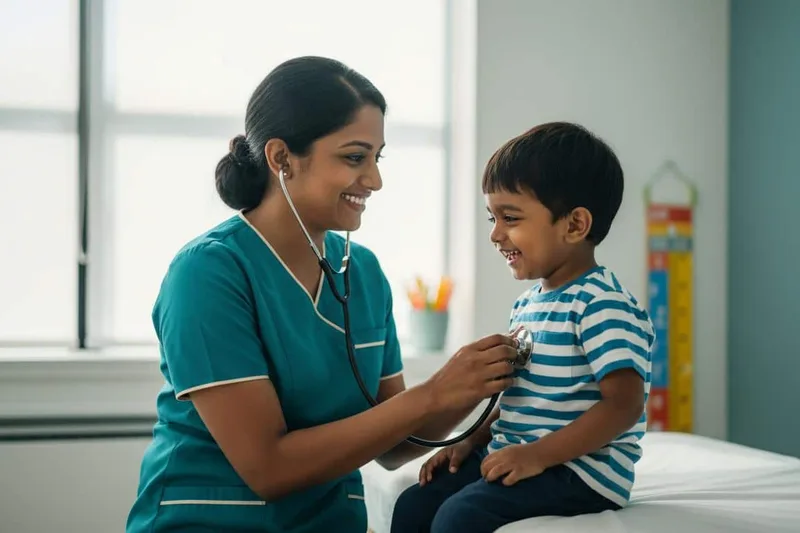
What exactly does a pediatrician do?
Imagine, a pediatrician is someone who looks after a child's health from A to Z. They have a role that goes beyond just treating a disease. 1. Preventive Care: This is the most important. It's better to prevent a disease than to suffer after it occurs, right?- Vaccinations: A pediatrician's primary responsibility is to provide children with the necessary vaccines at an early age to protect them from various infectious diseases. These vaccines can protect children from many dangerous diseases such as measles, mumps, rubella, and polio. When vaccines are given correctly, not only the child but also the entire society is protected.
- Regular health check-ups (Well-baby check-ups / Well-child check-ups): From the day your baby is born, even if he or she is not sick, you should continue to see your pediatrician. This is what we call ``Well-baby check-ups'' or ``Well-child check-ups''. During this time, the doctor will check your baby's growth and development.
- Physical development: The child's height, weight, and head circumference (infants) are measured to see if the child is growing appropriately for that age.
- Developmental Milestones: This is very important. "Developmental milestones" are things that a child should be doing at a certain age. Think about whether your baby is smiling, has a strong neck, rolls over, sits, kneels, walks, says words, and looks at others. Doctors pay attention to whether these are happening on time. Because if there is a delay, it can be corrected quickly.
- Minor Illnesses: Treats common illnesses in children such as colds, coughs, fevers, ear infections, and gastroenteritis.
- Complex medical conditions: Sometimes pediatricians also treat or refer children to specialists for more serious, long-term conditions (e.g., asthma, diabetes).
- Prescribing medications:Medications are safely prescribed according to the child's age, weight, and medical condition.
- Nutrition: Provides advice on many things, such as what foods to feed your baby, the importance of breastfeeding, and how to start complementary foods.
- Sleep: We discuss issues related to your child's sleep and what needs to be done to ensure good sleep.
- Safety: Teaches how to ensure the child's safety at home, while playing, and while traveling in a vehicle.
- Behavioral Issues: If parents have concerns about some of their child's behaviors (e.g., stubbornness, tantrums), they can talk about those as well and help find solutions.
- Mental Health: Children's mental health is as important as their physical health. Pediatricians pay attention to that as well.
Who should see a pediatrician?
Simply put, a child can receive the services of a pediatrician from the day they are born until they reach adolescence (usually 18 years old, sometimes around 21) .- Newborns: A pediatrician is the first person to examine a baby in the hospital after birth. Sometimes, premature babies or babies with complications may need the help of a specialized pediatrician (called a neonatologist).
- Toddlers and Preschoolers: Children at this age are very active. They often get sick, fall, and get injured. Also, their growth, speech, and social skills are developing during this time. Pediatricians pay close attention to all of this.
- School-age children: School-age children also need regular health checkups. You can also talk to your doctor about things like learning problems and behavioral issues.
- Adolescents/Teens: This is also a very important time. The body undergoes major changes (puberty). There are also many mental changes. Peer pressure, exams, etc. can cause mental stress. The guidance of a pediatrician is very valuable for all of this.
"That means that from a small baby, to a toddler, to a school-age child, and even beyond that, a pediatrician will look after your child's health from A to Z."
Is it important to have a good relationship with a pediatrician?
Definitely yes!This is very important. Just think, if your child talks and smiles without fear when they see the doctor, and if you can ask the doctor any question you have, no matter how small, without fear or doubt, how valuable would that be?- Trust and comfort: The child should trust the doctor, and he should feel comfortable around the doctor. Only then will the child be able to tell the truth about his problems. As a parent, you should also trust the doctor.
- Open communication: You should be able to ask your doctor any questions you have, no matter how small. Don't be shy about asking, even if it's something like, "Hey, doctor, my baby isn't eating well," or "He's not sleeping well at night."
- Continuity of care: It's best to see the same pediatrician as much as possible. That way, the doctor will know your child's medical history. The doctor will have a good understanding of your child's development, past illnesses, and medications.
What happens when you go to see a pediatrician?
This depends on whether you are going for a routine checkup or if your child is sick.A routine health check-up is:
- First, the child's height and weight are measured. If it's a small baby, the head circumference is also measured. From these, you can get an idea of the child's development.
- Then the doctor will examine the child completely . They will listen to the heart and lungs with a stethoscope, and examine the ears, throat, and stomach.
- You will be asked about your child's development, eating, sleeping, and behavior .
- If there are vaccinations that need to be given at that time, they will be given.
- Most importantly, this is the best time to ask your doctor any questions you have, no matter how small. It's also a good idea to take a notebook and write down your questions.
When Sick:
- The doctor will first ask you about your symptoms . Do you have a fever, how long it has been there, cough, runny nose, vomiting, stomach pain, etc.
- Then the child is examined , especially for any illness.
- Sometimes additional diagnostic tests may be done (e.g., a throat swab, a urine test).
- The doctor then makes a diagnosis and provides a treatment plan , including medications, how to give them, and how to care for the child at home.
When should you call a pediatrician urgently?
There are times when you need to call a pediatrician right away, without waiting at home.- High fever: Especially if a baby under 3 months old has a fever.
- Difficulty breathing:If the child is breathing loudly, if the chest is drawn in when breathing, or if the lips are turning blue.
- Severe vomiting or diarrhea: If your child is vomiting continuously, has severe diarrhea, especially if they are showing signs of dehydration (dry mouth, sunken eyes, decreased urine output).
- Unusual rash: A sudden, large rash on the body, especially with a fever.
- Serious injuries: If you have a major fall, cut, or burn (but in the event of an accident, the first thing to do is go to the emergency room of the nearest hospital).
- If your child seems to be in a lot of trouble , or if you feel very scared or suspicious , or if you think, "This seems a bit serious," don't hesitate to call and ask. Listen to your gut.
Are there any special fields of pediatrics?
Yes, there are. Just as there are cardiologists and neurologists among doctors who treat adults, there are also pediatricians who have specialized training in various fields. Here are a few examples:- Neonatologist: A doctor who specializes in newborn babies, especially those born prematurely or with complex medical conditions.
- Pediatric Cardiologist: A doctor who specializes in heart disease in children.
- Pediatric Neurologist: A doctor who treats diseases related to the brain and nervous system of children.
Finally, remember this (Take-Home Message)
So, from what we've discussed, I hope you've got a good idea of who a pediatrician is and what they do.Simply put, your pediatrician is your best friend and biggest supporter on your child's health journey.
- Remember, you should see a pediatrician not only when your child is sick. You should also see your doctor regularly (for regular check-ups) to make sure your child is growing and developing properly.
- Never be afraid or embarrassed to ask your questions. The doctor is there to help you.
- Trust your pediatrician. Build a good relationship. It's very important for you and your child.
`Pediatrician, child health, baby doctor, vaccination, child development, pediatrics, parenting advice


💬 Comments (0)
No comments yet. Be the first to share your thoughts here.
Add Your Comment