

Hello! How are you? Today we are going to talk about something that we get from our food, which is very important for our body. That is carbohydrates . You may have heard this name somewhere, right? Maybe a doctor says it, or you may have heard it in the newspaper or on TV talking about such foods. So, what are these carbohydrates? Do our bodies really need them? Let's talk about all this very simply, in a way that is easy for you to understand. Don't be afraid, I am going to talk about this as if I were talking to a friend, without using big words.
What are carbohydrates?
Simply put, carbohydrates are one of the three main nutrients in the food we eat. The other two are proteins and fats . You may have heard of these names. So, these carbohydrates are the main thing that gives our body energy, that is, the main thing that gives energy . Just like gasoline to a car, or electricity to a light, carbohydrates are to our body. We need energy to run, jump, think, work, and even breathe. That energy is mostly obtained from these carbohydrates.
Imagine, when you eat something in the morning and go to school or the office, you have the energy to work all day. These carbohydrates are a great help in giving you that energy.
Are there types of carbohydrates?
Yes, there are two main types of carbohydrates. Just like there are two types of peas (laughs). Let's see what they are:
1. Sugars: These are carbohydrates that provide quick energy to the body.
2. Starches and Fiber: These provide energy to the body more slowly, but help maintain energy over a longer period of time.
Now, shall we talk about each of these types in a little more detail ?
Sugars - quick energy!
When we say "sugar," we immediately think of the sugar we put in our tea, right? That's also a type of sugar. We also call these simple carbohydrates . Because their molecular structure is very simple, they are easily absorbed by the body and converted into energy.
Where are these sugars?
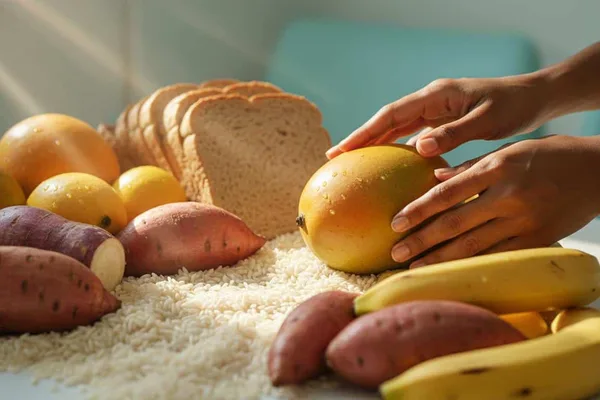
- Fruits: Fruits like mangoes, bananas, and papayas naturally contain sugar. These are very good.
- Milk and dairy products: Milk and yogurt, like dairy products, contain a type of sugar called `(Lactose).`
- Sugars we add to food: This sugar is found in things like sugar added to tea and coffee, sweet foods, cakes, biscuits, toffees, and chocolate.
- Sweetened drinks: Various sweetened drinks available in stores are also high in sugar.
These types of sugar give the body a quick boost of energy. Just think, when you feel tired, eating a piece of fruit can make you feel refreshed. However, consuming too much sugar, especially processed sugar, is not good for the body. It can lead to weight gain and tooth decay. Therefore, it is best to eat foods that contain natural sugars, such as fruits.
Complex Carbohydrates - Starches and Fiber - A healthy source of energy that is easily digested!
These are called complex carbohydrates . Because they are made up of many simple sugar molecules linked together, like long chains. Like a necklace made of many pearls strung together. So it takes a while for the body to digest them. But that's good, because then the body gets energy gradually, not all at once. So you can stay hungry for a long time.
Starches
Starch is a common ingredient in our main meals.
Where is this starch?
- Grains: Rice (white rice, brown rice), buckwheat, oats, barley, bread (especially bran bread), noodles, pasta, etc.
- Types of potatoes: Potatoes, sweet potatoes, cassava, and yams.
- Some vegetables and legumes: Things like corn, peas, and lentils also contain some starch.
These starchy foods give us the energy we need to work throughout the day.
Fiber
Fiber is also a type of complex carbohydrate. But the special thing about this is that our bodies cannot fully digest this fiber. "Then why eat it?" you may be wondering. Even though fiber is not digestible, it has many benefits for our bodies!
What are the benefits of fiber?
- Keeps the intestines functioning properly: Reduces problems like constipation.
- Gives a feeling of fullness: This helps control overeating and helps with weight control.
- Helps control blood sugar levels: This is especially important for people with diabetes.
- It also helps reduce blood cholesterol levels.
Where are these fibers?
- Fruit: Especially fruits that are eaten with the peel (like apples and pears).
- Vegetables: Almost all vegetables, such as greens, beans, carrots, and beets, contain fiber.
- Whole grains: brown rice (red rice), bran bread, oats.
- Nuts and foods made from nuts: lentils, chickpeas, green beans, peas.
So do you understand? Sugar, starch, and fiber are all carbohydrates. But the benefits that each type provides to our bodies and the way they work are slightly different.
How does our body use carbohydrates? - A little story!
Okay, now let's see how these carbohydrates we eat are converted into energy in the body. This is like a little story.
1. Taking food into the mouth and chewing it: When we eat a carbohydrate-containing food (for example, a piece of rice or a piece of fruit), the saliva in our mouth begins to digest it.
2. Journey to the stomach and intestines: This food then goes to the stomach, and from there to the small intestines. This is where carbohydrates are mainly digested and converted into glucose, its simplest unit. Imagine, just like we cut a large piece of wood into small pieces, the large molecules called carbohydrates are broken down into small glucose molecules.
3. Glucose absorption into the blood: The ``Glucose`` formed in this way is then absorbed into our blood from the intestines. Then our blood sugar level goes up a little. This is normal.
4. The role of insulin: When the level of `(Glucose)` in the blood increases like this, an organ called ` (Insulin) ` in our body produces a hormone called `(Insulin)`. This `(Insulin)` is a very important person. It's like a key.
5. Energy for cells: `(Insulin)` is what opens the doors of the smallest parts of our body , the cells , and helps the `(Glucose)` in the blood to enter the cells. The `(Glucose)` that enters the cells is what we use as energy. It's like fuel for the billions of tiny engines in our body.
What happens to the excess glucose?
When we eat more carbohydrates than we need, the excess glucose is first stored in our liver and muscles as glycogen . This is like a power bank. It can be used later when we need energy. However, if there is any excess glucose left after those stores are full, it is stored in the body as fat. That is why some people say that eating too many carbohydrates makes you fat. There is some truth to that, but it depends on the type of carbohydrates we eat, the amount, and our activity level.
So, why are carbohydrates important to us? What are good carbohydrates?
Now you probably understand that carbohydrates are essential for our bodies.
- Main source of energy: Our brain and central nervous system get their energy mainly from `(Glucose)`. This means that carbohydrates are essential for things like thinking, learning, and remembering properly.
- For physical activity: Carbohydrates provide energy for everything we do, whether it's running, jumping, or exercising.
- Benefits of Fiber: As we discussed earlier, fibrous carbohydrates have many benefits for our health.
How to choose good carbohydrates?
This is the most important thing. Not all carbohydrates are created equal. We should try to choose complex, fibrous, and nutritious carbohydrates .
- Choose whole grains: bran bread instead of white bread, brown rice instead of white rice, buckwheat, oats, etc. These are high in fiber and vitamins.
- Fruits and vegetables: Include several types of fruits and vegetables in your diet each day. These are full of natural sugars, fiber, vitamins, and minerals.
- Legumes: Eat things like lentils, chickpeas, green beans, and peas regularly. These are a good source of protein as well as carbohydrates.
- Limit sugar and sweet foods: Reduce your intake of things like cakes, biscuits, toffee, ice cream, and sweetened drinks as much as possible. These are just empty calories with no nutritional value.
Imagine, if you eat some oats with milk and some fruit in the morning, it will give you a good start to the day, fiber, and vitamins. And if you eat red rice with vegetables, lentils, and fish for lunch, that is also a very balanced meal.
Some misconceptions about carbohydrates and the truth
Sometimes there are misconceptions about carbohydrates in society. Let's take a look at that.
- "All carbohydrates make you fat": This is not entirely true. As we discussed earlier, the problem lies in the type and amount of carbohydrates we eat. Eating too much of sugary foods and starchy foods can lead to weight gain. But eating a moderate amount of good carbohydrates like whole grains, fruits, and vegetables will not.
- "Eliminating all carbohydrates from your diet is good for your health ": This is also a misconception. Our bodies, especially our brains, need carbohydrates for energy. Cutting out carbohydrates completely can lead to fatigue, headaches, and difficulty concentrating. The important thing is to choose the right carbohydrates and eat them in the right amounts.
Remember, no food can be labeled as "good" or "bad." What's important is balance and moderation.
Let's remember what we talked about in one breath. (Take-Home Message)
Okay, we've talked a lot about carbohydrates today, haven't we? Now let's summarize it all a bit and remember it.
- Carbohydrates are the main nutrient that gives our body energy, like gasoline for a car.
- There are two main types of carbohydrates: sugar (quick energy) and starch/fiber (slow, long-lasting energy).
- Our bodies digest carbohydrates into glucose , which, with the help of the hormone insulin, provides energy to cells.
- Choosing good carbohydrates is very important. Whole grains, fruits, vegetables, and legumes are the best choices.
- Limit sugary foods and drinks, and refined carbs as much as possible.
- It's not a good idea to completely eliminate carbohydrates from your diet. Eating the right amount of good carbohydrates in a balanced way is important for a healthy life.
So, I hope you have a clear understanding of carbohydrates today. When you look at your plate, you now know what carbohydrates are in it and how important they are for the body. To stay healthy, it is very important to be aware of what we eat. If you have any further questions, don't forget to ask a nutritionist or a doctor.
` Carbohydrates, sugar, starch, glucose, insulin, energy, healthy food




💬 Comments (0)
No comments yet. Be the first to share your thoughts here.
Add Your Comment