

Have you ever peed in a small cup? You probably have. If you have, you've probably had a urine test, or ``urinalysis''. This urine test is a very simple, yet very valuable test. It can help doctors find out a lot about what's going on inside your body and whether there's anything wrong with it.
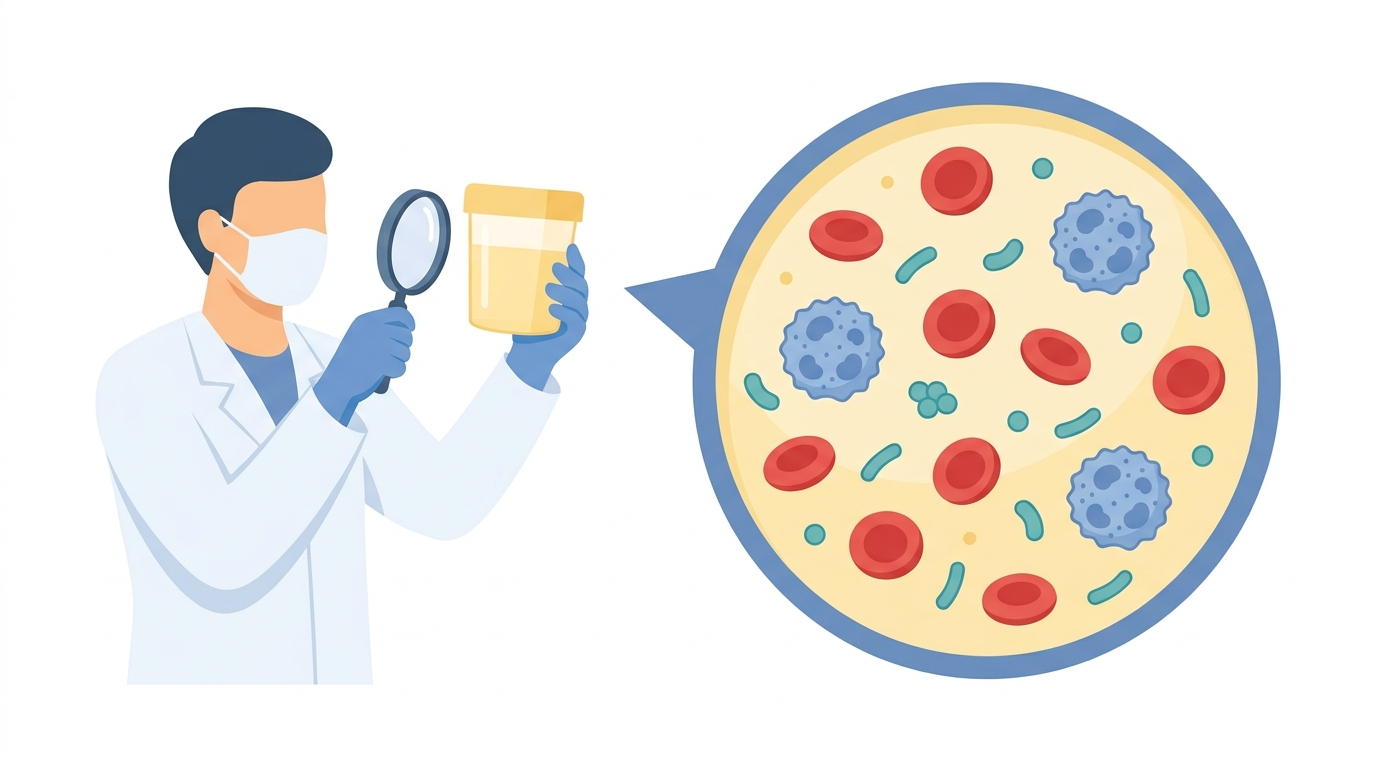
So, why do we do this urine test (Urinalysis)?
Simply put, our urine , that is, urine, is like a mirror of our body. Many things that are going on inside our body, and the symptoms of some diseases, can come out with urine. A doctor may ask you to do this `(Urinalysis)` test for several main reasons:
- As part of a general health checkup: Sometimes, even if you don't have any illness, this test is done to check your general health. Just like a car is serviced, this is to check whether our bodies are in good health.
- When you suspect an illness: If you have any symptoms, for example, pain when urinating , stomach pain, fever, or blood in your urine , your doctor will use this test to find out what is causing it.
- Check the status of an existing disease: If you already have a disease like Diabetes Mellitus or a kidney-related disease, this ``Urinalysis`` will also help to see if the disease is under control and how it is.
- Before surgery: Sometimes this test is done before an operation to get a complete picture of your health.
Imagine, you've been feeling really tired for a few days, you need to urinate frequently, and your mouth feels dry. Then the doctor might say, "Let's take a look at your urine ." That's when this urine test (urinalysis) becomes very important.
What can be detected by a urine test (Urinalysis)?
This is the most important part. This simple test can give us clues about many problems in our body.
Conditions like Diabetes Mellitus
This test checks for sugar, or glucose, in your urine . Normally, a healthy person's urine does not contain sugar. If it does, it can be a sign of diabetes. It also checks for ketones in the urine . When diabetes is not properly controlled, these ketones can build up in the body and be excreted in the urine .
Infections
This is a great test to find out if you have a urinary tract infection (UTI).
- UrineThey are checking to see if there are any bacteria in the urine.
- White blood cells (also called leukocytes) are checked for presence. These are cells that fight infection in the body.
- They also check for a chemical called nitrite . Certain types of bacteria convert nitrates in urine into nitrite.
If these are present, it could be a bladder infection (`Cystitis`) or perhaps a more serious kidney infection (`Pyelonephritis`).
Kidney problems
Our kidneys are like a filter in the body. The kidneys remove waste products from the body through urine . If there is a problem with the kidneys, it can also be detected through a urine test.
- Protein: Normally, there should be very little or no protein in the urine . If there is too much protein, it can be a sign that the kidneys are damaged.
- Red Blood Cells: This checks for blood in the urine . There can be many causes, including kidney stones, infections, or other kidney diseases.
- Casts: These are cylindrical structures that can only be seen under a microscope and form inside the kidney tubules. The presence of these also indicates kidney disease.
Other health problems
Many other things can be detected through this urine test (urinalysis).
- Liver disease: You can also get an idea of liver problems by checking the presence of substances like bilirubin and urobilinogen in the urine .
- Dehydration: This can also tell you if you are not getting enough water in your body. It is measured by the density of your urine , which is called the specific gravity .
- Urinary stones: By looking for crystals in the urine , you can determine whether you are at risk of developing urinary stones.
- pH: You can get an idea of some conditions by measuring the acidity or alkalinity (`pH`) of urine .
How to do a urine test (Urinalysis)? It's very easy!
This is very simple. There is nothing to be afraid of.
How to give the sample
Usually, the doctor will give you a small, clean cup to collect the urine sample.
- For adults: You are often asked to give a "mid-stream urine sample." This means collecting a small amount of urine into a cup about halfway through your urination . The first part of the urine that comes out, and the last part of the urine that comes out.It is best to remove a little. The reason for this is to reduce the risk of contamination of the sample by germs that may be present in the mouth of the urethra. Sometimes, cleaning `wipes` are also given to clean the area.
- For young babies: For young babies who cannot urinate in a cup, a special adhesive bag (`urine collection bag`) is given to collect urine . It is stuck around the baby's peeing area and carefully removed when the urine has collected.
The most important thing is to provide a fresh sample . That is, give it to the lab as soon as you collect it . If you keep it for too long, the contents of it can change, and the results may be incorrect.
What happens in the lab?
After you provide a urine sample, there are three ways to test it at the lab.
1. Visual Exam:
First, the person in the lab looks at the urine sample with both eyes.
- Color: What is the color of your urine ? Is it light yellow, dark yellow, reddish, or brown? These colors can give clues about certain illnesses. For example, urine may be light when you drink a lot of water, while it may be dark yellow when you drink less water. Red urine may be blood.
- Clarity: Check to see if the urine is clear or turbid. If it is cloudy, it could be a sign of infection.
2. Dipstick Test:
This is the quickest test. It uses a small plastic strip that has been coated with chemicals. When the strip is dipped in a urine sample, the cells on it change color. The values are calculated by comparing those colors with the colors on a chart. This can tell you many things at once:
- Acidity/Alkalinity (`pH`)
- Protein `(Protein)`
- Sugar `(Glucose)`
- Ketones
- Bilirubin
- Blood
- Nitrites
- White blood cells (Leukocyte Esterase)
- Density/Specific Gravity `(Specific Gravity)`
3. Microscopic Exam:
If the dipstick test shows anything unusual, or if your doctor specifically requests it, a drop of the urine sample will be taken and examined under a microscope. This is where more subtle things can be found:
- Red Blood Cells: How many are there and what their shape is.
- White Blood Cells: These are also checked for their number. They can be seen in higher numbers during an infection.
- Bacteria, yeast, or parasites: We look to see if these are present and, if so, what they look like.
- Casts:As mentioned earlier, these can be seen in kidney problems.
- Crystals: These can cause urinary stones. There are different types of crystals.
Sometimes, if an infection is suspected, the doctor may also order a urine culture test . This is done to identify the exact type of bacteria in the urine sample and determine the appropriate medication for it.
Is there anything to be afraid of about this test?
Not at all! This is a really simple, painless test. All you have to do is urinate into a small cup. After that, the lab does everything else. This is a very common test that is done very often. So if your doctor asks you to do a `(Urinalysis)`, don't be unnecessarily scared or worried about it.
Remember, this is like a detective. Your urine sample helps you find problems inside your body.
So, the most important thing to remember!
A urine test, or ``urinalysis,'' is a very valuable, simple medical test.
- This can provide clues about many diseases in our body.
- This helps in early detection of things like diabetes mellitus, urinary tract infections, and kidney problems.
- This is a painless, easy test.
- If the doctor asks you to do this test, understand that it is to check on your health .
So, the next time you have to do a `(Urinalysis)`, you now know what it entails and how important it is. Simple things like these can help us a lot in staying healthy!
` urinalysis, urine test, urine test, health tests, diabetes, infections, kidney disease
Doctor's Note
A urine test (Urinalysis) is a basic laboratory test that is performed to detect many diseases in the body as well as kidney and urinary tract infections (Urinary Tract Infections - UTI). In this test, the color, density and chemical levels of the urine (protein, glucose) as well as the presence of blood cells or bacteria are examined under a microscope. This test should be done immediately if a child has burning sensation during urination or frequent need to urinate.
❓ Some more questions you may encounter (FAQ)
What diseases can be detected by urine test (Urinalysis)?▼
Urinary tract infections (UTI), kidney disorders, diabetes (Glucosuria) and dehydration can be identified primarily.
What are the considerations when collecting a child's urine sample?▼
Thoroughly clean around the urinary tract, remove the first part of the sample and collect the mid-stream urine in a sterile cup.
What does the presence of red blood cells in the urine mean?▼
It may be a sign of a urinary tract infection, kidney stones, or some inflammation (inflammation) of the kidneys.


💬 Comments (0)
No comments yet. Be the first to share your thoughts here.
Add Your Comment