
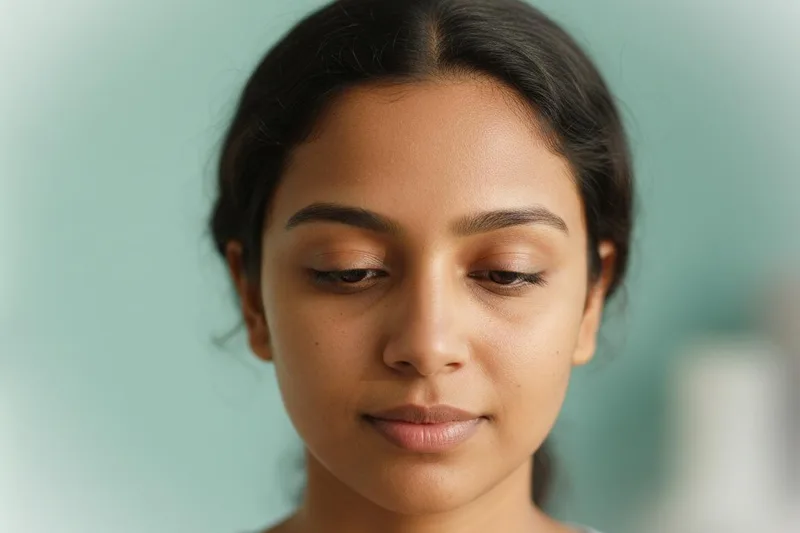
Do you sometimes find it difficult to close your eyes completely? Or does someone you know have this problem? While this may seem like a simple thing to some people, it can actually be a condition that needs to be taken seriously. Today we are going to talk about this inability to close your eyes completely, which in medical terms is called `(Lagophthalmos)`.
What exactly is ``Lagophthalmos''?
Simply put, ``Lagophthalmos`` is a condition where your eyelids are unable to close completely. This can occur in one or both eyes. Think about it, when we blink or sleep, our eyelids should be completely closed. This problem occurs when they are not.
This condition can sometimes occur on its own. Or, it can be associated with another medical condition, such as a drooping eyelid (ptosis). Sometimes, it can also occur as a side effect after eyelid surgery (blepharoplasty) or ptosis repair.
If the condition ` (Lagophthalmos)` is not too severe, that is, if the eyelid is only slightly open, it may not be a big problem. However, if the eyelid does not close properly, it can cause serious problems. Imagine, the black eye of our eye, that is, `(cornea), is constantly exposed to wind, dust, and other impurities. This can cause eye injuries, scarring, and sometimes even loss of vision. Therefore, it is very important to take care of this.
Are there types of `(Lagophthalmos)`?
Yes, there are several main types of this ``Lagophthalmos`` condition. Let's see what they are.
Nocturnal Lagophthalmos
This is when your eyes are normally closed when you are awake, but when you are sleeping, they do not close completely. The word "lagophthalmos" means "rabbit-like eyes." In the past, it was believed that rabbits slept with their eyes open. That's why it was called that. But now scientists say that rabbits sleep mostly with their eyes closed. However, it has been found that about 20% of people, or about one in five people, have their eyes partially or completely open while sleeping at night. This is called `(Nocturnal Lagophthalmos)`.
Paralytic Lagophthalmos caused by nerve damage
When the facial nerve is not working properly, that is, if it is inactive (such as paralysis), we may not be able to close our eyes completely. This nerve is located on both sides of our face. When this nerve is damaged, ``Paralytic Lagophthalmos'' occurs.
Mechanical Lagophthalmos caused by mechanical causes
Sometimes this condition can occur not because of a nerve problem, but because of some problem in the structure of the eyelids, or because of damage caused by an accident. This is called `(Mechanical Lagophthalmos)`. `(Cicatricial Lagophthalmos)` is also a type of `(Mechanical Lagophthalmos)`. That is, the eyelids cannot be closed properly due to scarring.
What are the symptoms of `(Lagophthalmos)`?
The main symptom is that the eyelids do not close properly. However, there may be several other symptoms in addition to this. See if you have any of these symptoms:
- Frequent watering of the eyes or a feeling of dryness in the eyes. Some may even feel as if their eyes are itching.
- A constant feeling of something stuck in the eye, like a bird has landed, or an eye burning or pain.
- Blurred vision. Not being able to see clearly.
- Redness of the eyes.
- Increased sensitivity to light (photophobia). This means that it is difficult to look at light, and the eyes feel as if they are turning blue.
- A corneal ulcer is a serious sign.
If you have one or more of these symptoms, it is important to definitely see a doctor and seek advice.
What are the causes of `(Lagophthalmos)`?
There are several possible causes for this condition. But it is not a contagious disease. You cannot catch it from someone else, nor can you catch it from someone else.
There are two main causes of ``Lagophthalmos``:
1. Damage to your facial nerve.
2. Damage to your eyelids.
Due to damage to the facial nerve
There are various reasons why the facial nerve can be damaged:
- Damage to the eyes from accidents or cuts.
- A condition called `Bell's palsy`. In this, the muscles on one side of the face suddenly become inactive.
- Conditions such as ` Stroke` .
- Tumors, such as acoustic neuromas.
- Some autoimmune disorders, such as Guillain-Barré syndrome.
- Genetic conditions such as `Moebius syndrome`.
- Various infections.
- Ingestion of toxins.
Due to damage to the eyelids
Eyelids can be damaged or scarred in a variety of ways. These include:
- Conditions such as `Lax eyelid syndrome (LES). In this case, the eyelids become loose and droop easily. `(Floppy eyelid syndrome (FES))` is also a similar condition. In this case, the eyelids roll out easily, sometimes even accidentally. `(Floppy eyelid syndrome)` is most commonly seen in obese men with a body mass index (BMI) of over 25.
- Some medical conditions, such as Stevens-Johnson syndrome, can cause blistering of the skin.
- Chemical burns.
- Sun damage to the skin.
- Eyelid surgery, for example `(ptosis repair)` or `(blepharoplasty)`.
How to recognize `(Lagophthalmos)`?
If you have these symptoms, see an eye care provider who will run various tests to determine if you have this condition. The doctor will usually do the following:
- They will ask questions about your health history, such as other illnesses you have and the medications you take.
- You will be told to close your eyes.
- They'll see how hard you close your eyes.
- They measure the size of your eyelids.
- They monitor how often you blink and whether your eyelids close completely when you blink.
After these tests, the doctor can tell you exactly whether you have ``Lagophthalmos'', if so, what type it is, and how severe it is.
How is Lagophthalmos treated?
Treatment for `(Lagophthalmos)` depends on the cause. Your doctor will first try to treat the underlying cause. For example, if it is an infection, if it is a tumor, or if it is a skin condition, they will treat it.
There are both surgical and nonsurgical methods of treating the condition ``Lagophthalmos''.
Nonsurgical treatments
- Eye drops (such as `artificial tears`) help reduce dryness and retain moisture in the eyes.
- Apply an ointment to your eyes at night. This provides extra moisture.
- Use tape to keep the eyelids closed at night or patch the eyes to retain moisture.
- Special glasses (`moisture goggles`). These help keep the eyes moist.
- Small weights that can be taped onto the eyelids.
Surgical treatments
In some cases, especially if the condition is severe or if other treatments do not help, surgery may be necessary.
- `Tarsorrhaphy`: This involves temporarily or permanently, partially or completely, tying the eyelids together.
- Implanting gold or platinum weights in the upper eyelid: This involves placing small weights inside the upper eyelid. Gravity causes the eyelid to drop down and close. This is especially useful for people with paralytic lagophthalmos (a condition caused by nerve dysfunction).
- Upper eyelid surgeries: These include surgeries on the muscles inside the upper eyelid (`retractor muscles`) and skin grafts.
- Lower eyelid surgeries: These include surgeries to tighten loose and "floppy" lower eyelids and skin grafts to lift the eyelids.
- Facial surgeries: If lagophthalmos is caused by facial paralysis, various surgeries are performed to lift the face. Some of these include nerve grafts and moving soft tissue.
Remember, your doctor will decide what treatment is right for you, so talk to him or her about it carefully.
Are there any complications or side effects of `(Lagophthalmos)` treatment?
As with any medical treatment, there are sometimes complications that can occur with treatment for ``Lagophthalmos.'' These don't happen to everyone, but it's good to be aware of them.
- Scarring.
- Infection.
- Entropion - This means that the eyelid turns inward, causing irritation to the eye.
- Drooping eyelids.
- Graft site issues.
If something like this happens, you should tell the doctor immediately.
How do I manage the symptoms of `(Lagophthalmos)`?
You can do some things to help keep your eyes moist.
- Using eye drops as prescribed by the doctor.
- Closing your eyes at night and playing tape.
If you have a condition like facial paralysis, you may also need help with things like eating and speaking. Talk to your doctor about that too.
How can I reduce the risk of `(Lagophthalmos)`?
There is no way to completely prevent ``Lagophthalmos''. However, you can take steps to protect your eyes by:
- Wear protective equipment that covers your eyes when you work or play contact sports.
- Wear sunglasses when it's sunny.
- Avoid unnecessary eye contact.
- Wash your hands thoroughly before touching your eyes.
Additionally, if you are considering surgery to correct a drooping eyelid (ptosis repair) or to improve your eyelid appearance (blepharoplasty), you should definitely consult an oculoplastic surgeon. Oculoplastic surgeons are eye doctors who specialize in reconstructive surgery around the eyes.
What happens if I have `(Lagophthalmos)`?
The prognosis for recovery from lagophthalmos is generally good, especially if it is not severe. Lagophthalmos caused by conditions such as Bell's palsy often resolves on its own.
However, if the condition is more severe, it is essential to seek proper treatment. Failure to do so can result in permanent damage to the eyes.
When should I see a doctor about `(Lagophthalmos)`?
If you have any of these symptoms, such as dry eyes, watery eyes, or a persistent feeling of something stuck in your eye, you should definitely see a doctor. Especially if you notice any changes in your vision, don't ignore it.
If you have already been diagnosed with `(Lagophthalmos)` and are receiving treatment for it, but the symptoms do not improve, or even worsen, inform your doctor immediately.
Sometimes you may not even realize that your upper and lower eyelids are not closing properly until it causes problems with your eyes. In most cases, this type of lagophthalmos is caused by a facial paralysis condition such as Bell's palsy. Therefore, if you have any vision problems or persistent eye discomfort, be sure to seek medical advice.
Finally, the most important thing (Take-Home Message)
So, `(Lagophthalmos)` is a condition in which the eyelids cannot close properly. This is not something to be taken lightly, because our eyes are very sensitive organs.
- If you notice anything unusual, uncomfortable, or change in your vision, please don't ignore it. See a doctor immediately.
- If symptoms such as dry eyes, watery eyes, and a gritty feeling persist, it may be a sign of ``Lagophthalmos''.
- If diagnosed and treated promptly, this condition can often be managed well.
- It is very important to follow medical advice and protect your eyes .
It is your responsibility to protect your eyes, so we ask you to be careful about this.
` Lagophthalmos, inability to close the eyes, dry eyes, eyelids, facial nerves, eye surgery, Bell's palsy, corneal ulcer, photophobia


💬 Comments (0)
No comments yet. Be the first to share your thoughts here.
Add Your Comment