
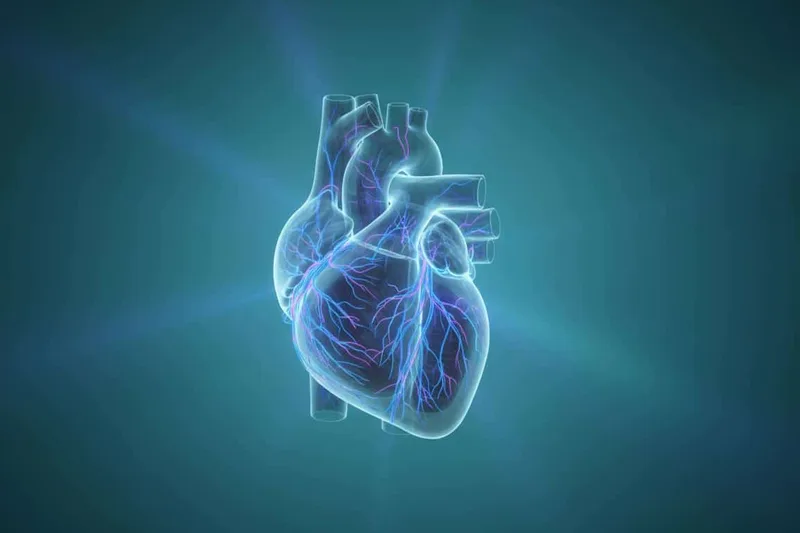
You may have been a little confused when you heard the words `(Left Anterior Fascicular Block)`, or you may have had trouble understanding what it is when a doctor told you about it. It's actually not as complicated as you think. Let's talk about it simply, in a way that you can understand. Let's see what it is, why it happens, what are the symptoms, how to detect it, and what we should do.
What is (Left Anterior Fascicular Block)? To put it very simply...
Think of your heart as a small electrical system. This electrical system controls the heartbeat, which is the heart's contraction and pumping of blood, at the right time. There is a special system of 'wires' inside the heart, or pathways, through which these electrical signals travel.
On the left side of the heart, there is a main electrical cord, which we call the 'left bundle branch'. Just like branches branch off from a tree trunk, this main cord also branches off into smaller branches called 'fascicles'. One of these branches is called the 'left anterior fascicle'. This carries electrical signals to the front wall of the left ventricle of the heart.
Now, a (Left Anterior Fascicular Block) is a slight obstruction to the electrical message that travels through the 'wire' called the 'left anterior fascicle'. It's like a traffic jam on a road, the message is delayed. This causes the left ventricle of the heart - the main pumping part of the heart - to contract a little later than the right ventricle.
Is this something that happens to many people?
Now you may be wondering, 'Is this a disease that affects everyone?' In fact, it is estimated that between 1% and 6% of the population may have this condition. However, it is most often seen in older people . It is relatively rare in young people.
What are the symptoms? Does it happen to everyone?
Here's the important thing. Many people with `(Left Anterior Fascicular Block)` do not have any symptoms . That is, they do not feel any discomfort. Sometimes they are discovered by chance when an `(ECG)` is taken for another reason.
However, sometimes, especially if this 'block' is more severe, or if it is accompanied by other heart conditions, some of the following symptoms may appear:
- Feeling dizzy (Dizziness)
- Feeling tired all the time (Tiredness)
- Fainting
If these symptoms are present, a doctor should determine whether it is due to `(Left Anterior Fascicular Block)` or to another cause.
Why does this (Left Anterior Fascicular Block) occur? What are the causes?
Well, then why is there such a disruption in the transmission of messages? There could be several reasons.
Researchers believe that some people may have a genetic , or hereditary, predisposition to develop certain abnormalities in the electrical signals in the lower chambers of the heart.
Apart from that, there are several more proven, commonly seen reasons:
- Coronary Artery Disease (CAD): This is what we usually call a blockage in the arteries that supply blood to the heart, or the main cause of heart attacks. This is a major cause of Left Anterior Fascicular Block.
- High Blood Pressure: Having high blood pressure for a long time can also affect the heart.
- Structural heart disease: For example, fibrosis or scarring of the heart. These can interfere with the transmission of electrical signals.
- Dilated Cardiomyopathy: In this condition, the heart chambers become enlarged and the muscles become weak.
- As a side effect of some heart surgeries or treatments:
- `(TAVR)` means `(Transcatheter Aortic Valve Replacement)` after a special treatment method that replaces heart valves.
- After a surgery called ``Surgical Septal Myectomy'', which is performed for a condition called ``Hypertrophic Obstructive Cardiomyopathy'', a condition in which the heart muscle becomes excessively thick.
- Sclerodegenerative disease of the bundle branch: This can happen with age.
- It may also be due to inflammation of the heart muscle (Myocarditis).
These factors can damage the heart's electrical pathways, causing a ``Left Anterior Fascicular Block''.
How do doctors diagnose this? What tests are done?
The main and simplest test to accurately diagnose `(Left Anterior Fascicular Block)` is the ECG (Electrocardiogram) . Have you ever had an `(ECG)`? Those little sticker-like things are stuck on your chest, arms, and legs and record the electrical activity of the heart. When a doctor looks at the `(ECG)` strip, he can easily tell whether this `block' is present or not.
In addition, if the doctor wants to know more, or to find out the cause, he or she may recommend other tests, such as:
- Echocardiogram: This is like an ultrasound scan of the heart. It can check many things, such as the size of the heart's chambers, the thickness of the walls, the function of the valves, and how well the heart is pumping blood.
- Stress test: This involves monitoring your ECG and blood pressure while you walk on a treadmill or exercise. This is done to see how your heart responds to stress.
- An MRI scan of the heart (Cardiac MRI): This can provide more detailed information about the structure and function of the heart.
- Nuclear imaging tests: These are special tests that look at things like the blood supply to the heart.
Is there a treatment for this?
Now you're probably thinking, 'Okay, what's the cure for this? How can I fix this?' Surprisingly, there is no specific treatment for `(Left Anterior Fascicular Block)` . That is, there is no specific medication to treat that small disruption in the transmission of electrical signals.
However, the most important thing is to treat the underlying heart disease or condition that caused this 'block' .
For example:
- If you have coronary artery disease (CAD), your doctor will treat it (such as medication, angioplasty, or bypass surgery).
- If it is due to high blood pressure, medication will be given to control it.
- If there is a weakness in the heart muscle (cardiomyopathy), appropriate treatment will begin.
Simply put, doctors are looking to find the underlying problem that caused this `(Left Anterior Fascicular Block)` and treat it.
What will happen in the future? (Outlook)
It's also important for you to know how this situation will go forward.
- If a young, healthy person has only a ``Left Anterior Fascicular Block'' without other heart symptoms, it is usually not considered a major problem. They are less likely to develop it, and if they do, it may not have much effect.
- However, if an older person , especially someone over 50, has it, it can sometimes be a precursor or indicator of other heart conditions.
Research has found that people with ``Left Anterior Fascicular Block'', more than others:
- Congestive Heart Failure
- Atrial Fibrillation (irregular, rapid heartbeat)
- And that there is an overall higher risk of death.
So, it's not a good idea to just dismiss this as 'Oh, it's just a small block,' especially if you're a little older or have other symptoms. It's important to talk to your doctor about this and get the necessary tests done.
How should I take care of my heart?
Since this `(Left Anterior Fascicular Block)` can be related to other heart conditions, the best thing to do is to take good care of your heart . These things can help you:
- Follow a healthy diet:
- Eat a diet low in saturated fat. Limit your intake of oils, fried foods, high-fat dairy products, and red meat.
- Add more fruits, vegetables, legumes, and whole grains to your diet.
- Reduce salt consumption.
- Exercise regularly: As recommended by your doctor, do moderate exercise, such as walking or swimming, for at least 30 minutes a day.
- Maintain a healthy weight.
- If you smoke, stop immediately. Smoking is very bad for the heart.
- Reduce stress: Things like meditation, yoga, breathing exercises, and engaging in hobbies can help.
- If you have high blood pressure and high cholesterol, control them well. Take the medication prescribed by your doctor on time and in the prescribed dosage. See your doctor and get these checked regularly.
- If you have diabetes, control it well.
When should I see the doctor?
- It's important to see your doctor regularly for checkups . This way, if you have chronic conditions like high blood pressure or cholesterol, you can see if they're being properly controlled.
- If you feel anything different than usual , especially if you experience chest pain, difficulty breathing, swelling in your legs, or feeling tired, be sure to see a doctor.
- If you know you have a `(Left Anterior Fascicular Block)`, continue to have `(ECG)` and other tests as your doctor recommends.
When should I go to the hospital immediately (ETU) ?
If you experience any of these symptoms of a heart attack , don't waste time and call 1990 immediately for an ambulance, or go to the nearest hospital emergency room as soon as possible:
- A sharp pain, tightness, or pressure in the center or left side of the chest. This pain lasts for more than a few minutes, or comes and goes.
- Sudden difficulty breathing.
- The pain feels like it is spreading to the shoulders, neck, jaw, arms, or back.
- Sudden sweating, nausea, vomiting, dizziness, or fainting.
Be aware of these symptoms. Prompt treatment can help save a life.
What should I ask the doctor?
When you see your doctor, don't be afraid to ask any questions you have about this `(Left Anterior Fascicular Block)`. Here are some questions you can ask. That will help you understand more:
- 'Doctor, why do I have this `(Left Anterior Fascicular Block)`? Do I have any other underlying heart disease?'
- 'Should I be tested for coronary artery disease?'
- 'What is my risk of developing a heart attack or other heart disease because of this 'block'?'
- 'What symptoms should I be especially concerned about?'
- 'What lifestyle changes can I make to keep my heart healthy?'
- 'How often should I have an ECG or other tests?'
Finally, what to remember (Take-Home Message)
Okay, so we've talked a lot about `(Left Anterior Fascicular Block)`. To summarize:
- This is a disruption in the signal path of a small 'wire' on the left side of the heart's electrical system.
- Many people have no symptoms.
- There is no specific cure for this, but the underlying cause is treated .
- This can be an indicator of other heart diseases in older people than in younger people.
Remember, although there is no specific treatment for this, it can give us a clue about other heart diseases . Therefore, the most important thing is to take care of your heart, follow the doctor's instructions. Protect yourself from coronary artery disease and heart failure. Go for regular checkups with your doctor, and use the medications prescribed exactly. Your heart is very valuable to you! So take good care of it.
` Heart disease, electrical system of the heart, ECG, heartbeat, Left Anterior Fascicular Block, heart health, heart attack


💬 Comments (0)
No comments yet. Be the first to share your thoughts here.
Add Your Comment