

You may have noticed small bumps or blisters on your skin from time to time, right? Some of them just go away, but others last a while, sometimes with itching. Today we are going to talk about a skin disease that is not so common, but it is worth knowing about. This is called Lichen Nitidus. Although the name is a bit strange, it is nothing to be afraid of. Let's talk about it in detail .
What is Lichen Nitidus?
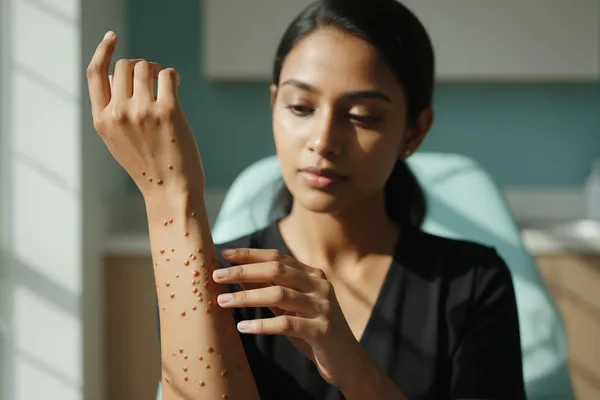
Simply put, Lichen Nitidus is a rare skin condition that causes small, shiny bumps (papules) to appear on the skin. These bumps are usually the same color as your skin, or they can sometimes be white. Think of them as tiny pearls that shine like pearls.
These bumps can appear anywhere on the body. Sometimes they can be clustered together in one place, or they can be scattered all over the body.
The most important thing is that this is not a contagious disease. That means you won't be able to pass it on to anyone else. So don't worry about it.
This condition is most often seen in children and young adults. However, it can sometimes occur in adults as well. In most cases, it does not require any special treatment and will get better on its own over time.
Is this a common condition?
Lichen Nitidus is actually a very rare skin condition. That is, it is not something that even doctors often encounter. There are different opinions about how rare it is.
Some medical reports suggest that this condition affects boys and men slightly more than girls and women . There has also been some research into whether there is a link with skin color. Some studies suggest that people of African American descent are more likely to develop this condition than white people.
However, according to some medical opinions, it is said that race, gender, and age do not affect this much. So, it seems that there is still no exact consensus on these matters. So, if you or your child has something like this, don't think, "Oh, is it just me?" It can happen to anyone, but it is very rare.
What are the risk factors for this?
When it comes to who is most at risk for developing lichen nitidus, children and young adults are at the top. This means that school-age children or young people in their 20s are most likely to experience this condition.
However, that doesn't mean that older people don't get it. Although rare, middle-aged or older people can also develop these lumps. However, relatively speaking, younger people are more prone to it.
What causes Lichen Nitidus?
Here's something to think about. In fact, doctors still don't know exactly what causes lichen nitidus. It's a bit of a mystery.
In the past, doctors thought that this might be a type of another skin disease called ``lichen planus.`` Lichen planus is also a condition that causes similar changes in the skin, nails, and inside the mouth. However, later research has shown that these two are not the same, but two different conditions.
So, according to current understanding, the exact cause of this has not been found. There is also research to see if it may be due to a genetic influence or a change in the functioning of the immune system. However, no firm conclusion has been reached yet.
What are the symptoms of this?
The main symptom of lichen nitidus is those small, shiny bumps (papules) that we talked about earlier. Let's talk about these in more detail.
- Nature of the lumps: These are usually small, about 1-2 millimeters. They are skin-colored or slightly white. The surface is shiny.
- Locations: These bumps can appear anywhere on the body. However, there are a few places where they are most commonly seen:
- In the stomach (abdomen)
- On the back of the hands (especially on the palms)
- In the buttocks area
- In the chest
- Underside of the arms (forearms)
- In men's penis
- How the bumps spread: Sometimes these bumps can be in groups. Other times they can be randomly spaced. What's special is that in some people, where there is a break in the skin, these bumps can appear in a row along that break. This is called the ``Koebner phenomenon''.
The best part is, most people with lichen nitidus don't show any symptoms. That is, they don't feel any discomfort other than those bumps.
However, some people may experience certain symptoms. These include:
- Severe itching: Sometimes these bumps can be very itchy. This is the main discomfort for many people.
- Nail changes: Rarely, changes can also be seen in the nails. The nails may appear as small pits or ridges along the length of the nail.
- Bumps inside the mouth: Very rarely, small, grayish or white bumps (papules) may develop inside the mouth, on the inside of the cheeks. These are usually not painful.
So, if you or your child has any of these symptoms, it's best to see a doctor.
How do doctors diagnose this?
When you go to see a doctor, the first thing they will do is examine the bumps on your skin. The appearance of the bumps, their location, and how they have spread can help the doctor get an idea of whether it is lichen nitidus.
Most of the time, this test can diagnose the condition. However, sometimes, to confirm the diagnosis and rule out other skin conditions, a doctor may decide to take a small sample of skin (biopsy) to test it.
What is a biopsy?
What happens in this is that a doctor takes a very small piece of skin from the area where the lump is on your skin (under local anesthesia, meaning that only that area is numbed) and looks at it under a microscope. Only then can we confirm exactly what the disease is. This is not a big deal, just a small test.
So, this is how doctors diagnose a condition called Lichen Nitidus.
What are the treatments for this?
Here is the most important thing that many people need to know. In most cases of Lichen Nitidus, no special treatment is needed. This is very comforting news, isn't it?
Remember, these bumps will last for a while, maybe a few months or a year. After that , they usually go away on their own . That means you don't need to take any special medication or do anything else.
However, sometimes, if the symptoms we talked about earlier (like itching) are a bit severe, a doctor may prescribe some treatment to control those symptoms.
- Corticosteroids: These are the most commonly used medications. They can be given as creams or sometimes as pills. These medications work by reducing swelling and itching in the skin. However, they should only be used for a limited period of time, as directed by a doctor.
- Phototherapy: This is another treatment. Simply put, it involves the controlled exposure of a special type of ultraviolet light to the skin. This is usually done in a hospital or a special clinic. This treatment is not necessary for everyone, and doctors only recommend it in severe cases.
- Other treatments: Sometimes, medications such as antihistamines can be given to control itching.
The most important thing is not to self-medicate. If you or your child has any of these lumps, it's best to see a doctor and follow their instructions.
What complications can this cause?
Lichen Nitidus does not cause any major medical complications. That is, it does not damage your internal organs or cause other serious diseases. That is also reassuring, isn't it?
However, for some people, these bumps can cause a little bit of anxiety about their appearance . Especially if these bumps are on the face or in visible areas like the hands, it can have a little psychological impact. Questions like "What will other people think?" "When will these get better?" may come to mind. That's normal.
But, remember, this is not a health hazard.
Can Lichen Nitidus be prevented?
Unfortunately, there is no way to prevent Lichen Nitidus. Because, as we have discussed before, the exact cause of this condition has not yet been discovered, it is difficult to say how to prevent it.
So, if this happens to someone, it's not their fault. It's just a situation that happens.
How long will this condition last? Will it get better? (Prognosis)
A question that many people have is how long these bumps will last and when they will get better. In most cases of lichen nitidus, these bumps can last anywhere from a few months to a year . Some people may have them for a little longer, but that is very rare.
The good news is that this condition usually resolves without leaving any long-term scarring or skin discoloration. That is, once the bumps are gone, your skin will return to its normal state.
When should you see a doctor if you have skin blisters?
If you or your child suddenly develop a rash, blister, or other rash for no apparent reason, it's a good idea to see a doctor. It's especially important to see a doctor if you're sure it's not an allergy or something else, like a mole.
Because, sometimes it could be something as harmless as lichen nitidus. But, sometimes it could be another skin condition that needs more attention. So, getting an accurate diagnosis is very important.
What are the important questions to ask the doctor?
If your doctor tells you or your child that you have lichen nitidus, there are a few questions you can ask them. Asking these questions can help you better understand the condition.
- "How serious is this situation, Doctor?"
- "What kind of treatment is there for this? Does I/my child need treatment?"
- "How long will these bumps last?"
- "Will this leave scars or skin discoloration?"
- "Is this contagious?" (We now know that this is not contagious, but it's best to ask a doctor to confirm)
- "If there are symptoms like itching, is there anything I can do at home for it?"
- "Could this happen again?"
Don't be afraid to ask questions like these. Clear all your doubts.
Is it interfering with daily activities?
Most people with lichen nitidus do not need to make any changes to their daily routines. This is because, as we have discussed before, this condition rarely causes symptoms (such as itching). It is also not contagious.
So, there is no problem in going to school, playing, going to your job, doing your daily activities. There is no problem in socializing with other people either.
Shall we recall what we talked about together? (Take-Home Message)
Okay, so let's review the most important points we talked about Lichen Nitidus.
- Lichen Nitidus is a harmless skin condition that causes small, shiny bumps on the skin.
- This is not contagious.
- It often occurs in children and young people.
- I don't know the exact reason.
- Most people have no symptoms. Some may experience itching, nail changes, or mouth sores.
- Often, no treatment is needed and it gets better on its own . Doctors can prescribe medications such as corticosteroids for things like itching.
- This does not cause major medical complications.
- There is no way to prevent it.
- It usually heals within a few months to a year and does not leave scars.
- If you notice new skin bumps, see a doctor for a proper diagnosis.
Remember, if you notice anything unusual on your skin, it's best to see a doctor for advice without worrying too much. They're the ones who can best help you.
So, I hope you now have a better understanding of Lichen Nitidus. It's nothing to be afraid of, but it's worth being aware of.
` Lichen Nitidus, Skin Diseases, Skin Blisters, Skin Diseases in Children, Skin Diseases, Lichen Nitidus, Skin Lumps




💬 Comments (0)
No comments yet. Be the first to share your thoughts here.
Add Your Comment