
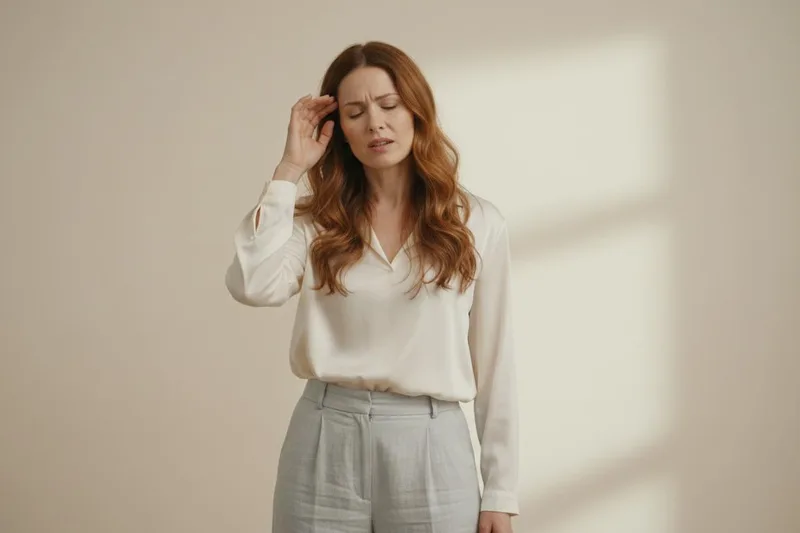
Do you feel dizzy or lightheaded when you stand up suddenly, whether you're sitting or lying down? Sometimes you even feel like you're going to faint for a while, right? This is the condition we're going to talk about today, called ``Orthostatic Hypotension''. Some people also call it ``Postural Hypotension.'' Don't worry, this is something that can happen to many people, especially as they get older. Let's talk about this in detail and simply.
What is `(Orthostatic Hypotension)`? Simply put...
Simply put, `(Orthostatic Hypotension)` is when your blood pressure suddenly drops when you stand up from a sitting or lying position. Imagine, you are sitting in a chair reading a newspaper and suddenly stand up because someone is talking. That's when you feel dizzy. `(Orthostatic)` refers to an upright position. `(Hypotension)` refers to low blood pressure. So, this is when your blood pressure drops when you change position.
So, what is this blood pressure?
We often hear about blood pressure, or ``Blood Pressure''. This measures the pressure that blood exerts on the walls of the arteries as our heart beats. It is similar to the pressure that water exerts on the pipes when it flows through a water pump. This is measured in millimeters of mercury ``(mmHg)``.
When you go to a doctor, they tell you two numbers when they check your blood pressure, right?
- The top number `(Systolic)`: This refers to the pressure when your heart beats and pumps blood into your veins.
- The bottom number `(Diastolic)`: This refers to the pressure in the arteries between two heartbeats, that is, when the heart relaxes a little.
Doctors write it as a top number/bottom number (e.g. 120/80 mmHg). Most people's healthy blood pressure is less than 120/80 mmHg. A reading below 90/60 mmHg is considered low blood pressure.
How much does blood pressure drop in ``Orthostatic Hypotension''?
There is no exact value for this. However, doctors determine this by looking at your normal blood pressure and how much it drops when you stand up. Generally, if the top number ``Systolic`` drops by 20 mmHg or the bottom number ``Diastolic`` drops by 10 mmHg within three minutes of standing up , it is considered ``Orthostatic Hypotension``.
Who is more likely to develop Orthostatic Hypotension?
This condition can actually develop in anyone, but it becomes more common as you age. The following factors may increase your risk of developing it:
- Anemia or Vitamin B12 deficiency: This condition can occur when there is a decrease in blood volume or a decrease in vitamin B12.
- Dehydration due to laxatives, vomiting, or diuretics: When the amount of water in the body decreases, blood pressure can drop.
- Endocrine problems: Conditions like diabetes, thyroid disease, and Addison's disease.
- Heart conditions: Things like heart rhythm disorders (Arrhythmias), heart valve disease.
- Certain medications: It can also be caused by certain medications taken for high blood pressure, heart disease, or depression.
- Neurological problems: Diseases like Parkinson's disease and dementia.
- Pregnancy: Especially within the first 24 weeks.
- Staying in bed for a long time due to an illness: Like bed rest during pregnancy.
Imagine, Uncle Somapala from our village. He has diabetes and takes medication for high blood pressure. He says he feels dizzy when he gets out of bed in the morning. People like that are more likely to develop this condition.
How common is this condition?
Orthostatic hypotension affects about 20% of the elderly , especially those living in nursing homes. It is also common in people who have been bedridden for long periods of time, and in new mothers who have had a baby. It can also occur in teenagers who are experiencing growth spurts.
What are the symptoms of this?
Orthostatic hypotension is often most noticeable and symptoms are worse in the morning. This is because our blood pressure is usually a little lower when we wake up in the morning.
Some people may have no symptoms at all. For others, these symptoms worsen during hot weather, fever, or bathing in hot water.
The main symptom is dizziness or lightheadedness upon standing up . This should go away when you sit or lie down again. Some people may even lose consciousness (syncope).
Other symptoms are:
- Blurred vision
- Chest pain, shoulder pain or neck pain
- Difficulty concentrating
- Fatigue or weakness
- Headaches (Sorry, a word from another language was accidentally inserted here. Correct word: Headaches )
- Heart palpitations
- Nausea or feeling hot and sweaty
- Shortness of breath / Dyspnea
Why does this `(Orthostatic Hypotension)` occur? What are the causes?
When we sit or lie down, the blood in the veins of our legs flows easily back to our heart. But when we stand up, gravity makes it harder for the blood in our legs and feet to reach our heart. This reduces the amount of blood that can be pumped to our heart, other organs, and muscles. As a result, our blood pressure temporarily drops.
There may be several reasons for this:
- Your heart can't pump enough blood.
- Your autonomic nervous system (the system that normally regulates blood pressure) is not working properly.
- If you have diseases such as Parkinson's disease, Lewy body dementia, or multiple system atrophy .
- If you have been in the same position (e.g. lying down) for a long time (such as bed rest during pregnancy).
- If your blood volume is reduced due to loss of blood or fluids (dehydration).
- If you have a problem with your adrenal gland .
- Because of the way your body responds to a certain medication you take .
How do you accurately diagnose orthostatic hypotension?
When you go to a doctor, they will first measure your blood pressure while you are sitting, then lying down, and then standing up. Not only that, they will also ask you about your medical conditions and the medications you are taking.
In addition, one or more of the following tests may be performed:
- Blood tests: Check for conditions like diabetes and anemia.
- Echocardiogram (Echocardiogram / echo): See how the heart pumps blood.
- Electrocardiogram (EKG): Look for changes in the heart's rhythm.
- Exercise stress test: Measure your heart rate while you are exercising.
- Portable EKG devices / Holter monitor: Measure heart rhythm throughout the day.
- Tilt table test: A test that safely measures blood pressure, heart rate, and heart rhythm by having you lie on a table and tilting the table to a vertical position.
What are the treatments for Orthostatic Hypotension?
Treatments depend on the cause of this condition.
The following can be done as treatment:
- If there is a disease or condition that is causing orthostatic hypotension, treat it.
- Changing the dosage of a medication that is causing this condition or switching to another medication (this should be done after talking to your doctor).
- If you are on bed rest, get used to sitting up in bed.
- Wearing elastic stockings. These reduce blood pooling in the legs.
- If you are dehydrated, drink plenty of water and salty fluids.
What medications are given for this?
This can often be controlled with lifestyle changes. However, some people may need to take medications to increase blood volume and blood pressure. However, these are very rare.
Some of these types of medications are:
- `Droxidopa`
- Erythropoiesis-stimulating agents (ESAs) (e.g. Procrit® or Epogen®)
- `Desmopressin (Nocdurna® or `DDAVP®)`
- `Octreotide (Bynfezia Pen™` or `Mycapssa®)`
- `Fludrocortisone`
- `Midodrine hydrochloride`
- `Pyridostigmine (Mestinon®` or `Regonol®)`
Important: These medications should only be taken under the advice of a doctor. Taking medications on your own can have dangerous consequences.
Are there any side effects of the treatment?
Some medications used for Orthostatic Hypotension can cause side effects such as:
- Numbness
- Itching
- Headaches
- Swelling
- Low potassium levels
- Heart failure (this is very rare)
That is why it is important to receive treatment under the supervision of a doctor.
What are the complications that can occur due to Orthostatic Hypotension?
People with this condition may be at increased risk for the following:
- Bone fractures or head injuries (concussions) can occur from falling while dizzy or unconscious .
- Postprandial hypotension: This is a drop in blood pressure within 30 minutes to two hours after eating a meal (especially a meal high in carbohydrates).
- If blood pressure continues to be too low, shock or organ failure may occur (this is very rare).
- Risk of stroke or heart disease due to fluctuations in blood pressure .
- Supine hypotension: This means that blood pressure drops when lying down (this can be caused by some medications).
What happens if I have `(Orthostatic Hypotension)`?
Many people can control the symptoms of this condition (Orthostatic Hypotension) by following some preventive measures. For example, you should take your time when you get up. This is very unlikely to cause serious long-term problems.
Is it impossible to fully recover from this condition?
There is no "cure" for orthostatic hypotension. However, symptoms can be largely controlled by following the advice your doctor gives you. This advice may include:
- Taking the prescribed medication correctly.
- Eat small meals instead of eating large meals at once.
- Drink plenty of water and fluids.
- Wearing special types of socks (Compression stockings).
How can I reduce the risk of Orthostatic Hypotension?
If you experience dizziness like this, following these steps may help reduce symptoms:
- Control your body temperature: Don't bathe in very hot water.
- Stay hydrated: Drink plenty of water. Limit alcohol. Don't eat a heavy meal with lots of carbohydrates at once.
- Keep your head slightly elevated when sleeping in bed: use one or two extra pillows, or raise the head of the mattress slightly.
- Prepare before getting up: Take a moment to stand up from a sitting or lying position. Have something sturdy to hold on to when you get up.
- Exercise your muscles: If you have to stand for a long time, instead of standing still, take a short walk by lifting your legs alternately. Before getting up, do isometric exercises (e.g., squeezing a small rubber ball). This can slightly increase your blood pressure.
- Improve blood circulation and pressure: Wear special compression stockings or an abdominal binder.
When should I see a doctor?
If you often feel dizzy when you stand up, you should definitely see a doctor . Even if this only happens sometimes, it's a good idea to tell your doctor about it.
When should I go to an Emergency Treatment Unit (ETU) ?
If you have these symptoms, seek treatment immediately :
- Chest pain.
- Falls or fainting.
- Problems with balance or coordination.
- If there is a suspicion of a fracture or head injury from a fall.
- If your stool is bloody or black.
- Signs of shock (cold body, sweating, rapid breathing, blue skin, weak pulse).
What questions should I ask the doctor?
When you go to see the doctor, you can ask questions like these:
- Why do I have this condition called ``Orthostatic Hypotension''?
- What is the best treatment for this?
- Are these symptoms caused by the medication I'm taking? Should I change my medication?
- What changes should I make to manage these symptoms?
- What signs of complications should I look out for?
Are `(Orthostatic Hypotension)` and `(Postural Tachycardia Syndrome - POTS)` the same thing?
The symptoms of a condition called `(Postural Tachycardia Syndrome)` or `(POTS)` are similar to `(Orthostatic Hypotension).` In both cases, dizziness and fainting can occur upon standing up. However, in `(POTS)`, in addition to a drop in blood pressure, the heart rate increases by about 30-40 beats per minute within 10 minutes of standing up. In `(Orthostatic Hypotension)`, the heart rate usually does not increase as much.
The condition ``POTS'' is seen slightly less frequently than ``Orthostatic Hypotension''.
Orthostatic hypotension (Hypotension) can be a very serious condition. It can be dangerous if you lose your balance and fall or if you lose consciousness. However, the symptoms often improve when you change the way you stand. Talk to your doctor about your symptoms. You may need to change your medications. In more severe cases, your doctor may prescribe medications to improve blood flow and blood pressure.
The most important things to remember (Take-Home Message)
Okay, so now you have a better understanding of what we've been talking about, Orthostatic Hypotension. It's nothing to worry about, it's a condition that happens to many people. The most important thing is:
- If you suddenly feel dizzy or your eyes are blurry, don't ignore it. Seek medical advice.
- Wake up early, especially when getting out of bed in the morning, or when getting up after sitting for a long time, take a moment and grab something to stand up.
- Drink plenty of water. This can also happen if you are dehydrated.
- Talk to your doctor about the medications you are taking. Some medications can also cause this condition.
- Avoid hot environments and bathing in hot water.
- Be careful as you could fall. If you feel dizzy, try to sit down or lie down quickly.
We hope this information is helpful to you. It is best to seek the advice of a doctor for any health concerns you may have.
` Orthostatic hypotension, postural hypotension, low blood pressure, dizziness, fainting, blood pressure drop, blood pressure, heart health, elderly health, dehydration, medication side effects, Sinhala health information


💬 Comments (0)
No comments yet. Be the first to share your thoughts here.
Add Your Comment