
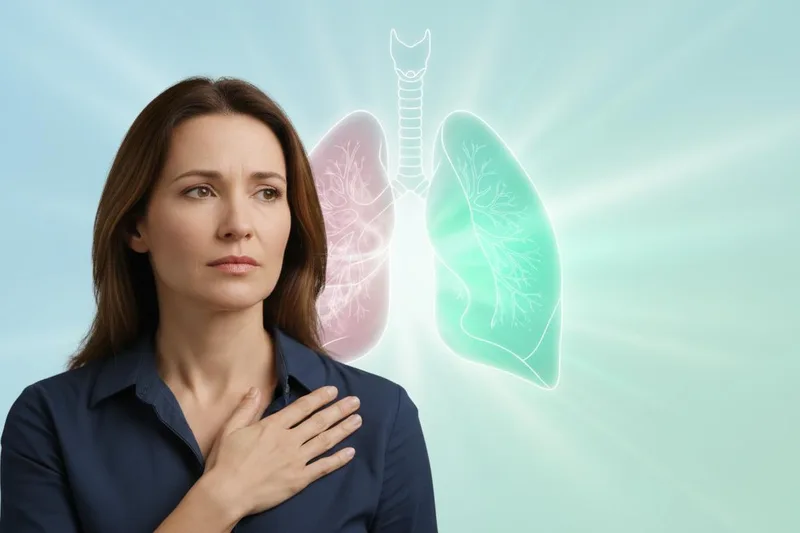
Are you also having difficulty breathing day by day due to severe emphysema? Do you feel faint even after doing small tasks? Even after taking medication and going to rehabilitation programs, your breathing difficulty does not decrease? If so, perhaps your doctor can talk to you about a special surgery. That is what we are talking about today. This is called Lung Volume Reduction Surgery, or LVRS for short.
Simply put, what is LVRS surgery?
Think of your lungs as two sponges. When emphysema is severe, air bubbles form in some parts of this sponge, causing them to become bloated. These damaged areas are no longer able to breathe, and they are not able to absorb oxygen into the blood. Not only that, but these bloated, useless areas also block the healthy parts of the lungs, making them unable to function properly.
LVRS surgery involves cutting out and removing those damaged, swollen, and useless parts of the lung.
That is, the size of the lungs is reduced. What happens when you do this? The remaining healthy parts of the lungs are allowed to expand and work properly. Then, the oxygen in the air you breathe in can be properly absorbed into the blood and sent throughout the body.
The important thing is that this surgery does not completely cure emphysema. And it is not guaranteed to extend your life. The main goal of this surgery is to reduce your breathing difficulties and improve your quality of life.
Who can have this surgery? Isn't it possible for everyone?
No, this surgery is not suitable for everyone. Studies have found that this surgery only works best for patients who meet certain criteria. Your doctor will examine you carefully to determine if you are a good candidate for this procedure. These criteria are usually considered:
- Being under 75 years of age.
- Having severe shortness of breath (dyspnea) that persists despite medication and pulmonary rehabilitation.
- The damage to the lungs should be mostly in the upper parts. This means that the rest of the lungs should be in relatively good condition.
- Evidence of overinflated lungs and air trapping.
- You must have completely stopped smoking for at least 4 months. This surgery will not be performed on someone who continues to smoke.
- Be physically and mentally able to participate in a pulmonary rehabilitation program for 6-10 weeks before surgery and 10-12 weeks after surgery.
What are the surgical methods?
There are two main methods for removing damaged parts of the lung. Your surgeon will decide which method is best for you based on your condition.
| Surgical method | Simply explained |
|---|---|
| Thoracoscopy | This involves making 3 or 5 very small incisions between the ribs instead of a large incision in the chest. A camera (videoscope) is inserted through one incision to look at the lungs, and surgical instruments are inserted through other incisions to remove the damaged parts. This method is also called VATS (Video-Assisted Thoracic Surgery) . Since there is no large incision, the recovery time may be a little faster. |
| Sternotomy | This is an open surgery. The surgery is performed by cutting the breastbone lengthwise in the middle of the chest and opening the chest. The advantage of this method is that both lungs can be easily reached through a single incision. |
Additionally, in some cases, there is a method called Bronchoscopic Lung Volume Reduction (BLR), which involves inserting small valves into the lungs using a bronchoscope to allow air to escape from damaged areas, without surgery. But that's a separate topic.
What tests are done before surgery?
To determine if you are a good candidate for this surgery, your doctor will ask you to undergo several tests. Don't worry, all of these tests are done for your safety and to get the best results from the surgery.
- Imaging Tests: Chest X-rays and high-resolution CT scans can show how much air is trapped in the lungs and where the most damage is.
- Pulmonary Function Tests (PFTs): These are used to measure how well your lungs are working. They look at things like your FEV1 value to predict how much benefit you will get from surgery.
- Exercise Tests: Things like the six-minute walk test measure how far you can exercise.
- Lung Diffusion Test (DLCO): This tests how well your lungs absorb oxygen into your blood.
- Cardiac Tests: Things like an EKG, an echocardiogram, and a stress test are done to make sure your heart is functioning properly.
- Other tests: Things like a V/Q scan and an arterial blood gas test provide more information about the respiratory system.
The benefits and risks of surgery
Like any surgery, this one has both benefits and risks. It's important to talk openly about this with your doctor and gain a good understanding.
What are the advantages?
- The quality of life has improved significantly.
- Decreased shortness of breath.
- Improved lung function.
- Increased ability to exercise.
- Easier breathing process.
What are the risks?
Every surgery has risks, and doctors do their best to minimize them.
- Adverse reactions to anesthesia.
- Collapsed lung (pneumothorax).
- Air leakage from the stitches.
- Infectious conditions such as pneumonia.
- A heart attack (myocardial infarction).
This is a serious surgery. According to statistics, the risk of death from this surgery is between 3% and 5%. That is why choosing the right patient is very important.
How long does it take to recover?
After the surgery, you will need to stay in the hospital for 3 to 7 days. After you go home, you will be asked to start a pulmonary rehabilitation program again within the first few weeks. This is very important because these exercises and training are essential to get the most out of your surgery.
The breathing relief that comes with surgery usually lasts for two to five years. Therefore, it is very important to completely abstain from smoking and follow the doctor's instructions during this time.
When should I see a doctor?
If any of the following symptoms occur after surgery, you should go to the hospital's Emergency Treatment Unit (ETU) immediately .
- Fever.
- Severe chest pain.
- Severe difficulty breathing.
- Blue discoloration of the skin, lips, or fingernails (cyanosis).
Take-Home Message
- LVRS is a surgery performed only on a select group of patients with severe emphysema.
- If you are planning to have this surgery, it is imperative to completely quit smoking.
- This is not a curative surgery, its main goal is to reduce breathing difficulties and improve quality of life.
- The results of the surgery last for several years, and pulmonary rehabilitation is very important to maximize them.
- Before making any decision, discuss the pros, cons, and risks of this surgery with your doctor to gain a clear understanding.
👩🏽⚕️ Additional questions (FAQs)
💬 What is Leg Swelling / Peripheral Edema?
This is not just your legs getting stiff as you gain weight/get older! 'Leg Swelling' is a condition where one of your legs (but often both legs), ankles and soles become unusually large due to fluid accumulation (Edema) under the skin, making it difficult to put on shoes/walk. When you press on this swollen area with your finger, it will go down like a pit for a while (Pitting edema). This is a siren of major, fatal damage to the body's 'heart or kidneys'!
💬 What are the main fatal causes of swollen feet and legs (Leg Swelling)?
There are 4 main causes of this: 1) 'Heart Failure' - When the heart is unable to pump blood/is weak (like when you are stuck in a plane), that blood builds up in the legs due to gravity and swells. 2) 'Kidney Failure/Nephrotic Syndrome' - When the kidneys are unable to produce urine/the kidneys lose protein and fill with water. 3) Side effects of certain blood pressure pills and breast cancer medications. 4) Liver Cirrhosis - In this case, the entire abdomen fills with water and becomes enlarged like a balloon.
💬 When a leg swells, what are the 'life-threatening/emergency situations' where you should go to a hospital/emergency department immediately, without just applying oil/balm?
It is normal to have swollen legs during pregnancy and to have swelling after standing for a long time (Mild leg edema - keep your legs elevated). But this is the biggest danger! Along with swollen legs, 1) 'If only one leg (only one side) is swollen, red and burning (Warmth/Redness/Severe Pain - DVT/blood clot)', 2) If you suddenly have difficulty breathing and chest tightness and cough/vomit (Pulmonary Embolism / Heart Failure), you can die in minutes, you need to go to the hospital emergency department (Ambulance) immediately!


💬 Comments (0)
No comments yet. Be the first to share your thoughts here.
Add Your Comment